Imagine Rohan, a brilliant software engineer in Bengaluru. Every day, he spends ten hours coding but feels constantly drained. When he looks in the mirror, he sees someone who looks fragile rather than fit. His clothes hang loosely, and his family keeps telling him he looks pale. Consequently, Rohan wants to know how to gain weight without junk, but he feels overwhelmed. By trying to eat samosas and sweets for a week, he only ended up with a sluggish stomach and a breakout. Ultimately, he is not looking for a bulky body; he just wants to feel strong enough to climb the stairs without panting.
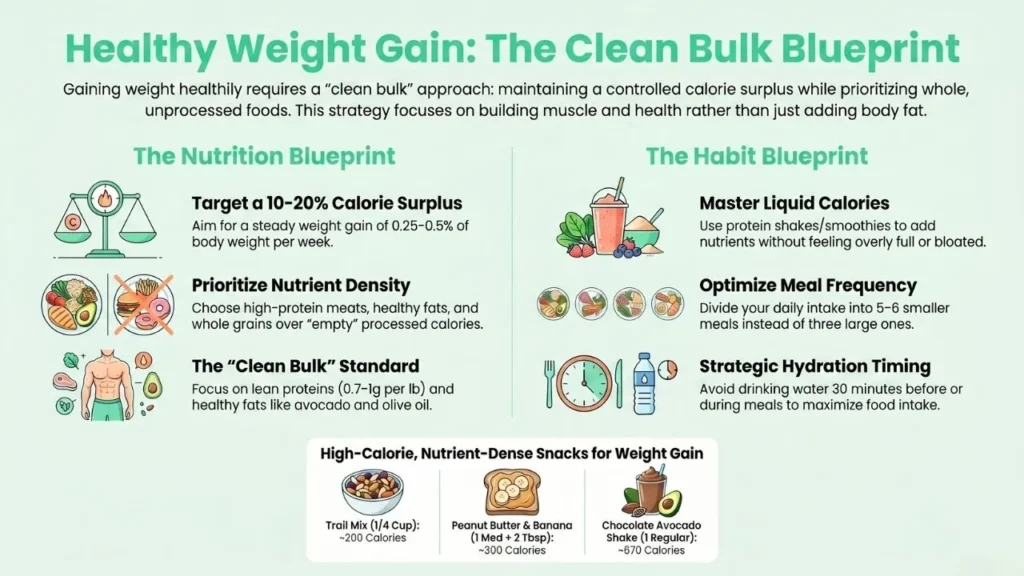
To learn how to gain weight without junk, you must consume a daily calorie surplus of 300–500 kcal through nutrient-dense Indian whole foods. Prioritize full-fat dairy, ghee, nuts, and complex carbs like brown rice or ragi. Eat 5–6 small meals daily and avoid sugary snacks to ensure muscle-focused growth.
Understanding the Indian Underweight Crisis
I know it is hard to admit when you feel weak. While we often praise thinness, there is a big difference between being lean and being undernourished. In India, being underweight remains a significant health hurdle for many. For example, the National Family Health Survey (NFHS-5) shows us some startling numbers. Although obesity is rising, a large portion of our people still have a Body Mass Index (BMI) below 18.5.
What this means for your daily routine is that your body might lack the energy to function properly. Notably, women with a BMI below normal have decreased from 22.9% to 18.7%, which is progress, but it still leaves millions vulnerable. For men, the figure stands at 16.2%. These are not just numbers; they represent real people dealing with lower immunity, constant fatigue, and even hair loss.
| Category | NFHS-4 (%) | NFHS-5 (%) | Improvement (Points) |
| Women (BMI < 18.5) | 22.9 | 18.7 | 4.2 |
| Men (BMI < 18.5) | 20.2 | 16.2 | 4.0 |
| Children Stunted | 38.4 | 35.5 | 2.9 |
| Children Underweight | 35.8 | 32.1 | 3.7 |
Furthermore, data from the NFHS-5 suggests that regional differences are massive. In states like Bihar and Gujarat, nearly 40% of children are underweight. If you are an adult struggling with weight, it might be a carry-over from childhood nutrition patterns.

Why Thinness Can Be Deadlier Than Obesity
Let’s simplify this. We often hear about the dangers of fat. However, being too thin can actually be riskier in some cases. Specifically, a Danish study highlighted by Harvard Health and the NIH shows that individuals in the underweight category face nearly three times the mortality risk compared to those in the upper-normal weight range.
When you are underweight, your body lacks the reserve to fight off infections. Think of your body like a bank account. If your balance is zero, any small expense like a flu or a fever can lead to a crisis. Underweight individuals are more likely to suffer from bone fractures because they lack the density provided by minerals and muscle tension.
Moreover, I see many young women who lose their periods because they are too thin. This is called amenorrhea, and it happens because the body decides it does not have enough energy to support a pregnancy. If you are feeling dizzy or irritable, your body is likely screaming for more fuel.
The Science of the Calorie Surplus
I know it sounds technical, but a calorie surplus is just a fancy way of saying eat a bit more than you burn. Every single day, your body burns calories just to keep your heart beating and your brain working. To gain weight, you need to provide extra.
To calculate your status, professionals use the Body Mass Index formula:
BMI = weight (kg) / height (m)2
If your result is below 18.5, you are clinically underweight. To gain weight gradually, aim for an extra 300 to 500 calories per day. If you want to gain faster, you might need 700 to 1,000 extra calories. But wait, do not just reach for the chocolate. We want healthy weight, not just fat storage.
| Macronutrient | Calories per Gram | Role in Your Body |
| Protein | 4 kcal | Builds and repairs muscle tissue. |
| Carbohydrates | 4 kcal | Provides the primary fuel for daily energy. |
| Fats | 9 kcal | High-density energy and hormone support. |
By focusing on healthy fats, you can get more calories without eating a mountain of food. One tablespoon of ghee has about 112 calories. That is much easier to eat than an extra bowl of salad if you have a small appetite.
Why Junk Food is a Trap
I know it is tempting to think that a burger or a plate of samosas is the fastest way to gain weight. While they are high in calories, they are empty calories. They provide a quick spike in energy followed by a massive crash. More importantly, junk food is often loaded with trans fats and refined sugars.
Consequently, experts at Harvard explain that these foods are linked to chronic inflammation and insulin resistance. You might end up with a belly while your arms and legs remain thin. This is known as visceral fat, and it is very dangerous for your heart. We want to gain weight in a way that makes you feel vibrant, not sluggish.
What this means for your daily routine is that you should skip the sugary sodas and deep-fried snacks. They fill you up too quickly and leave no room for the nutrients your muscles actually need.
Building the Perfect Indian Weight Gain Plate
Let’s talk about your kitchen. The traditional Indian diet is actually a goldmine for healthy weight gain. We have grains, lentils, dairy, and healthy fats already in our pantry. However, the secret is in the portion sizes and the combinations.
Clinical nutritionist Lovneet Batra explains that simply eating healthy isn’t enough; the key is balancing fibre, protein, fats and carbohydrates on the plate to ensure stable blood sugar and sustained energy.
A balanced plate should follow the Plate Method but with a twist for weight gain. Usually, people fill half the plate with vegetables to lose weight. In contrast, for you, I want one-quarter of the plate to be protein, one-quarter to be complex carbohydrates, and the rest to be a mix of healthy fats and cooked vegetables.
Dairy: Your Secret Weapon for Muscle Growth
Milk is often called a complete food, and for a good reason. It contains a balance of proteins, fats, and carbohydrates. Studies show that milk, especially full-fat versions, helps in adding muscle mass. If you find it hard to drink plain milk, try making it into a milkshake or a smoothie.
Paneer, or cottage cheese, is another powerhouse. It is rich in casein protein, which is slow-digesting. This means it provides your body with a steady stream of amino acids for several hours.
| Dairy Product | Calorie Content (Approx) | Best Way to Eat |
| Full-fat Milk (1 cup) | 150 kcal | With honey or in a fruit smoothie. |
| Paneer (100g) | 265 kcal | Grilled as tikka or in a spinach curry. |
| Curd/Yogurt (1 bowl) | 100 kcal | With granola, honey, or in a lassi. |
| Ghee (1 tbsp) | 112 kcal | Drizzled on rotis, dal, or khichdi. |
I suggest drinking two glasses of milk a day. Specifically, have one with breakfast and one before bed with a pinch of turmeric for better recovery.
Grains and Starchy Vegetables for Sustained Energy
I know it’s hard to find time, but simply swapping white bread for whole-grain options can make a huge difference. Rice is a staple in most Indian homes and is very calorie-dense. One cup of cooked rice provides about 200 calories. It is easily digestible, which is great if you struggle with bloating.
Starchy vegetables like potatoes and sweet potatoes are your best friends. They provide the carbohydrates your body needs to fuel your brain and prevent muscle breakdown.
Let’s simplify your meal. Instead of a plain roti, have an aloo paratha or a paneer paratha. Searing it with a little butter or oil increases the calorie count significantly without making the meal feel heavy. Additionally, sweet potatoes can be boiled and mashed with a bit of milk and honey for a delicious evening snack.
The Power of Pulses and Legumes
If you are a vegetarian, you might worry about protein. But look at our dals! Chickpeas (chana), kidney beans (rajma), and lentils are excellent for gaining weight. They are packed with protein and complex carbohydrates.
What this means for your daily routine is that a bowl of thick dal makhani or rajma chawal is a perfect weight-gain meal. The combination of rice and lentils provides a complete amino acid profile, similar to meat.
Furthermore, I recommend making your dals thick rather than watery. Adding a tempering (tadka) of ghee, cumin, and garlic adds those much-needed extra calories and aids digestion. Sprouted moong beans can be a great mid-day snack, especially if you toss them with some peanuts and lime.
Healthy Fats: Small Volume, Big Impact
If you have a small appetite, eating large meals is hard. This is where healthy fats come in. They have more than double the calories of proteins or carbs per gram. Adding them to your food doesn’t change the volume much but boosts the energy.
Avocados are becoming popular in India and are an excellent source of monounsaturated fats. One avocado can have up to 320 calories. If you can’t find avocados, don’t worry. Our traditional nuts like almonds, cashews, and walnuts are just as good.
Notably, a handful of mixed nuts provides about 150-200 calories. You can also use nut butters. Spreading thick peanut butter on a slice of whole-wheat bread or a banana is an easy way to sneak in 200 calories during a busy workday.
Sattu: The Original Indian Superfood for Weight Gain
I love talking about Sattu. It is made from roasted Bengal gram and is a staple in Bihar and Uttar Pradesh. It is cheap, nutritious, and incredibly effective for weight gain.
When sattu is mixed with milk and jaggery, it becomes a high-calorie protein drink. One glass can provide nearly 400 calories. It is also high in fiber, which helps keep your gut healthy.
| Sattu Recipe Type | Ingredients | Goal |
| Sattu Weight Loss | Sattu + Water + Lemon + Salt | Satiety & cooling. |
| Sattu Weight Gain | Sattu + Milk + Jaggery + Nuts | Calorie & protein boost. |
I recommend drinking a sattu milkshake in the evening or after a long day of work. It replenishes your energy and provides the protein your muscles need to grow while you sleep.
This is a sensitive topic. Many people think they can’t gain weight if they have diabetes because they have to restrict food. That is a myth. You just need to be smarter about your choices. The goal is to gain weight without causing blood sugar spikes.
The secret lies in the Glycemic Index (GI). Low-GI foods release sugar slowly. For weight gain, we want low-GI but high-calorie foods. This means focusing on proteins and healthy fats.
| Diabetic-Friendly Gainers | Why They Work | How to Eat |
| Almonds/Walnuts | High magnesium helps insulin use. | Handful as a snack. |
| Fatty Fish (Surmai/Ravas) | Omega-3s reduce inflammation. | Grilled or in a coconut curry. |
| Beans/Lentils | Fiber prevents sugar spikes. | As a thick soup or curry. |
| Seeds (Chia/Flax) | Adds calories and healthy fats. | Sprinkled on curd or oats. |
I suggest eating six small meals a day instead of three large ones. This keeps your energy steady and prevents the sugar highs and lows that can leave you feeling exhausted.
Meal Planning for the Busy Professional
I know your schedule is packed. Between meetings and commuting, eating can feel like another chore. However, if you want to gain weight, you cannot skip meals. Consistency is the most important factor.
The best hack for professionals is Liquid Calories. It is much easier to sip a high-calorie smoothie at your desk than to eat a full meal. For instance, a blend of milk, banana, oats, and peanut butter can give you 500 calories in a few minutes.
What this means for your daily routine is that you should always have Grab-and-Go snacks in your bag. A packet of roasted chana, a box of dates, or a few peanut chikkis are perfect for those times when a meeting runs late.
Homemaker Hacks: Cooking Once for the Whole Family
If you are a homemaker, you are likely cooking for children and elders. You don’t need to cook a separate diet for yourself. Instead, you can simply enhance the meals you are already making.
I suggest adding a Calorie Booster to your portion. While you serve everyone dal, add an extra teaspoon of ghee and a handful of crushed peanuts to your bowl. If you are making rotis, sear yours with a little more oil or butter.
Let’s simplify your afternoon. Instead of just having tea and a biscuit, have a bowl of curd with some chopped mango or banana. If it’s winter, a bowl of gajar halwa made with jaggery and plenty of nuts is a nutritious way to add calories.
The Non-Gym Audience: Building Muscle at Home
I know the gym can be intimidating. You don’t need a heavy barbell to gain healthy weight. However, you do need some form of movement. If you eat a lot but don’t move, the weight will mostly be stored as fat. We want muscle.
Yoga is a fantastic option. Poses like Surya Namaskar (Sun Salutations) use your own body weight to build strength. They also help improve digestion and increase your appetite.
Specifically, I recommend doing simple strength movements at home. Use two one-liter water bottles as weights. Do 10 squats and 10 lunges while you wait for the whistle on the pressure cooker. These small bursts of activity tell your body to use those extra calories to build strong tissues.
Metabolic Adaptation: Why Your Scale Isn’t Moving
Have you ever felt like you’re eating a lot but still staying thin? This might be because your metabolism has adapted. Your body is a survival machine. If it thinks it needs to be thin, it might speed up its calorie burning to match your intake.
Another hidden factor is stress. When you are stressed, your body produces cortisol. High cortisol can lead to muscle breakdown and make it very hard to gain healthy weight.
Consequently, sleep is non-negotiable. Aim for 7–8 hours of quality rest. During sleep, your body releases growth hormones that repair your tissues and help you grow.
Meal Prep Secrets for the Week Ahead
The biggest reason people fail at weight gain is because they run out of food options. If you are hungry and there is nothing healthy to eat, you will either skip the meal or reach for junk.
I recommend Batch Prepping on Sundays. Boil a large container of chickpeas and kidney beans. Prepare a Bhuna Masala (onion-tomato-ginger paste) and freeze it in cubes.
| Meal Prep Item | How to Storage | Use Case |
| Boiled Dal/Beans | Airtight Container (Fridge) | Quick curries, salads, or mashes. |
| Ginger-Garlic Paste | Ice Cube Trays (Freezer) | Instant flavor for any dish. |
| Paratha Dough | Airtight Container (Fridge) | Fresh breakfast in 5 minutes. |
| Roasted Nuts/Seeds | Dry Jar (Pantry) | Easy snacking throughout the week. |
Having these ready cuts your cooking time by 70%. Consequently, you can have a nutritious, high-calorie dinner on the table in less than 15 minutes.
The Emotional Side of Being Underweight
I want to be real with you. Being thin in a culture that is obsessed with weight can be lonely. People often make jokes about your size that hurt. They might say, Don’t you eat anything? or A gust of wind will blow you away.
This can lead to a difficult relationship with food. Some people start to see eating as a task or a duty rather than a pleasure. If you feel this way, I want you to know it’s okay.
Therefore, I suggest making mealtime a social event. Eat with your family or friends. When you are engaged in conversation and enjoying your surroundings, you often find it easier to eat a bit more without feeling forced.
Smart Hacks for Appetite Stimulation
If you simply don’t feel hungry, you can’t force yourself to eat. We need to wake up your digestive system. Traditional Indian wisdom has some great answers for this.
Try having a small piece of ginger with a drop of lime and a pinch of salt before your main meals. This stimulates the production of digestive enzymes. Furthermore, avoid drinking a lot of water right before your meal, as it fills up your stomach and makes you feel full faster.
I also recommend using aromatic spices like green cardamom and cinnamon. They don’t just smell good; they actually help in stimulating the appetite and improving the metabolic use of carbohydrates.
Monitoring Your Progress Without Obsession
I don’t want you to step on the scale every single day. Weight fluctuates based on water, salt, and even your stress levels. Checking it too often will only make you anxious.
Specifically, I suggest weighing yourself once a week, at the same time, ideally in the morning on an empty stomach. A healthy goal is to gain about 0.5 kg (about 1 lb) per week. This might seem slow, but over a month, that is 2 kg of solid, healthy weight.
Pay attention to how your clothes fit and how your energy feels. Are you able to concentrate better? Do you feel less cold? Notably, these are better indicators of health than just the number on the scale.
A 3-Day Sample Indian Weight Gain Plan
Let’s put everything we’ve learned into a simple plan you can follow. This plan focuses on high-calorie, nutrient-dense Indian meals that are easy to prepare.
Day 1: The Traditional Power Start
- Breakfast: 2 Stuffed Paneer Parathas with a large bowl of curd and a teaspoon of white butter.
- Mid-Morning: 1 large Banana and a handful of soaked Almonds.[3, 18, 3]
- Lunch: 1 large bowl of Rajma, 1 cup of Basmati Rice with ghee, and a side of Cucumber Raita.
- Evening Snack: Peanut Butter on Whole Wheat Toast and a cup of Milk.
- Dinner: Mixed Vegetable Curry cooked in coconut milk, 2 Ghee-laden Rotis, and 1 bowl of thick Moong Dal.
- Before Bed: A glass of Turmeric Milk with 1 teaspoon of Honey.
Day 2: The Busy Professional’s Choice
- Breakfast: Vegetable Poha with plenty of peanuts and two boiled eggs.
- Mid-Morning: A glass of Sattu Milkshake with Jaggery and crushed Walnuts.
- Lunch: Paneer Tikka Masala, 1 cup of Brown Rice, and a small bowl of Dal Tadka.
- Evening Snack: A handful of Trail Mix (dried figs, raisins, cashews) and a cup of tea.
- Dinner: Chicken or Soya Chunk Curry, 2 Multigrain Rotis, and a side salad with olive oil dressing.
- Before Bed: A bowl of warm Oats cooked in full-fat milk with dates.
Day 3: The Homemaker’s Family Feast
- Breakfast: 2 Besan Chillas stuffed with grated paneer and vegetables.
- Mid-Morning: A bowl of full-fat Yogurt with honey and a sliced Apple.
- Lunch: Aloo Gobi, 1 bowl of thick Chole, 2 Rotis with ghee, and 1 cup of Rice.
- Evening Snack: 2 Peanut Chikkis or a small bowl of Roasted Makhana.
- Dinner: Fish Curry (or Paneer Bhurji), 2 Rotis, and a bowl of Khichdi with extra ghee.
- Before Bed: A glass of warm Milk with a pinch of Nutmeg and Cardamom.
When to Seek Professional Help
I know you want to do this on your own, but sometimes there are things we can’t see. If you have been eating in a calorie surplus for four weeks and haven’t gained any weight, you should see a doctor.
Specifically, you might have a condition like hyperthyroidism, where your thyroid gland is overactive and burns calories too fast. Or you could have a malabsorption issue, where your gut isn’t absorbing the nutrients from your food.
If you feel a sudden loss of weight without trying, or if you feel extremely weak, please get a blood test. Checking your Iron, Vitamin B12, and Thyroid levels is a great first step toward understanding your body’s unique needs.

Conclusion: Your Journey to a Stronger You
I know it feels like a long road, but you don’t have to walk it all at once. Start by adding just one high-calorie snack to your day. Maybe it’s that sattu milkshake or a handful of nuts. Once that feels like a habit, move to the next step.
Weight gain isn’t just about the numbers on the scale. It’s about having the energy to play with your kids, the focus to excel at your job, and the confidence to feel comfortable in your own skin. You have the tools in your kitchen and the wisdom in our traditions.
Let’s simplify this journey together. If you need a plan that is tailored specifically to your lifestyle, your health history, and your taste buds, I am here to help. At DietDekho, we believe in nutrition that fits your life, not the other way around.
Ready to take that first step? Let’s map out your success. Fill out our simple assessment form here

FAQs
1. How can I gain weight without junk food naturally?
To gain weight without junk food naturally, increase your daily intake of nutrient-dense Indian staples. Specifically, focus on healthy fats like desi ghee and nuts, high-quality proteins such as paneer and eggs, and complex carbohydrates like brown rice and ragi. Consuming 5–6 small, frequent meals ensures a consistent calorie surplus for muscle growth.
2. What are the best high calorie Indian diet foods for vegetarians?
The best high calorie Indian diet foods for vegetarians include full-fat milk, paneer, thick dals, and ghee. Furthermore, starchy vegetables like potatoes and sweet potatoes, along with calorie-rich fruits like bananas and mangoes, provide healthy carbohydrates. Traditional superfoods like sattu and peanut chikki are also excellent for healthy weight gain.
3. How can I gain weight fast naturally if I have a small appetite?
If you have a small appetite, focus on caloric density. For example, add healthy fats like olive oil or ghee to your meals, as they provide more calories in smaller portions. Drink high-calorie smoothies or milkshakes (like sattu or banana shakes) between meals, as liquid calories are less filling than solid food.
4. Is it possible to gain weight without junk food for diabetics?
Yes, diabetics can gain weight safely by choosing low-glycemic index (GI) foods that are high in calories. Focus on healthy fats from nuts, seeds, and avocados, and lean proteins like tofu or fish. Consequently, this approach helps you maintain a calorie surplus without causing dangerous blood sugar spikes.
5. What are the health risks of being underweight for adults?
Being underweight can lead to a weakened immune system, making you more prone to infections. It also increases the risk of osteoporosis, anemia, and fertility issues in women. Clinically, a BMI below 18.5 is associated with significantly higher mortality rates compared to those in the healthy weight range.

Contact Us
We understand how overwhelming nutrition and weight loss information can feel. With so many opinions and confusing advice online, it’s easy to feel stuck or unsure about what to do next.
At Diet Dekho, you never have to figure it out alone. You can contact us anytime with any questions or concerns. Our expert dietitians are available 24/7 to guide, support, and help you stay on track. Whether your goal is weight loss or building healthier habits, we’re here to make the journey simpler and more sustainable for you.
Disclaimer
This blog is intended to help readers make healthier food choices. Your health should always be the top priority. Before starting any restrictive or special diet, especially if you have a medical condition or health concern, please consult a doctor or a qualified dietitian. Each body responds differently to food and lifestyle changes. Always choose what is safe and suitable for you.

Abhinav is the Founder of Diet Dekho, helping people manage weight and lifestyle health through simple, practical nutrition and personalized diet plans.