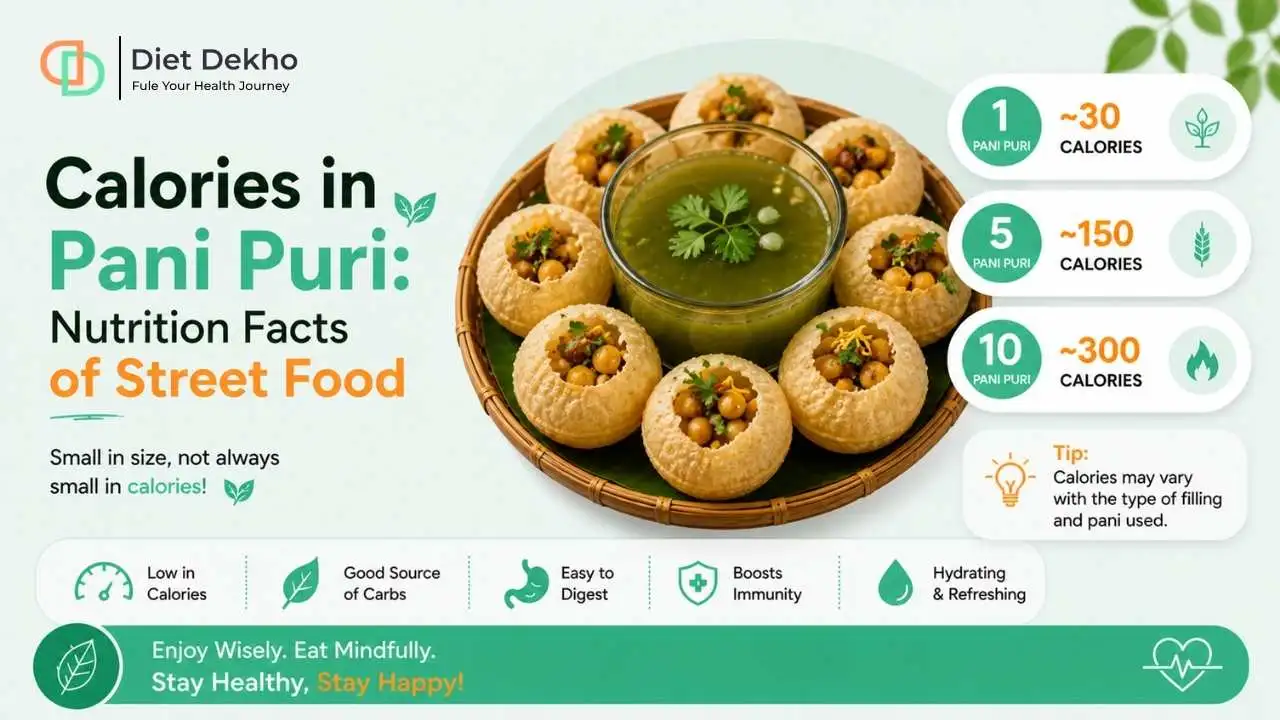
Imagine this: you’ve just finished a long, exhausting day at the office. The sun is setting over the city, and as you walk toward your car or the train station, that familiar, spicy aroma hits you. It’s the local chaat stall. You see the vendor deftly cracking open a crisp, golden shell, filling it with spiced potatoes, and dunking it into a pot of swirling, emerald-green mint water. Your mouth waters instantly. I know it’s hard to resist that evening craving, but before you pick up that first plate, we really need to talk about the calories pani puri adds to your day and what it means for your health journey.
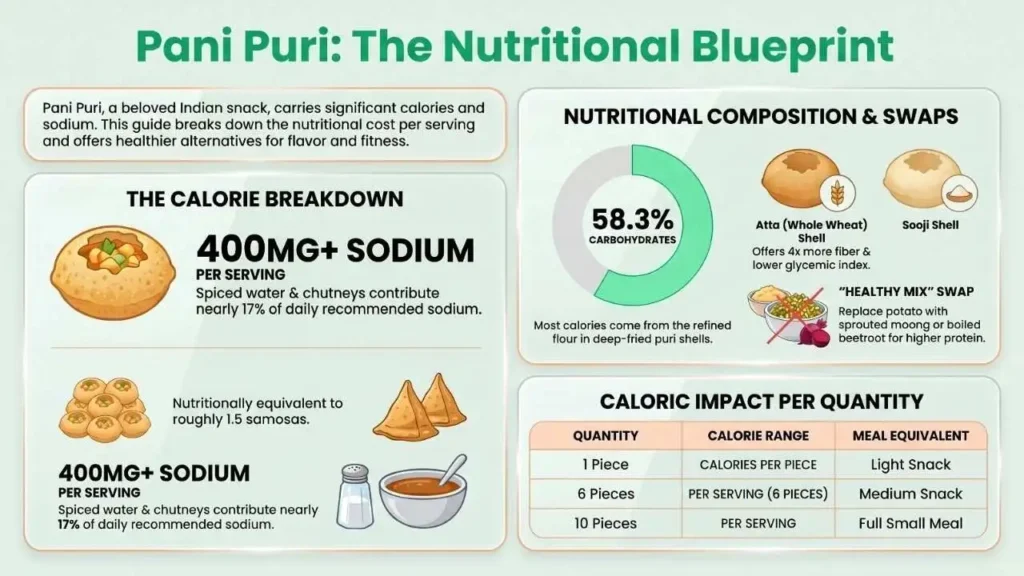
A single pani puri typically contains between 25 and 51 calories, meaning a standard plate of six pieces provides approximately 200 to 329 calories. Most of these calories come from deep-fried refined flour shells and starchy potato fillings, which can cause rapid blood sugar spikes, especially for those managing diabetes or looking for weight loss solutions.
Why We Love It and What It Costs Your Body
I’m not here to tell you that you can never eat street food again. That wouldn’t be realistic, and as your dietitian friend, I want to find solutions that actually fit your life. Let’s simplify this: the reason we crave these little flavor bombs is the perfect combination of salt, fat, and sugar. It’s a sensory explosion. But for a busy professional or a homemaker juggling a dozen tasks, those calories pani puri provides aren’t just numbers on a page; they represent how much energy-or how much of a sugar crash-you’re going to have an hour later.
The structure of a pani puri is a bit like a hidden energy trap. The shell, or the puri, is usually a mix of semolina (suji) and refined flour (maida). While wheat sounds healthy, the moment that dough hits the hot oil, it acts like a sponge. Research shows that deep-fried foods can absorb between 10% and 25% of their weight in fat. This means that even though a puri feels light and airy in your hand, it’s actually carrying a heavy load of degraded oils.
When we look at the standardized nutritional breakdown, the numbers tell a story of imbalance. A 100-gram serving of pani puri-which is roughly 10 to 12 pieces-delivers about 355 calories. If you’re a busy professional who eats 10 or 12 of these as a light snack before dinner, you might accidentally consume 500 calories without even realizing it.
| Component of Pani Puri | Weight/Volume | Estimated Calories | Primary Source |
| Single Fried Puri Shell | ~3-5g | 15-25 kcal | Refined Carbs & Fat |
| Potato Filling (per puri) | ~10g | 10-20 kcal | Simple Starch |
| Spicy Mint Water (per puri) | ~30ml | 2-4 kcal | Micronutrients |
| Sweet Chutney (per puri) | ~5ml | 10-15 kcal | Added Sugars |

The Real Story Behind the Puri Shell
What this means for your daily routine is that the shell is the biggest villain in the story. I know it’s hard to find time to cook, so we often grab whatever is available. But those street-side puris are often fried in oil that has been heated and reheated all day. The Food Safety and Standards Authority of India (FSSAI) has warned that reheating cooking oil releases harmful toxins and increases trans fats.
For your heart, this is a major concern. When oil reaches its smoking point repeatedly, it creates free radicals that damage your blood vessels. Harvard Health research indicates that people who eat fried foods just 4 to 6 times a week have a 39% increased risk of type 2 diabetes. If you’re already struggling with your blood sugar, those crispy shells are making the battle much harder.
Let’s look at the macronutrients. About 60% to 70% of the calories pani puri contains come from carbohydrates. These aren’t the good carbs like you’d find in a bowl of oats; these are refined starches that your body turns into sugar almost instantly. The fat content makes up another 30%, while protein is sadly left behind, often contributing less than 10% to the total.
The Impact on Diabetes and the Indian Phenotype
If you’re managing diabetes, I want you to pay close attention to this. There is something called the South Asian Phenotype. It sounds like medical jargon, but it basically means that as Indians, our bodies are genetically predisposed to store fat around the belly and resist insulin more than other groups. This makes us much more sensitive to the refined starch bomb that is a plate of golgappas.
When you eat a potato-filled puri made of maida, your blood sugar doesn’t just rise; it spikes. Within 15 to 30 minutes, your glucose levels can shoot up, forcing your pancreas to pump out a massive amount of insulin. Over time, this constant spiking and crashing leads to exhaustion of your insulin-producing cells.
The ICMR-INDIAB study, which is one of the largest dietary studies in India, found that over 62% of the daily calories in the average Indian diet come from these low-quality carbohydrates. This is exactly why we are seeing such a surge in diabetes and obesity across our cities.
| Metabolic Marker | Impact of 1 Serving (6 pieces) | Timeline |
| Blood Glucose Spike | High (Rapid increase) | 0-30 minutes |
| Insulin Requirement | Significant response needed | 30-60 minutes |
| Satiety (Fullness) | Low (Hunger returns quickly) | 1-2 hours |
| Potential Glucose Plateau | Elevated levels | 2-3 hours |
I know it’s hard to keep track of everything, but what this means for your daily routine is that choosing a snack with a high glycemic index like pani puri is like putting high-pressure steam into a fragile pipe. Eventually, something gives. According to the NIH, managing these spikes is the single most important thing you can do to prevent long-term complications.

Regional Varieties: Phuchka, Golgappa, or Gupchup?
It’s fascinating how the calories pani puri offers can change just by crossing a state border. In North India, you get the classic Golgappa with a potato and chickpea mix. In Kolkata, the Phuchka is larger and uses a spicier mashed potato and black gram filling. Down in Mumbai, the ragda pani puri uses warm white peas instead of potatoes.
From a dietitian’s perspective, the Mumbai style or the Bangalore version using white peas (ragda) is actually a bit better for you. Why? Because legumes like peas and chickpeas add fiber and protein. Fiber is like a security guard that slows down the entry of sugar into your blood. If you’re at a stall, asking the vendor for more chana (chickpeas) and less aloo (potato) is a simple, immediate fix you can start following today.
| Regional Style | Main Filling | Nutritional Profile |
| Delhi Golgappa | Potato/Chickpea | High Starch, Moderate Fiber |
| Kolkata Phuchka | Mashed Potato/Gram | High Starch, Very Spicy |
| Mumbai Pani Puri | Ragda (White Peas) | Lower GI, Higher Protein |
| Bangalore Gupchup | Ragda/Sprouts | Best for Satiety |
The Sodium Trap: Why You Feel Bloated
Have you ever noticed that after a plate of chaat, your rings feel tight or your face looks a bit puffy the next morning? That’s not fat; it’s water retention caused by the staggering amount of salt in the teekha pani. The spicy water and masala mixes are loaded with sodium. A single serving can easily contain a large portion of your daily salt limit.
The NIH and the American Heart Association recommend staying under 2,300 mg of sodium a day, but for those with high blood pressure, that limit drops to 1,500 mg. Excess salt forces your heart to work harder by increasing your blood volume. Over time, this leads to hypertension and puts a strain on your kidneys.
I know it’s hard to find time to exercise, so we have to be extra careful with the salt shaker. If you’re already dealing with blood pressure issues, the hidden salt in street food is one of the biggest hurdles to your health.

Let’s Talk Solutions: The Supportive Dietitian Guide
I want to empower you, not restrict you. If you’re a busy professional or a homemaker who loves pani puri, here is how we can make it work. It’s all about timing and smart swaps.
First, let’s talk about timing. Never eat pani puri as a late-night snack. Your digestion is much stronger in the afternoon. If you have a craving, have your plate at noon or as a mid-afternoon snack. This gives your body the rest of the day to move around and process those carbohydrates.
Second, the Last Puri rule. We all love that free sukha puri (dry puri) at the end, right? But that’s usually just extra fried dough and salt. Skip the dry puri and the sweet chutney. The sweet tamarind water is basically liquid sugar, adding 50 to 60 calories per serving. Stick to the spicy mint water-it’s actually got some great ingredients like cumin and hing that help with digestion.
| Instead of This… | Try This Today… | Why It Works |
| 12 Puris at 7 PM | 6 Puris at 1 PM | Better metabolic processing |
| Extra Potato Filling | Extra Moong/Sprouts | Adds protein and fiber |
| Sweet Tamarind Water | Spicy Mint/Cumin Pani | Saves 100+ calories of sugar |
| Maida (Refined) Puris | Atta (Whole Wheat) Puris | More fiber, slower sugar rise |

The DietDekho Homemade Revolution
What this means for your daily routine is that the safest, healthiest way to enjoy this snack is at home. And no, you don’t need to spend hours in the kitchen. If you use an air fryer, you can make puris with 80% less oil. You can buy high-quality, whole wheat puris from the store and just pop them in the air fryer for a few minutes until they puff up.
For the filling, let’s keep it simple. Instead of peeling and mashing a bunch of potatoes, use canned or boiled chickpeas and moong dal sprouts. They are packed with protein and will keep you full much longer than potatoes ever will.
For the pani, you can blend fresh mint, coriander, and a bit of ginger. These aren’t just for flavor-mint is anti-inflammatory, and ginger is fantastic for your gut health. Add some black salt and roasted cumin powder, and you’ve got a digestive tonic that tastes like a treat.
| Homemade Preparation | Calories per 6 Puris | Fat Content |
| Traditional Deep-Fried | 329 kcal | 12-15g |
| Air-Fried Whole Wheat | 160 kcal | 2-3g |
| Sprout-Based Filling | 140 kcal | 1g |
A Word of Encouragement for the Journey
I know it feels like a lot to manage, especially when you’re busy taking care of everyone else. But making these small changes isn’t about being perfect; it’s about being kind to your body. Every time you choose sprouts over potatoes or air-fried over deep-fried, you’re giving your heart and your pancreas a much-needed break.
Remember, you don’t have to do this alone. If you’re feeling overwhelmed by your diet or your blood sugar numbers, we are here to simplify things for you. You deserve a plan that works for your life, not a textbook lecture.

Frequently Asked Questions
How many calories are in 1 plate of pani puri?
A typical street-style plate of six pieces contains approximately 200 to 329 calories. The total can increase significantly if you add extra sweet chutney or more than one serving of potato filling.
Is pani puri healthy for someone with diabetes?
Traditional pani puri is high in refined carbs and can cause blood sugar spikes. However, you can make it diabetic-friendly by using whole wheat puris, skipping the sweet chutney, and using moong sprouts as the main filling.
Can I eat pani puri while trying to lose weight?
Yes, but portion control is key. Stick to 5-6 pieces and avoid eating them in the evening to prevent salt-induced water retention. Making them at home using an air fryer can cut the calories pani puri contains by nearly half.
Is the water in pani puri good for digestion?
The teekha pani often contains cumin, mint, black salt, and ginger, which are known to aid digestion and reduce bloating. However, ensure the water is hygienic to avoid stomach infections.
What is the best time to eat pani puri?
The best time is during the afternoon (lunchtime) when your metabolic rate is higher. Avoid eating it as a pre- or post-workout snack, as your body needs more protein and fewer refined fats during those times.
Ready to transform your health without giving up the foods you love?

Contact Us
We understand how overwhelming nutrition and weight loss information can feel. With so many opinions and confusing advice online, it’s easy to feel stuck or unsure about what to do next.
At Diet Dekho, you never have to figure it out alone. You can contact us anytime with any questions or concerns. Our expert dietitians are available 24/7 to guide, support, and help you stay on track. Whether your goal is weight loss or building healthier habits, we’re here to make the journey simpler and more sustainable for you.
Disclaimer
This blog is intended to help readers make healthier food choices. Your health should always be the top priority. Before starting any restrictive or special diet, especially if you have a medical condition or health concern, please consult a doctor or a qualified dietitian. Each body responds differently to food and lifestyle changes. Always choose what is safe and suitable for you.

Abhinav is the Founder of Diet Dekho, helping people manage weight and lifestyle health through simple, practical nutrition and personalized diet plans.