It is 6:00 PM on a Tuesday. You are heading home after a long day of meetings and back-to-back calls. Suddenly, the aroma of sizzling samosas and tangy tamarind water hits you. Your stomach rumbles. I know it is hard to find time to cook when your schedule is packed, but understanding street food calories india can help you navigate these cravings without derailing your health goals. Whether you are managing diabetes or simply trying to feel lighter, you do not have to give up your favorite flavors. Let us simplify this journey together.
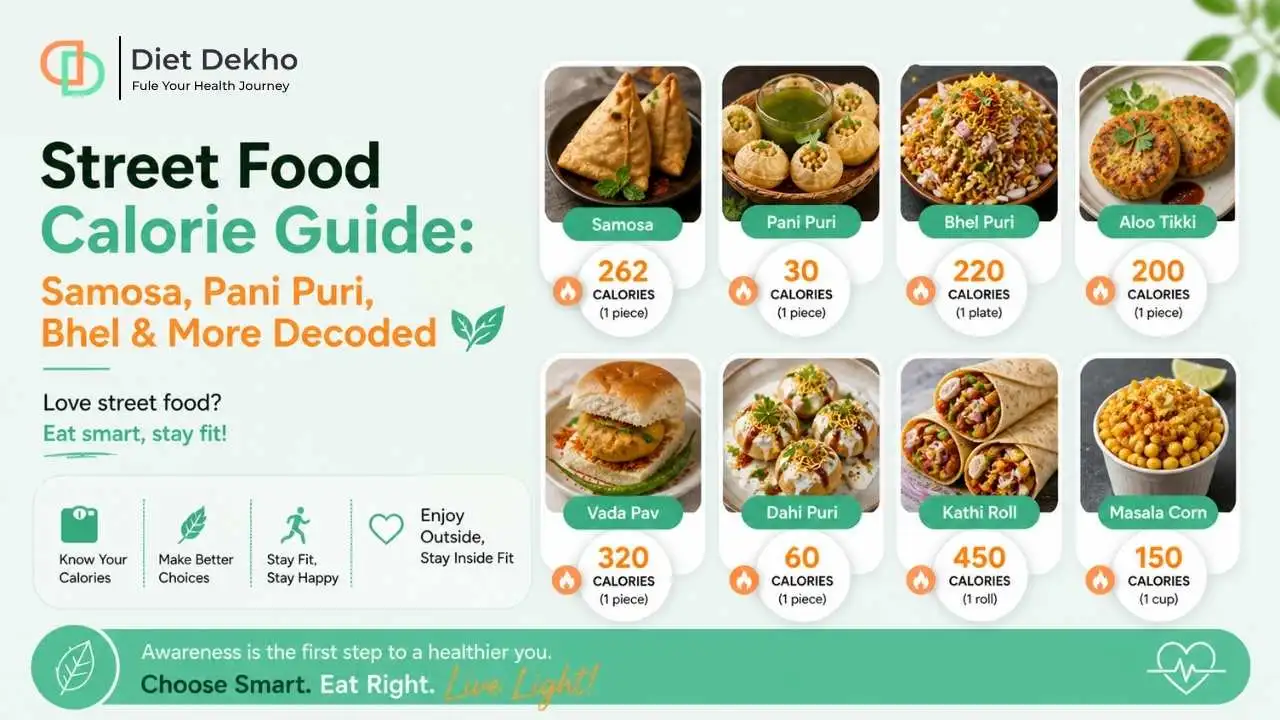
Typical street food calories india range from 150 to 500 per serving. A single samosa averages 250-262 calories, while six pieces of pani puri provide 166-216 calories. For those with diabetes, focusing on steamed options like dhokla or fiber-rich bhel puri with minimal sweet chutney helps manage blood sugar spikes effectively while satisfying evening hunger.
The Heart of the Matter: Why Our Cravings Are So Strong
The streets of India are more than just transit routes. They are living, breathing kitchens. I see so many of my clients struggling because street food is not just about hunger. It is about culture and memory. However, what this means for your daily routine is a constant battle with high-calorie, low-nutrient traps. The reality of street food calories india is often hidden behind layers of spices and vibrant colors.
When we look at the data, the situation in urban India is quite stark. Roughly 73 million urban Indians are now higher weight people. I understand that between managing a home and a career, exercise often takes a backseat. This sedentary lifestyle, combined with a diet that is 62% carbohydrates, creates a perfect storm for metabolic issues. Most of these carbs come from low-quality sources like white rice and refined flour.
Let us look at the scale of the challenge we face together.
| Category | Population Impact (Millions) | Percentage of Urban Population |
| Overweight/Obese | 73 | 20% |
| Living with Diabetes | 101 | 14.2% (Urban) |
| Pre-diabetic Risk | 136 | N/A |
These numbers are not meant to scare you. They are here to show you that you are not alone in this struggle. Understanding street food calories india is your first step toward reclaiming control.
The Samosa: A Deep Dive into India’s Favorite Pyramid
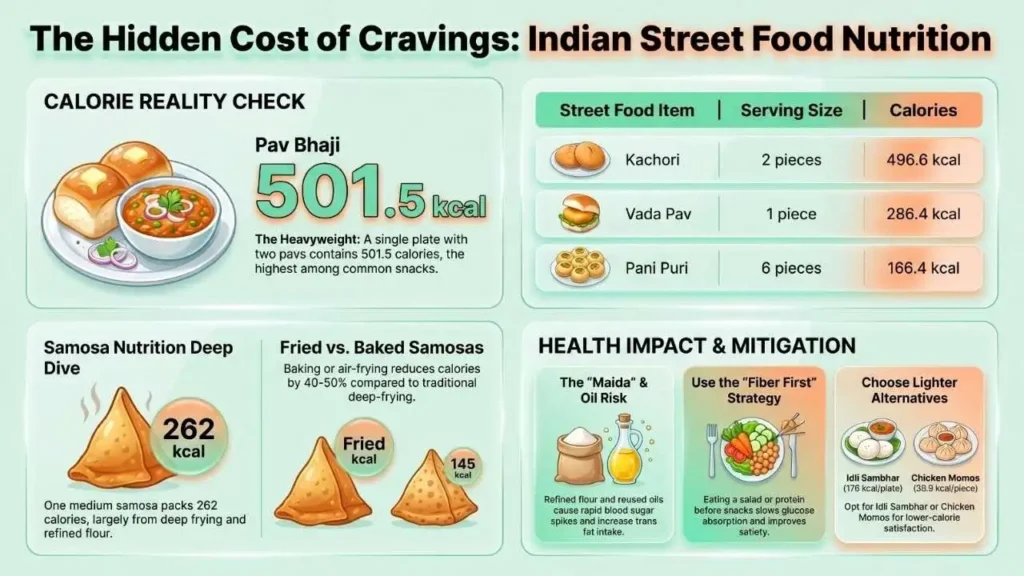
If there were a king of Indian snacks, it would be the samosa. But for a busy professional or a homemaker, this king can be a demanding one. A single medium samosa packs about 262 calories. If you have two, which is very common, you have already consumed a quarter of your daily caloric needs.
The structure of a samosa is what makes it so calorically dense. The outer shell is made of refined flour (maida). This flour is stripped of all its fiber and nutrients. This results in a high glycemic index (GI) of around 85-90. When you eat it, your blood sugar levels spike almost immediately.
| Component | Caloric Contribution (%) | Nutritional Value |
| Refined Flour Crust | 40% | High Glycemic, Low Fiber |
| Deep Frying Oil | 35-40% | Saturated/Trans Fats |
| Potato Filling | 20-25% | Starchy Carbohydrates |
The oil used by street vendors is another concern. Often, this oil is heated and reheated. This process creates trans fats and oxidized compounds. These can block your arteries and increase the risk of diabetes. I know it tastes amazing, but the internal cost is high.
If you really crave that crunch, let us look at a home-based solution. An air-fried samosa can drop the calories to about 150. This is a practical step you can start following today. By using whole wheat flour for the crust, you also add much-needed fiber.
Pani Puri: The Deceptive Little Water Bombs
You might think pani puri is a safe bet because it is mostly water. While it is lighter than a samosa, the street food calories india in golgappas can add up quickly. A serving of six pieces usually contains between 166 and 216 calories.
The main issue for my diabetic friends is the Meethi Chutney. This sweet tamarind sauce is concentrated sugar. It is the primary driver of the glycemic load in this snack.
| Ingredient | Calories per 6 pieces | Impact on Blood Sugar |
| Fried Puris | 80-100 | Moderate Spike |
| Potato/Chickpea Filling | 40-60 | Slow Release (if mostly chickpeas) |
| Flavored Water | 10-20 | Low (if no sugar added) |
| Sweet Chutney | 50-70 | High Spike |
I often tell my clients to ask for more Teekha Pani (spicy water) and less sweet chutney. What this means for your daily routine is that you still get the experience without the sugar crash.
According to Harvard Health, picking better sources of carbohydrates can help you control your weight and prevent chronic conditions. In the case of pani puri, prioritizing the chickpea filling over the potato filling is a smart, small change. Chickpeas are rich in protein and fiber, which help stabilize your glucose levels.
Bhel Puri: The Satiety Hero
If you are out with friends and need to choose a snack, Bhel Puri is often my top recommendation. It is generally lighter because its base is puffed rice. Puffed rice is airy and low in fat.
A standard plate of bhel puri contains about 175 to 250 calories. It provides a better balance of nutrients compared to other fried snacks. You get fiber from the onions, tomatoes, and coriander. You get a little protein if the vendor adds peanuts or sprouts.
| Nutritional Metric | Bhel Puri (150g) | Samosa (1 pc) |
| Total Calories | 250 kcal | 262 kcal |
| Total Fat | 10g | 10g |
| Carbohydrates | 40g | 38g |
| Protein | 5g | 5g |
Wait, the numbers look similar, right? But the volume is different. You get a whole bowl of bhel puri for the same calories as one small samosa. This is why bhel puri is more satiety-friendly. It keeps you full for longer.
To make it even better, ask the vendor to skip the extra Papdi and Sev. These are the silent calorie bombs. Instead, ask for extra sprouts or chopped cucumber. It is a simple, trustworthy solution you can implement immediately.
Vada Pav and Pav Bhaji: The Carb-on-Carb Crisis
For many busy professionals in cities like Mumbai, a Vada Pav is a quick lunch. However, this Indian burger is a nutritional nightmare for someone with diabetes. A single piece of Vada Pav has 286.4 calories.
The breakdown is roughly 60% fat and 33% carbohydrates. You are essentially eating a fried potato patty inside a refined flour bun. This combination leads to a massive insulin spike.
| Snack | Calories | Sodium (mg) | Main Concern |
| Vada Pav | 286.4 | 209 | High Fat/Refined Carbs |
| Pav Bhaji | 501.5 | 589 | Excessive Butter/Salt |
Pav Bhaji is another heavy hitter. While it contains many vegetables, they are often mashed and cooked in a large amount of butter. A plate with two pavs contains over 500 calories.
I know it is hard to find time to prepare a healthy lunch, but let us simplify this. If you must have Pav Bhaji, try to eat it at home. Use multigrain pav instead of refined flour pav. Use a small amount of homemade white butter or olive oil. This small shift can make a huge difference in your metabolic health.
The Momo Trend: Steamed vs. Fried
Momos have taken India by storm. For the non-gym audience, they seem like a healthy, non-fried option. But we need to look closer at the street food calories india for this Himalayan treat.
The cooking method changes everything. Steamed momos are a much lighter choice.
| Type of Momo (6 pcs) | Calories | Fat (g) | Protein (g) |
| Steamed Veg | 180-220 | 4-6 | 5-8 |
| Fried Veg | 250-300 | 10-12 | 5-8 |
| Steamed Chicken | 250-300 | 8-10 | 15-20 |
| Fried Chicken | 300-350 | 12-15 | 15-20 |
As you can see, steaming saves you about 100 calories per plate. The fried version absorbs oil into the refined flour wrapper, which is a big no-no for weight management.
For my friends with diabetes, momos can be tricky because of the maida wrapper. One smart substitute is to look for Atta Momos or even better, make Cauliflower Momos at home where you use large vegetable leaves as the wrapper.

The Science of 5%: Small Changes, Big Impact
I want to share a very powerful statistic with you. A major study by the ICMR found that replacing just 5% of your carbohydrate calories with plant or dairy proteins can significantly lower your risk of diabetes.
What does this look like in real life?
- Instead of a second samosa, have a handful of roasted peanuts.
- Instead of a third pav, have a bowl of curd or some paneer.
- Instead of sugary tea with your snack, have a glass of buttermilk.
This is the cornerstone of managing street food calories india. It is not about deprivation; it is about balance.
According to the National Institutes of Health (NIH), focusing on non-starchy vegetables and lean proteins is key to maintaining stable blood sugar. This is why adding a cucumber salad or some sprouts to your street food plate is so effective.
The Role of Fiber and the Glycemic Index
We often talk about calories, but for diabetes management, the quality of those calories matters more. High-GI foods like maida (refined flour) and white rice cause your blood sugar to roller-coaster.
| Food Ingredient | Glycemic Index (GI) | Recommended? |
| Maida (Refined Flour) | 85-90 | No |
| White Rice | 73 | Limit |
| Whole Wheat | 60-65 | Better |
| Millets (Ragi/Bajra) | 50-55 | Yes |
| Chickpeas/Dal | 28-32 | Excellent |
Most street foods are unfortunately built on a foundation of maida. This is why you feel tired and hungry again just an hour after eating a Vada Pav or a plate of Chole Bhature.
To fix this at home, always choose stone-ground whole wheat or millet flours. These have a lower GI and are rich in fiber, which slows down the absorption of sugar.
Practical Snacking Tips for Busy Professionals
I know you are often on the run. Here is a simple game plan for when you are out:
- The Plate Method: If you are at a buffet or a party, fill half your plate with salad or vegetables. Fill one quarter with a protein like paneer or chicken, and only one quarter with that samosa or kachori.
- Hydrate First: Drink a large glass of water before you start eating. It helps you feel full faster.
- Portion Control: Share your plate. If you want a jalebi, share it with three friends. You get the taste without the 400-calorie hit.
- Avoid Liquid Calories: Skip the soda or the sweet lassi. Stick to water or unsweetened tea.
The 7-Day Snack Rotation for Homemakers
If you are managing the kitchen, you have the power to transform street food calories india. Here are some home-based solutions:
- Monday: Roasted Makhana (Fox Nuts) with a dash of black salt. Low GI and high in protein.
- Tuesday: Moong Dal Chilla with plenty of chopped veggies. This is basically a high-protein pancake.
- Wednesday: Sprouted Moong Chaat. Squeeze some lemon for a vitamin C boost.
- Thursday: Steamed Dhokla. Fermented foods are great for your gut health.
- Friday: Roasted Chana. It is the ultimate clean protein hit.
- Saturday: Vegetable Oats Upma. High in fiber to keep your energy stable.
- Sunday: Air-fried Vegetable Cutlets. Use sweet potato instead of regular potato for a lower GI.
Understanding the Hidden Dangers: Salt and Trans Fats
Beyond the calories, street food often contains very high levels of sodium. A single plate of chaat can contain 800-1000mg of sodium. For those with high blood pressure, this is a major concern.
Furthermore, the trans fats in reused oil can increase your bad cholesterol (LDL) and reduce your good cholesterol (HDL). This is why home-cooked versions, where you control the quality of the oil, are always superior.
Conclusion: You Have the Power to Choose
I know it feels overwhelming to change your habits when your life is so busy. But please remember: every small choice adds up. You do not have to be perfect. If you eat a samosa today, just make sure your next meal is rich in vegetables and protein.
Let us simplify this one last time. Prioritize steaming over frying. Choose whole grains over refined flour. And most importantly, listen to your body. You deserve to feel energetic and healthy.
If you are struggling to create a plan that fits your specific lifestyle, we are here to help. Our team of expert dietitians can create a roadmap tailored just for you.
Let’s start your journey to a healthier you today.

FAQs
How many calories are in 6 pieces of Pani Puri?
A standard serving of 6 pieces of pani puri contains approximately 166 to 216 calories. The variation depends on the amount of potato filling and sweet tamarind chutney used. For a lower-calorie option, ask for more sprouts and less sweet chutney.
Which is the healthiest street food in India?
The healthiest street foods are generally steamed or pulse-based. Dhokla, Idli Sambar, and Sprouted Moong Chaat are excellent choices. They are lower in fat, provide good protein, and have a lower glycemic index, making them safer for people with diabetes.
Are momos healthy for weight loss?
Steamed vegetable momos can be a part of a weight loss diet if eaten in moderation (4-6 pieces). They contain about 180-220 calories. However, you should avoid fried momos, which can have over 300 calories and significant amounts of unhealthy fats.
How can I manage my diabetes while eating street food?
To manage diabetes, follow the Plate Method: fill half your plate with salad/veggies first. Choose snacks with a low glycemic index, like roasted chana or chilla. Always avoid sugary drinks and limit high-carb items like samosas or white bread sandwiches.
What are the calories in a single Samosa?
One medium-sized samosa contains roughly 250 to 262 calories. Most of these calories come from the refined flour crust and the oil used for deep frying. Air-frying a samosa at home can reduce the calorie count by nearly 40%.
Contact Us
We understand how overwhelming nutrition and weight loss information can feel. With so many opinions and confusing advice online, it’s easy to feel stuck or unsure about what to do next.
At Diet Dekho, you never have to figure it out alone. You can contact us anytime with any questions or concerns. Our expert dietitians are available 24/7 to guide, support, and help you stay on track. Whether your goal is weight loss or building healthier habits, we’re here to make the journey simpler and more sustainable for you.
Disclaimer
This blog is intended to help readers make healthier food choices. Your health should always be the top priority. Before starting any restrictive or special diet, especially if you have a medical condition or health concern, please consult a doctor or a qualified dietitian. Each body responds differently to food and lifestyle changes. Always choose what is safe and suitable for you.

Abhinav is the Founder of Diet Dekho, helping people manage weight and lifestyle health through simple, practical nutrition and personalized diet plans.