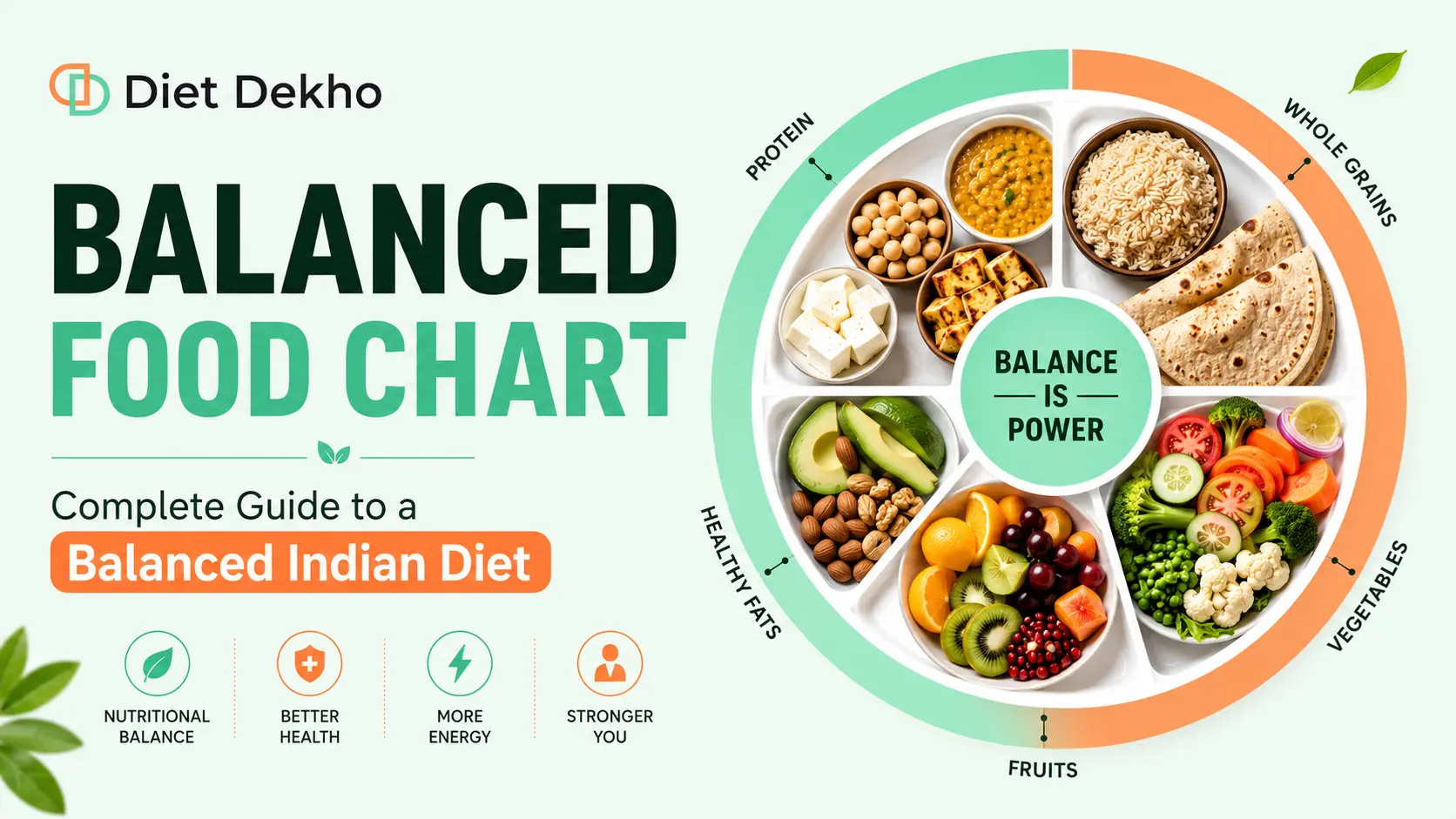
I know it feels hard to find time, but planning your meals shouldn’t feel like a chore. Most of my clients come to me feeling completely overwhelmed by conflicting advice. They want to feel energetic and healthy. Fortunately, keeping a simple balanced food chart in your kitchen can instantly remove all that daily stress.
This tool is a visual guide showing the correct daily proportions of different food groups. Specifically, it recommends filling half your daily plate with nutritious vegetables and fruits. You should fill the remaining half with equal parts of whole grains and healthy proteins. Additionally, include small portions of low-fat dairy and beneficial fats.
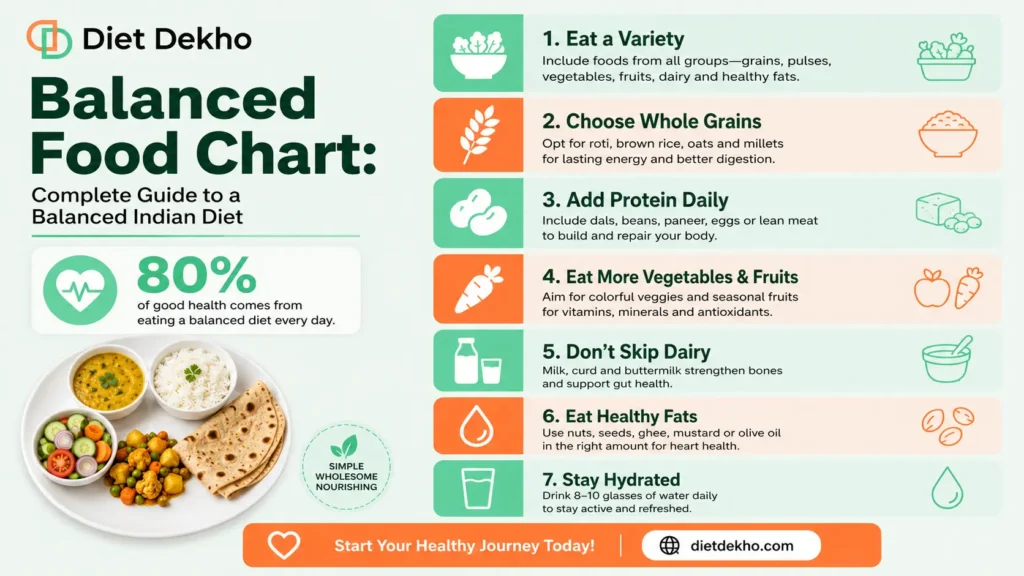
Why Your Daily Thali Needs a New Structure
Here’s something most people don’t realise: traditional Indian meals are already close to being perfect. However, we often get the portions wrong in our kitchens. For example, we tend to eat too much rice or roti. Meanwhile, we consume too little protein and fiber from vegetables. As a result, we feel sluggish and tired after eating.
To make your thali work for you, we must look at the proportions. Fortunately, the Indian Council of Medical Research (ICMR) released updated guidelines for Indians in 2024. Most importantly, their research suggests a practical way to divide your daily intake. Let’s simplify this for you to make your meals healthier.
Understanding the Rising Nutritional Challenge in India
Many of my clients want to lose weight because they feel out of shape. In fact, India faces a complex mix of undernutrition and rising obesity today. The latest National Family Health Survey (NFHS-5) highlights this struggle clearly.
Specifically, child stunting remains high at 35.5 percent. Underweight children also make up 32.1 percent of our young population. At the same time, obesity and higher weight body issues are steadily rising in many households. Therefore, restructuring our daily thali is crucial for the health of our families.
| Nutritional Health Indicator (NFHS-5) | Prevalence Rate (%) | Clinical Relevance & Long-term Risks |
| Child Stunting (Under 5) | 35.5% | Impaired cognitive growth, lower productivity |
| Child Underweight (Under 5) | 32.1% | Weakened immunity, high infection risk |
| Child Wasting (Under 5) | 19.3% | Acute malnutrition, muscle loss |
| Higher weight body Children (Under 5) | 3.4% | Early-onset metabolic risks, obesity |
The Golden Proportions of the My Plate Model
Our National Institute of Nutrition (NIN) recommends a simple thali template. Specifically, half of your daily plate should consist of colorful vegetables and fresh fruits. This portion ensures you get enough protective vitamins, fiber, and essential minerals.
What this means for your daily routine is that you must increase your vegetable portion. For instance, try eating two rotis instead of three. Also, add two big bowls of green vegetables to your plate. This small change will boost your nutrient intake significantly. Let’s look at the exact amounts recommended by the latest ICMR-NIN 2024 guidelines.
| Daily Food Group (ICMR-NIN) | Target Intake (g or ml / Day) | Energy Contribution (kcal / Day) | Primary Nutrient Benefit |
| Cereals & Nutricereals | 250g | 800 kcal | Complex carbs, B-complex |
| Pulses & Legumes* | 85g | 274 kcal | Plant-based protein, iron, fiber |
| Low-Fat Milk & Curd | 300 ml | 216 kcal | Calcium, quality protein, probiotics |
| Fresh Vegetables | 400g | 174 kcal | Micronutrients, active antioxidants |
| Seasonal Fruits | 100g | 56 kcal | Vitamin C, soluble dietary fiber |
| Nuts & Oilseeds | 35g | 181 kcal | Monounsaturated fats, minerals |
| Healthy Fats & Oils | 27g | 243 kcal | Essential fatty acids, fat-soluble vitamins |
Note: Eggs, fish, or lean meat can substitute a portion of pulses to maintain essential amino acids.

Designing Your Personal Daily Thali
Indeed, customizing your daily meals doesn’t mean saying goodbye to your favorite traditional foods. You don’t need to overhaul everything overnight. In fact, you can easily integrate local staple dishes into a healthier lifestyle.
Let me tell you about a client who loved white rice. Because she wanted to lose weight, she was afraid of carbs. However, we did not banish rice from her kitchen. Instead, we simply reduced her rice portion to one small katori. Subsequently, we increased her dal and green vegetable servings.
As a result, she felt much more energetic and satisfied. What this means for your daily routine is that balance is about ratios, not restrictions. Therefore, this traditional indian diet chart is designed to fit your busy life. Let’s make healthy eating practical and sustainable for your family.
Regional Traditions in Your Weekly Thali
Most of my clients love regional dishes like idlis, rotis, or simple rice with dal. Fortunately, you can easily adapt these items to fit your plate. For example, a South Indian thali can include brown rice or ragi. In addition, you can enjoy a bowl of sambar packed with mixed vegetables.
Similarly, a North Indian thali can feature whole-wheat rotis alongside a generous serving of palak paneer. Indeed, you do not need to buy fascinating or expensive ingredients. Instead, use locally grown, seasonal items that your family already enjoys.
What this means for your daily routine is that healthy eating is highly affordable. Also, it connects you directly to your rich culinary roots. Let’s simplify this further by focusing on specific ingredient combinations that build muscle.

Master the Cereal-Pulse Protein Formula
Cereals and pulses are the heart of our traditional meals. Because many Indians follow a vegetarian diet, getting enough complete protein can be a challenge. However, there is a simple scientific trick to solve this easily.
Research published in the National Library of Medicine database shows the benefits of grain combinations. Specifically, combining cereals and pulses in a 3:1 ratio creates a complete protein. This combination provides all the essential amino acids your body needs to thrive.
Therefore, traditional pairings like khichdi, idli, or dosa are actually highly scientific. Next, try to include a variety of lentils in your weekly diet. For instance, rotate between moong dal, masoor dal, and chickpeas to keep meals exciting.
How Sprouting and Fermenting Boost Nutrients
Pre-cooking methods are incredibly important in Indian households for better nutrition. For example, soaking your lentils before cooking reduces anti-nutritional factors like phytates. Consequently, your body absorbs essential minerals like iron and zinc much better.
Similarly, sprouting pulses like green gram increases their vitamin C and folate content. It also makes them far easier on your stomach, preventing bloating. Besides, fermenting batters for idli or dhokla creates beneficial probiotics. These natural microbes support your gut health, digestion, and immunity. Therefore, try to include sprouted or fermented dishes in your weekly meals regularly.
| Pre-Cooking Method | Targeted Food Group | Key Biochemical Benefit | Impact on Digestion & Nutrients |
| Soaking (6-8 hours) | Dals, whole pulses | Reduces phytates and tannins | Enhances absorption of iron and zinc |
| Sprouting (Germination) | Green gram, chana | Multiplies vitamin C and folates | Breaks down complex starches, prevents gas |
| Fermentation (Overnight) | Rice-urad batter | Generates gut-friendly probiotics | Restores intestinal flora, boosts B-vitamins |

How to Fit in Daily Dairy and Vegetables
Most of my clients ask how they can hit their daily dairy and vegetable targets easily. First, aim to consume about 350 grams of vegetables daily. Also, add 150 grams of fresh fruits, as recommended by the ICMR-NIN guidelines.
Second, include at least 300 milliliters of low-fat dairy like curd or buttermilk in your diet. These foods are excellent sources of calcium and gut-friendly probiotics. Consequently, they support your bone strength and overall digestive health.
Finally, do not forget to add a small handful of nuts and seeds. For instance, eating almonds or walnuts provides healthy fats that protect your heart. Such nutrient-dense snacks will keep you full and satisfied between your main meals.

A Practical Plate Structure for Busy Indians
Let’s simplify this for you by looking at a real-world example. I know it feels hard to find time, but a structured daily diet plan saves hours. Here is a sample menu that fits a typical busy Indian household perfectly.
For breakfast, you could have a warm bowl of vegetable upma. Alternatively, try two moong dal chillas served with fresh mint chutney. These healthy options provide slow-releasing energy that keeps you focused all morning.
For lunch, pack two small whole-wheat rotis and a bowl of thick dal. In addition, add a generous portion of spinach sabzi and fresh curd. This combination ensures a perfect mix of fiber, carbs, and plant protein.
| Meal Timing | Suggested Menu Option (Vegetarian / Lean Protein) | Portion Guide | Key Nutritional Focus |
| Early Morning | Warm lemon water plus soaked almonds and walnuts | 1 glass + 5 nuts | Micronutrient activation |
| Breakfast | Vegetable upma or multigrain dal chilla with chutney | 1.5 bowls | Complex carbohydrates |
| Mid-Morning | Low-fat paneer chunks or a cup of fresh curd | 100g / 1 bowl | Lean protein, calcium |
| Lunch | Whole-wheat rotis, thick masoor dal, bhindi sabzi, raita | 2 rotis + 1 bowl each | Fiber and complete protein |
| Evening Snack | Roasted makhana or chana with sugar-free green tea | 1 small bowl | Satiety, heart-healthy fats |
| Dinner | Light vegetable khichdi or grilled paneer with vegetables | 1 bowl | Easy digestion, muscle repair |
Your Step-by-Step Portion Guide
Dinner should always be light and easy to digest before bedtime. For instance, a bowl of mixed vegetable khichdi with ghee is perfect. Alternatively, you can opt for grilled paneer with stir-fried vegetables.
Between meals, stay hydrated by drinking plenty of water or fresh coconut water. In fact, drinking enough water is crucial because we often mistake thirst for hunger. Therefore, keep a water bottle at your desk to drink regularly.
Structuring your balanced meals doesn’t require expensive or imported ingredients. Besides, local foods like seasonal bhindi, lauki, and apples are highly nutritious. Always choose local and seasonal produce to get the freshest nutrients.

Small Habits for Big Health Improvements
You don’t need to overhaul everything overnight to see changes. First, start by swapping refined grains for nutrient-rich whole grains. For example, choose brown rice or whole-wheat atta instead of maida.
Second, reduce your daily salt and sugar intake to protect your body. Most importantly, limit your salt to less than five grams daily. Lowering your salt helps control blood pressure and protects your kidneys. Also, avoid sugary beverages because they contribute to abdominal obesity.
Finally, pay attention to how you prepare your food daily. Choose healthier cooking methods like boiling, steaming, or pressure cooking. These simple methods preserve essential vitamins and lower unnecessary fat intake.
The Power of Mindful Eating Habits
Most of my clients are shocked by how quickly they finish meals. However, eating too fast often leads to overeating and digestive discomfort. Therefore, try to chew your food slowly and enjoy every bite.
In fact, it takes about twenty minutes for your body to register fullness. Consequently, mindful eating helps you maintain portion control naturally. Additionally, try to avoid screens and phones while eating your meals. Focusing on the taste and texture of your food improves digestion significantly.

Nutrition Truths and Vital Information
Let’s look at some important food health facts to guide your journey. Many people believe that all fats are bad for weight loss. However, healthy fats are absolutely essential for hormone production and vitamin absorption.
According to the Harvard T.H. Chan School of Public Health, healthy oils support heart health. Therefore, do not eliminate fats like ghee or mustard oil completely. Just use them in moderation to avoid consuming excess calories.
To help you visualize this, imagine your plate. This visual image helps you build your thali. Let’s make every meal a step toward a healthier you.

Frequently Asked Questions
What are the key components of an indian diet chart?
A healthy meal plan includes whole grains, rich pulses, fresh vegetables, fruits, dairy, and healthy fats. Most importantly, it balances these groups in proper proportions. This balance ensures you get essential nutrients without overeating. Consequently, your body stays fully energized throughout the day.
How do I plan balanced meals on a busy schedule?
To organize your cooking easily, prep your ingredients during the weekend. For instance, boil lentils, chop vegetables, and set curd in advance. This simple habit helps you assemble a nutritious plate in minutes. Consequently, you will avoid ordering unhealthy takeout food on busy weeknights.
Why should I use a balanced food chart daily?
Using this chart helps you manage portion sizes and ensures dietary diversity. Specifically, it guides you to fill half your plate with vegetables and fruits. As a result, you automatically reduce excess carbs. Also, you easily increase essential fiber and protein.
What is the best daily diet plan for weight loss?
The best weight loss plan focuses on a sustainable calorie deficit without skipping meals. First, replace refined carbohydrates with whole grains like oats or millets. Second, increase your protein intake through dals or paneer. These foods keep you full and protect your muscles.
Can I eat traditional sweets while following a healthy diet?
You can enjoy traditional sweets occasionally, but moderation is key. Most importantly, restrict added sugar to less than thirty grams daily. If you crave sweets, choose fresh fruits or dates. These healthy options are much better than highly processed desserts.
Conclusion
I know it feels hard to find time. However, investing in your health is the best choice you can make. You don’t need to overhaul everything overnight. Start with one small change today. For example, add an extra bowl of vegetables to your lunch.
To help you build a personalized meal plan, our expert dietitians at DietDekho are here for you. You can book a free consultation with a dietitian to get a customized plan. Let’s work together to make healthy eating a natural part of your life.
Contact Us
We understand how overwhelming nutrition and weight loss information can feel. With so many opinions and confusing advice online, it’s easy to feel stuck or unsure about what to do next.
At Diet Dekho, you never have to figure it out alone. You can contact us anytime with any questions or concerns. Our expert dietitians are available 24/7 to guide, support, and help you stay on track. Whether your goal is weight loss or building healthier habits, we’re here to make the journey simpler and more sustainable for you.
Disclaimer
This blog is intended to help readers make healthier food choices. Your health should always be the top priority. Before starting any restrictive or special diet, especially if you have a medical condition or health concern, please consult a doctor or a qualified dietitian. Each body responds differently to food and lifestyle changes. Always choose what is safe and suitable for you.

Abhinav is the Founder of Diet Dekho, helping people manage weight and lifestyle health through simple, practical nutrition and personalized diet plans.