Have you ever woken up feeling like your internal battery is at five percent, even after eight hours of sleep? You reach for your morning tea, but your hands feel unusually cold, and you notice your hair looks a bit thinner in the mirror. I know how frustrating it is when you’re doing everything right-managing the kids, the house, and your work-yet your body feels like it’s dragging through mud. Often, the missing piece isn’t just rest but a tiny nutrient your thyroid is screaming for. Incorporating a specific food rich in iodine into your daily meals could be the simple shift that finally brings your energy back.
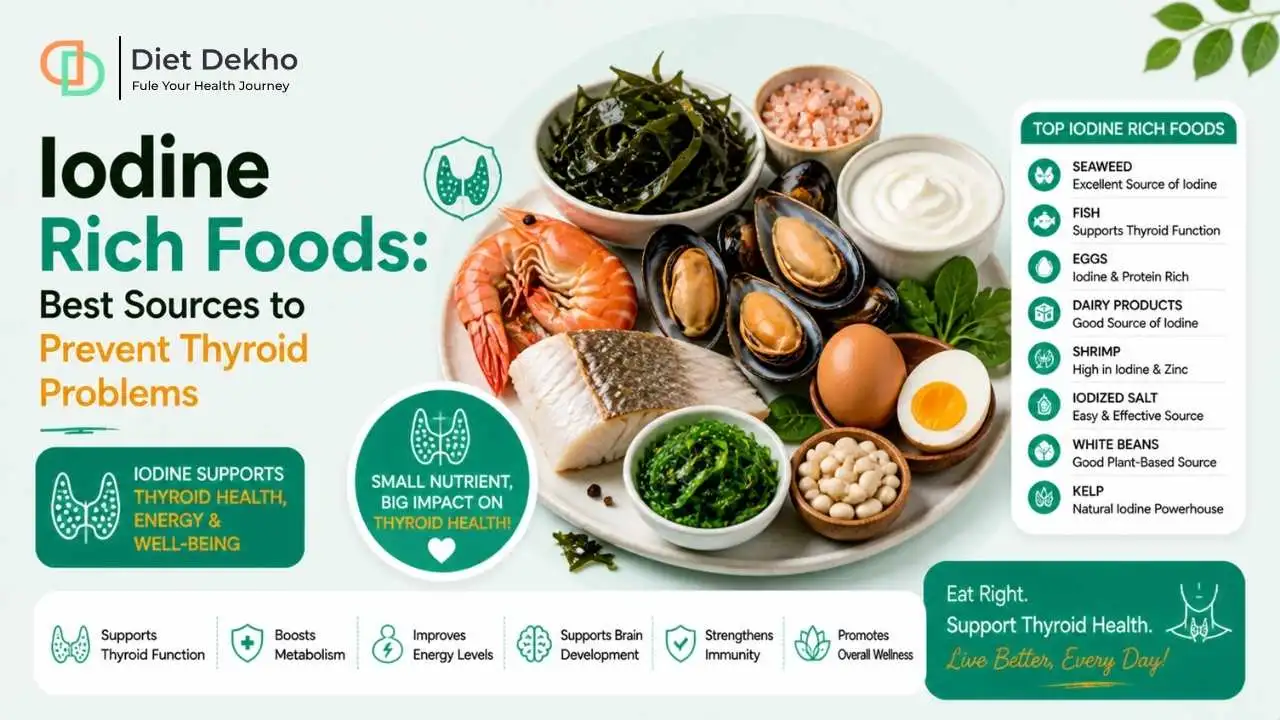
The most effective way to prevent thyroid problems is by consuming a food rich in iodine like iodized salt, dairy products (milk and curd), and seafood (fish and shrimp). For vegetarians, seaweed (nori), eggs, and fortified grains are excellent choices. Adults need 150 mcg daily, while pregnant people require 220-250 mcg to ensure proper thyroid function and metabolic health.

Understanding the Silence of the Thyroid Gland
The thyroid is that small, butterfly-shaped gland sitting at the base of your neck. It’s like the thermostat of your body. When it works, you don’t notice it. When it falters, everything from your heart rate to how fast you burn a roti for energy starts to go haywire. I often tell my clients at DietDekho that the thyroid doesn’t ask for much-it just needs a steady supply of iodine to make its hormones, thyroxine (T4) and triiodothyronine (T3).
I know it’s hard to find time to study biology when you’re busy with back-to-back meetings or managing a household. But what this means for your daily routine is that without iodine, your thyroid gland literally starts to swell up to catch more of it from your blood. This is what we call a goiter. In India, we’ve seen a huge rise in thyroid issues because our soil is often depleted of this mineral due to flooding and heavy rains, meaning the vegetables we grow don’t always have enough.
| Clinical Indicator | Role of Thyroid Hormones (T3,T4) | Impact of Iodine Deficiency |
| Metabolic Rate | Regulates how cells use energy | Significant weight gain and fatigue |
| Body Temperature | Maintains internal warmth | Constant sensitivity to cold |
| Cognitive Function | Supports brain development and focus | Brain fog and lower IQ in children |
| Protein Synthesis | Builds muscle and repairs tissue | Muscle weakness and hair thinning |
The Indian Crisis: Why Our Geography Matters
In India, iodine deficiency isn’t just a personal health choice; it’s an environmental reality. We live in a region where the Himalayan slopes and the great river plains have been leached of iodine over millennia. Statistics show that more than 200 million people in India are at risk of Iodine Deficiency Disorders (IDD), and about 70 million are already suffering from them.
I remember a client who lived in a mountainous region and switched to pure Himalayan salt thinking it was better. Within a year, her energy tanked. Let’s simplify this: the purity of the salt doesn’t matter if it lacks the one thing your thyroid needs to survive. The National Iodine Deficiency Disorders Control Programme (NIDDCP) was actually renamed from the National Goitre Control Programme because we realized that goiter is just the tip of the iceberg-the real danger is the hidden hunger affecting our brains and metabolism.
| State/Region Metric | Findings (NFHS-V & NIDDCP) |
| Endemic Districts | 263 out of 324 districts surveyed |
| Household Salt Coverage | 94.3% use iodized salt, but only 76% is adequately iodized |
| Self-Reported Thyroid Disorders | 2.9% of the general population |
| Risk for Newborns | 8 million newborns at risk annually due to maternal deficiency |

Salt: The Foundation of Your Thyroid Health
Let’s talk about salt. It is the most common food rich in iodine we use, yet it is the most misunderstood. Lately, there has been a lot of hype around pink salt and sea salt. I know they look pretty in a glass jar on your kitchen counter, but most of them are not fortified with iodine.
If you are using Himalayan pink salt exclusively, you are likely missing out on the 150 micrograms of iodine you need every day. Pink salt contains trace minerals like magnesium and potassium, but the amounts are so small they don’t really impact your health unless you eat dangerous amounts of salt. For a busy professional or a homemaker, the simplest solution is to use standard iodized salt. It’s cheap, effective, and it’s the primary reason we have saved over 4 billion IQ points in India over the last 20 years.
The Right Way to Use Salt
I want you to try a small change in your cooking. Iodine is a bit delicate; it can vanish if you cook it at very high heat for a long time. Instead of adding salt right at the start of your sabzi or dal, try adding it toward the end or when the food is simmering. This helps preserve the iodine so it actually reaches your thyroid.
Comparing Common Salts
| Salt Type | Iodine Content (per gram) | Clinical Recommendation |
| Iodized Table Salt | 15-30 mcg (standardized) | Best for daily prevention |
| Himalayan Pink Salt | Negligible | Use for flavor, but don’t rely on it for iodine |
| Sea Salt | Trace (varies wildly) | Usually insufficient for thyroid health |
| Rock Salt (Sendha Namak) | Low | Great for fasting, but not for daily iodine |

Dairy: The Unsung Hero for Vegetarians
For my vegetarian friends, I know it’s a struggle to find enough iodine without eating fish. This is where dairy becomes your best friend. Milk and curd are fantastic sources of iodine because cows in India are often given iodine-fortified feed and the equipment used in milk processing is cleaned with iodine-based sanitizers.
A simple bowl of homemade dahi with your lunch or a glass of milk before bed can provide a significant chunk of your daily requirement. I recommend cow milk over buffalo milk if you’re looking for something lighter on the stomach, as it’s generally easier to digest while still being a great food rich in iodine.
Dairy Iodine Breakdown
- Non-fat Cow’s Milk: 85 mcg per cup (about 57% of your daily need).
- Greek Yogurt: 116 mcg per cup (almost 75% of your daily need).
- Cottage Cheese (Paneer): 24-30 mcg per 100g (a decent boost for your paneer tikka).
- Curd (Dahi): 74 mcg per cup (perfect for a quick raita).
I know life gets busy, but setting curd at home is one of the best things you can do for your family. It’s packed with probiotics that help your gut absorb the nutrients from your other foods. Think of it as a double win: you’re feeding your thyroid and your digestion at the same time.

Seafood: The Powerhouse of the Ocean
If you enjoy non-vegetarian food, you have access to some of the richest sources of iodine on the planet. Marine fish are naturally high in iodine because they live in the ocean, which is a giant reservoir of the mineral.
In India, we have a clear distinction between marine fish and freshwater fish. While a Rohu or Catla from the river is delicious and healthy, they don’t have nearly as much iodine as a marine fish like Hilsa, Pomfret, or Sardines.
| Fish Category | Average Iodine (mcg/100g) | Examples |
| Marine Fish | 193 mcg | Cod, Hilsa, Pomfret, Mackerel |
| Freshwater Fish | 8-27 mcg | Rohu, Catla, Mrigal |
| Shellfish | 700-2500 mcg | Prawns, Crabs, Oysters |
What this means for your daily routine is that if you’re struggling with fatigue, try incorporating a marine fish twice a week. A small portion of grilled or steamed cod provides about 158 mcg of iodine, which covers your entire daily requirement in just one meal.

The Diabetes-Thyroid Connection: Why It Matters to You
Many of my clients come to me for diabetes management, but they don’t realize their thyroid might be the reason their blood sugar is so hard to control. These two conditions love to travel together. About 13% of people with diabetes also have a thyroid problem.
Let’s simplify this: when your thyroid is slow (hypothyroidism), your whole metabolism slows down. This includes how fast your body clears sugar from your blood. I’ve seen many busy professionals struggle with high fasting glucose levels, only to find out that their marginal iodine deficiency was slowing down their thyroid, which in turn was making them insulin resistant.
| Factor | Hypothyroidism Impact | Hyperthyroidism Impact |
| Insulin Sensitivity | Decreases (Insulin stays in blood longer) | May decrease over time due to high sugar production |
| Glucose Absorption | Slower | Faster (Leads to spikes after eating) |
| Weight Management | Very difficult due to low BMR | Rapid weight loss, but can be dangerous |
If you’re managing diabetes, it’s worth asking your doctor for a TSH (Thyroid Stimulating Hormone) test. Taking care of your thyroid with a food rich in iodine can actually make your diabetes medications work more effectively by waking up your metabolism.
Makhana: The Superfood for Your Evening Cravings
I know the 4 PM hunger pangs are the hardest part of the day. You’re tired, you’re at your desk, and you want something crunchy. Instead of reaching for a packet of chips that are loaded with bad salt and zero nutrients, I want you to try Makhana (Fox Nuts).
While Makhana itself isn’t a primary source of iodine, it is a metabolic superstar. It has a low glycemic index, which is perfect for diabetes, and it’s rich in magnesium and potassium that help your heart and muscles. If you roast them in a little ghee and sprinkle just a bit of iodized salt, you’ve created the perfect thyroid-supporting snack.
- Protein: 9.7g per 100g (great for muscle repair).
- Fiber: 14.5g per 100g (helps with constipation, a common thyroid symptom).
- Fat: Almost zero.

Eggs: A Simple, Home-Based Solution
I know you’re busy, but boiling an egg takes exactly six minutes. Eggs are a wonderful food rich in iodine because the yolk contains about 24-31 mcg of the mineral. They also provide selenium, which is like a bodyguard for your thyroid gland, protecting it from damage.
Having two whole eggs for breakfast can get you nearly 40% of the way to your daily iodine goal. It’s a simple, trustworthy solution that you can start following today without needing any fancy ingredients or long cooking times.
Fruits and Vegetables: Small Boosts for Big Results
Normally, fruits and vegetables aren’t the best sources of iodine because they depend entirely on the soil they were grown in. However, some have been found to hold onto more iodine than others. If you’re looking for a refreshing snack, try these:
- Strawberries: 13 mcg per 100g.
- Dried Prunes: 13 mcg in 5 prunes (also great for your digestion!).
- Cranberries: 2 mcg.
- Bananas: 3 mcg (not a lot, but every bit helps).
- Potatoes: About 7 mcg in a medium potato (keep the skin on for more nutrients!).
I know it’s hard to keep track of these numbers, but you don’t have to. Just aim for a rainbow on your plate. A variety of colorful fruits and vegetables provides antioxidants that help reduce inflammation in the thyroid.

The Goitrogen Myth: Do You Need to Stop Eating Cabbage?
I often hear people say, I have a thyroid problem, so I can’t eat cauliflower or cabbage. Let’s simplify this once and for all. These vegetables (cruciferous) contain goitrogens, which can block iodine absorption, but only if you eat them raw and in very large quantities.
What this means for your daily routine is: don’t stop eating your gobhi or sarson ka saag! Just make sure you cook, steam, or stir-fry them. Heat deactivates most of the goitrogenic compounds, making them perfectly safe for your thyroid. The only thing I would suggest avoiding is drinking raw cabbage or kale juice every day. Keep it simple-cook your greens, and your thyroid will be fine.
Practical Kitchen Wisdom for Busy People
I know it’s hard to find time to cook elaborate meals. Let’s make this practical. Here are three 5-minute habits that can change your thyroid health:
- The Overnight Soak: Soak 2 walnuts and 4 almonds overnight. Eat them first thing in the morning. They are rich in zinc and omega-3s, which help your thyroid hormones switch on your metabolism.
- The Buttermilk Ritual: Make a quick glass of chaas with some roasted cumin and a pinch of iodized salt. It’s hydrating, iodine-rich, and great for your gut.
- The Pulse Power: Always have a bowl of dal (lentils) with your lunch. Lentils like Moong Dal are packed with zinc and protein, which act as the raw materials your body needs to produce energy.
Expert Quote on Iodine
Iodine is an essential micronutrient required for normal thyroid function, growth, and development. The most damaging consequences of deficiency are in the first 1000 days of life, but it continues to affect productivity and energy levels in adults throughout their lives. – Public Health Review on NIDDCP.
Managing Your Routine: A Day in the Life
If you’re a busy professional or a homemaker, your day probably looks like a race. Here is how you can sneak in your food rich in iodine without even thinking about it:
- 7:00 AM: Wake up and have your soaked nuts.
- 8:30 AM: A quick breakfast of two boiled eggs or poha seasoned with iodized salt.
- 11:00 AM: An apple or a banana to keep you going.
- 1:30 PM: Lunch with 1-2 rotis, a bowl of dal, and a large bowl of dahi. (This is your main iodine boost!)
- 4:30 PM: A handful of roasted Makhana or Chana.
- 8:30 PM: Light dinner like Khichdi or grilled fish with steamed vegetables.
I know it’s hard to stay consistent, but even if you only manage two of these things, you’re already doing better than most. Every small step is an investment in your energy.

FAQs: Your Questions Answered
1. Can I get enough iodine from pink Himalayan salt?
No, unfortunately, pink salt is not fortified and contains very little natural iodine. If you use it, you must ensure you are getting a food rich in iodine from other sources like dairy, eggs, or seafood to prevent thyroid issues.
2. How do I know if I have an iodine deficiency?
Common symptoms include feeling tired all the time, being sensitive to cold, dry skin, thinning hair, and unexpected weight gain. If you notice a swelling in the front of your neck, that is a clear sign of a goiter and you should see a doctor.
3. Is milk a good source of iodine in India?
Yes, dairy products like milk and curd are some of the most reliable sources of iodine for vegetarians in India. A cup of milk provides about half of what an adult needs daily.
4. Are there any fruits that are a food rich in iodine?
Strawberries and dried prunes are the best fruit sources. While they don’t have as much as fish or milk, they are healthy snacks that contribute to your overall daily intake.
5. Does cooking destroy the iodine in my salt?
High heat can cause some iodine to be lost. To prevent this, try adding your iodized salt toward the end of the cooking process rather than at the very beginning.
Conclusion: Taking the First Step Today
I know health can feel overwhelming, especially when you’re juggling so much. But your thyroid doesn’t need a complicated transformative journey. It just needs the right fuel. By simply choosing iodized salt, enjoying a bowl of curd, or boiling a couple of eggs, you are giving your body the tools it needs to keep your energy up and your metabolism steady.
What this means for your daily routine is that you don’t need to spend hours in the gym or buy expensive supplements. You just need to make smarter choices in your kitchen. If you’re feeling stuck or want a plan that is tailored specifically to your health needs, I’m here to help.
Ready to reclaim your energy?
Contact Us
We understand how overwhelming nutrition and weight loss information can feel. With so many opinions and confusing advice online, it’s easy to feel stuck or unsure about what to do next.
At Diet Dekho, you never have to figure it out alone. You can contact us anytime with any questions or concerns. Our expert dietitians are available 24/7 to guide, support, and help you stay on track. Whether your goal is weight loss or building healthier habits, we’re here to make the journey simpler and more sustainable for you.
Disclaimer
This blog is intended to help readers make healthier food choices. Your health should always be the top priority. Before starting any restrictive or special diet, especially if you have a medical condition or health concern, please consult a doctor or a qualified dietitian. Each body responds differently to food and lifestyle changes. Always choose what is safe and suitable for you.

Abhinav is the Founder of Diet Dekho, helping people manage weight and lifestyle health through simple, practical nutrition and personalized diet plans.