Have you ever looked at a bowl of colorful fruit and felt a little bit of guilt? Maybe you’ve been told that fruit is just sugar, or you’ve seen your blood sugar spike after a quick snack and thought you had to give up your favorites forever. I remember talking to a friend named Adarsh, a busy professional from Punjab who was struggling with a weight of 165 kilograms and a frightening prediabetes diagnosis. He felt overwhelmed, panting just from walking, and he thought he had to say goodbye to every joy of eating to save his health. But what we discovered together, and what the latest research shows, is that eating the right fruit and salads isn’t just a treat; it is a powerful tool for healing your body from the inside out.
The simple habit of eating fruit and salads daily provides a high-fiber, nutrient-dense solution that stabilizes blood sugar, aids digestion, and promotes long-term weight management without the need for a gym. By choosing whole fruits with a low glycemic index, you ensure a slow release of energy that keeps you full and protects your metabolic health.
Why your body craves the fiber in fruit and salads
I know it’s hard to find time to cook elaborate meals when you’re rushing between meetings or managing a household. What this means for your daily routine is that we need to find the most efficient way to get nutrients into your system. When we talk about fruit and salads, we are really talking about the magic of the food matrix. Unlike a glass of juice, which is essentially a sugar bomb, whole fruit comes with a built-in braking system: fiber.
This fiber acts like a natural broom in your gut. It slows down how fast your body absorbs sugar, which prevents those nasty spikes and crashes that leave you feeling tired by 4 PM. Soluble fiber, found in things like apples and pears, turns into a gel-like substance in your stomach. This gel catches sugar and fat, making sure they enter your bloodstream slowly and steadily.
Table 1: Fiber Content and Satiety Impact of Common Indian Fruits
| Fruit Name | Fiber Type | Impact on Satiety | Digestive Benefit |
| Guava | Pectin (Soluble) | Very High | Relieves constipation |
| Apple | Soluble & Insoluble | High | Feeds good gut bacteria |
| Pear | Soluble | High | Softens stool |
| Papaya | Insoluble | Moderate | Prevents bloating |
| Berries | Insoluble | High | Improves insulin response |
Let’s simplify this even further. When you eat a whole apple, your body has to work to break it down. That work burns calories and gives your brain time to realize you’re full. If you drink the juice of three apples, you’re getting all the sugar in seconds with none of the work. Research from Harvard has shown that people who eat at least two servings of whole fruits like apples or grapes each week can reduce their risk of type 2 diabetes by 23%. On the flip side, drinking fruit juice every day can actually increase your risk by 21%.

The secret of the Glycemic Index for your daily routine
I often hear people say they are scared of mangoes or grapes because they are sweet. I want to reassure you that sweetness isn’t the enemy; it’s the Glycemic Index (GI) that matters. The GI tells us how fast a food raises your blood sugar. As a rule of thumb, we want to stick to fruits with a low GI, usually under 55.
Think of the GI like a speed limit. Low-GI fruits are like a calm, steady drive through a neighborhood, while high-GI foods are like a car racing on a highway. For my friends managing diabetes, picking the right mix for your fruit and salads is like choosing the right fuel for a sensitive engine.
Table 2: Glycemic Index (GI) and Glycemic Load (GL) of Diabetic-Friendly Fruits
| Fruit | GI Score | GI Category | Glycemic Load (per serving) |
| Guava | 12-24 | Very Low | 1.3-5 |
| Jamun | 25 | Low | Low |
| Apple | 36-40 | Low | 6 |
| Pear | 33 | Low | 4 |
| Pomegranate | 35 | Low | 18 |
| Orange | 40-45 | Low | 4 |
| Papaya | 60 | Moderate | Low (due to fiber) |
What this means for your afternoon snack is that a guava or a small apple is much safer than a piece of white bread or a biscuit, even if the fruit tastes sweeter. The fiber and water in the fruit keep the load on your system very low.
Guava: The Indian superhero for blood sugar
If I could recommend just one fruit for my Indian clients, it would be the humble guava. It’s affordable, available almost everywhere, and it’s a nutritional powerhouse. Guava has an incredibly low GI and is packed with Vitamin C-even more than oranges!
I know it’s hard to find snacks that don’t make you feel guilty, but guava is a freebie for most people. Its high fiber content, specifically pectin, is great for your heart and your gut. If you’re struggling with constipation, which often goes hand-in-hand with diabetes, eating a guava a day can be a total game-changer. Just remember to eat it with the skin, as that’s where many of the antioxidants live, but you can remove the seeds if they bother your digestion.

Jamun and the power of purple
During the monsoon, you’ll see those beautiful deep-purple jamuns in the market. Please, don’t walk past them! Jamun is a traditional Indian remedy for diabetes for a reason. It contains a compound called jamboline that actually helps slow down the conversion of starch into sugar in your body.
It’s almost like nature’s own version of a blood sugar regulator. I recommend keeping a small bowl of jamun on your desk. When you feel that 4 PM urge to have chai and a samosa, try a few jamuns instead. Not only will they satisfy your sweet tooth, but they’ll also help keep your levels stable.
Making fruit and salads work for a busy professional life
I hear you-you’re busy, you’re tired, and the last thing you want to do is spend thirty minutes chopping a salad. Let’s simplify this. You don’t need a fancy recipe to enjoy the benefits of fruit and salads.
One of my favorite tricks for professionals is the Jar Method. You can wash and chop your fruits on a Sunday evening. The key is to keep them from turning brown and soggy. A little splash of lemon or lime juice does wonders here; the acid prevents oxidation. Store them in airtight glass containers instead of steel ones to avoid any metallic taste or reactions.
Table 3: Weekly Prep Guide for Busy Professionals
| Task | Day | Time Needed | Storage Tip |
| Wash & Dry Grapes | Sunday | 5 Mins | Remove stems, store in paper-lined glass |
| Seed Pomegranate | Sunday | 10 Mins | Use the water bowl method to avoid stains |
| Slice Hard Fruits (Apples/Pears) | Daily | 2 Mins | Toss with lemon juice to prevent browning |
| Peel/Chop Bananas | Just Before Eating | 1 Min | Bananas brown too fast for pre-chopping |
What this means for your daily routine is that you spend 15 minutes on Sunday to save an hour during the week. When you’re reaching for a snack, the healthy choice is already there, ready to go.
Why whole fruit beats juice every single time
I want to take a moment to talk about something that confuses a lot of people: fruit juice. It’s often marketed as healthy, but for someone watching their blood sugar or weight, it’s one of the most dangerous things in the kitchen.
When you juice a fruit, you strip away the fiber. You’re left with the sugar and some vitamins, but without the fiber, that sugar hits your liver like a freight train. A study published by the NIH showed that drinking fruit juice is linked to a higher risk of diabetes, whereas eating whole fruit is linked to a lower risk.
Let’s look at the numbers. A 150ml glass of fruit juice-which is quite small-can have as much as 15 grams of free sugar. That’s sugar that isn’t trapped in fiber, so your body absorbs it instantly. If you swap just three glasses of juice a week for whole fruits, you could lower your diabetes risk by 7%.
The non-gym audience guide to weight management
I know many of you don’t have the time or the desire to hit the gym for an hour every day. That’s perfectly okay. Weight management is 80% about what happens in the kitchen.
Fruits are naturally low in calories but high in water. This is called low energy density. It means you can eat a huge bowl of watermelon or strawberries and consume fewer calories than you would in just two or three biscuits.
The water in these fruits also helps with bloating. Many people find that once they start eating more fruit and salads, they feel lighter and more energetic because they are finally properly hydrated.
Table 4: Calorie Comparison: Fruit vs. Processed Snacks
| Fruit/Snack (100g) | Approx. Calories | Satiety Level |
| Watermelon | 30 kcal | High (Water-rich) |
| Strawberries | 32 kcal | High (Fiber-rich) |
| Apple | 52 kcal | Very High |
| Digestive Biscuits | 480 kcal | Low (High Sugar/Fat) |
| Potato Chips | 530 kcal | Very Low (High Fat) |

Healing your gut with every bite
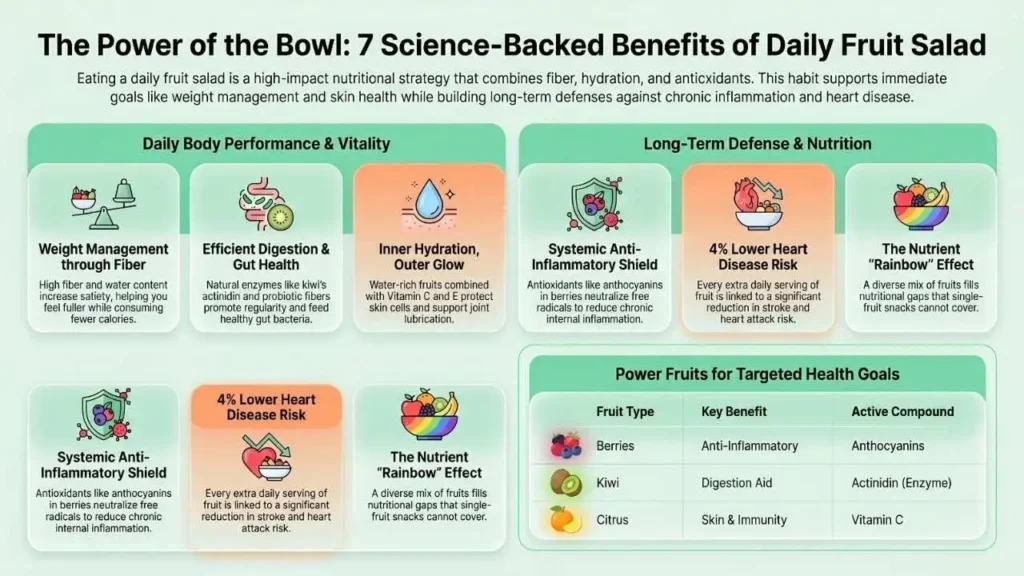
What many people don’t realize is that your gut is like a garden. To keep it healthy, you need to feed the good bacteria. Fruits like apples, bananas, and even kiwi are rich in prebiotics. These are special fibers that act as food for your good gut microbes.
When your gut is happy, your inflammation goes down. This is vital for my friends with diabetes or heart issues, as inflammation is often the root cause of these problems. Enzymes like actinidin in kiwi or papain in papaya also help your stomach break down proteins more easily, which means less gas and bloating after your meals.
The ICMR-NIN 2024 Guidelines: What you need to know
The Indian Council of Medical Research recently updated their guidelines, and they are very clear: we need to be eating more plants. They recommend about 400 grams of fruits and vegetables every single day.
In their My Plate for the Day model, they suggest that half of your plate should be filled with fruits and vegetables. For most Indians, this is a big change from the traditional plate filled with rice or rotis. But making this shift is the most sustainable way to prevent obesity and diabetes.
Seasonal eating in Pune and Maharashtra
I always tell my clients to look at what’s growing in their own backyard. In Maharashtra, we are blessed with some of the best produce in the world. Buying seasonal fruits isn’t just cheaper; it means the fruit is fresher and hasn’t been sitting in a cold storage warehouse for months.
In the winter, enjoy our local strawberries and citrus fruits. In the summer, while we have to be careful with mangoes if we are diabetic, a small slice of a local Alphonso can be enjoyed if paired with a handful of almonds to slow down the sugar.
Table 5: Maharashtra Seasonal Fruit Calendar
| Season | Best Fruits to Buy | Health Focus |
| Winter (Nov-Mar) | Oranges, Grapes, Strawberries, Guava | Vitamin C & Immunity |
| Summer (Mar-June) | Watermelon, Mango, Jackfruit | Hydration & Energy |
| Monsoon (July-Oct) | Jamun, Pomegranate, Custard Apple | Blood Sugar & Heart |

How to build the perfect Diabetes-Friendly bowl
Let’s simplify the construction of your bowl. You don’t want to just throw random fruits together. To keep your blood sugar perfectly stable, I recommend a simple three-step formula:
- Pick your base: Choose low-GI fruits like guava, apple, or pear.
- Add a Pop of color: Throw in some berries or pomegranate arils for antioxidants.
- The Safety Net: Always add a source of healthy fat or protein. This is crucial! A few walnuts, some soaked almonds, or a dollop of plain curd will slow down the digestion of the fruit sugars even further.
I know it’s tempting to add honey or chaat masala. If you can, skip the extra honey-the fruit is sweet enough. A little pinch of black salt or rock salt is okay and can actually help with digestion.
FAQs for your fruit and salads journey
Can I eat fruit and salads if I have high blood sugar?
Yes, you absolutely can. The key is to choose low-glycemic fruits like guava, jamun, and apples and keep your portions to about one small bowl at a time. Always try to pair your fruit with a few nuts or seeds to keep your levels steady.
Is it better to eat fruit on an empty stomach?
Many dietitians, including myself, recommend eating fruit about 30 minutes before a meal or as a standalone snack. Eating fruit immediately after a heavy meal can sometimes cause fermentation in the gut, leading to gas and acidity.
Which fruit is best for losing belly fat without exercise?
While no fruit burns fat, high-fiber fruits like grapefruit, apples, and berries help you feel full for longer. This naturally reduces the amount of junk food you eat, helping with weight loss even if you aren’t hitting the gym.
Should I avoid bananas if I am diabetic?
You don’t have to avoid them completely, but moderation is key. A small, slightly under-ripe banana has more resistant starch and a lower GI than a very ripe, spotted one. Limit yourself to half a banana at a time and pair it with some protein.
How long can I store a pre-cut fruit salad?
For the best taste and nutrient levels, try to eat it within 24 hours. However, if stored in an airtight glass container in the fridge, it can stay safe for up to 3 days. Adding a bit of citrus juice will keep it looking fresh.
Let’s take the first step together
I know it’s hard to change your habits overnight. I’ve seen people like Adarsh turn their lives around just by making small, consistent choices. Starting with a simple bowl of fruit and salads today is a promise to your future self. You deserve to feel energetic, light, and in control of your health.
If you’re feeling a bit lost and want a plan tailored specifically for your lifestyle and health needs, we are here to help. Let’s simplify your journey to health together.
Ready to start your customized nutrition plan

Contact Us
We understand how overwhelming nutrition and weight loss information can feel. With so many opinions and confusing advice online, it’s easy to feel stuck or unsure about what to do next.
At Diet Dekho, you never have to figure it out alone. You can contact us anytime with any questions or concerns. Our expert dietitians are available 24/7 to guide, support, and help you stay on track. Whether your goal is weight loss or building healthier habits, we’re here to make the journey simpler and more sustainable for you.
Disclaimer
This blog is intended to help readers make healthier food choices. Your health should always be the top priority. Before starting any restrictive or special diet, especially if you have a medical condition or health concern, please consult a doctor or a qualified dietitian. Each body responds differently to food and lifestyle changes. Always choose what is safe and suitable for you.

Abhinav is the Founder of Diet Dekho, helping people manage weight and lifestyle health through simple, practical nutrition and personalized diet plans.