Imagine it is 4:00 PM on a rainy Tuesday in Mumbai or a breezy afternoon in Delhi. The kettle is whistling, and the aroma of masala chai fills the kitchen. For millions of Indians, this moment is incomplete without the familiar crunch of a biscuit. Perhaps you reach for a digestive biscuit, thinking it is the healthier choice because the packaging promises fiber and wholesomeness. You have been working hard on your fitness goals, hitting the gym, and watching your portions. But here is the thing: that innocent-looking biscuit might be the very reason your weight loss progress has plateaued. What this really means is that the health halo surrounding the biscuit industry is often built on clever marketing rather than clinical nutrition.
The Cultural Significance and Nutritional Evolution of the Indian Biscuit
Table of Contents
- 1 The Cultural Significance and Nutritional Evolution of the Indian Biscuit
- 2 The Maida Trap: Why Refined Flour Sabotages Fat Loss
- 3 The Fiber Gap and the Satiety Mechanism
- 4 Decoding the Fat Content: Palm Oil and Trans Fats
- 5 The Sugar-Free Myth: Maltitol and Hidden Carbs
- 6 Protein Biscuits: Can They Enhance Your Metabolism?
- 7 The Case for Millets: Ragi, Jowar, and Bajra
- 8 Brand Audit: Who Passes the Fitness Test?
- 9 How to Read a Nutrition Label Like a Pro
- 10 The Role of Portion Control: The 2-Biscuit Rule
- 11 Metabolic Timing: When Should You Snack?
- 12 Home-Baked Alternatives: The Ultimate Strategy
- 13 Expert Consensus: The ICMR and AIIMS Nagpur Warnings
- 14 Better Than Biscuits: Superior Tea-Time Snacks
- 15 Strategic Substitution for Beginners
- 16 The Role of Hydration and Digestion
- 17 Conclusion: Making the Right Choice for Your Journey
- 18 Frequently Asked Questions (FAQs)
- 19 Contact Us
- 20 Disclaimer
The ritual of tea and biscuits is more than just a snack; it is a deeply ingrained habit that spans generations. Historically, biscuits were developed as a portable, shelf-stable source of energy. The original digestive biscuits were created in the 19th century by Scottish doctors who believed the inclusion of sodium bicarbonate and whole wheat could aid digestion. However, the modern industrial version of these treats has strayed far from those medicinal roots. Today, the Indian market is flooded with options ranging from glucose biscuits to high-protein cookies and keto-friendly crackers.

For a beginner in fitness, navigating these aisles is like walking through a nutritional minefield. You see words like whole grain, multigrain, and sugar-free, but these terms can be incredibly deceptive. Most commercial biscuits, even those marketed as healthy, are classified as ultra-processed foods (UPFs) by organizations like the Indian Council of Medical Research. These products are industrially manufactured and often contain ingredients you would never find in a home kitchen, such as hydrogenated oils, emulsifiers, and synthetic raising agents.
Understanding the Standard Biscuit Profile
Before identifying the best biscuits for weight loss, we must understand why the average biscuit fails the health test. Most tea-time biscuits, specifically the popular glucose and Marie varieties, are essentially a combination of refined flour, added sugars, and low-quality fats. They are energy-dense but nutrient-poor. This means they provide a lot of calories without offering the fiber or protein needed to keep you full. Dr. Amreen Sheikh, a leading nutritionist in Mumbai, warns that these biscuits provide empty calories that directly affect metabolic health, which refers to how well your body manages blood sugar and cholesterol.
| Biscuit Type | Calories per 100g | Primary Flour | Sugar Content | Fat Source |
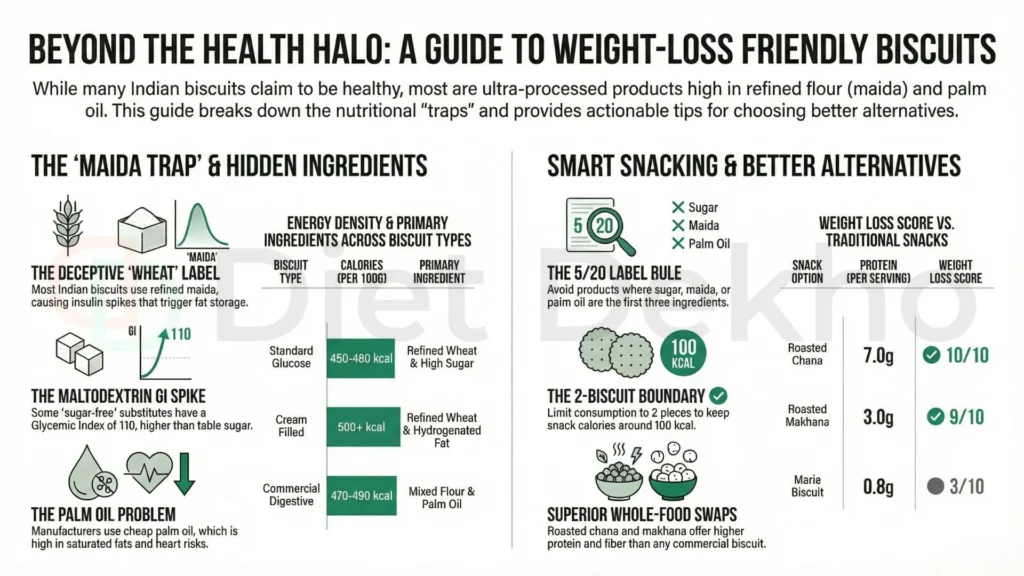
| Standard Glucose | 450-480 kcal | Refined Wheat (Maida) | High (30%+) | Vegetable Oil / Palm Oil |
| Standard Marie | 400-420 kcal | Refined Wheat (Maida) | Moderate (15-20%) | Vegetable Oil |
| Cream Filled | 500+ kcal | Refined Wheat (Maida) | Very High (35%+) | Hydrogenated Fats |
| Commercial Digestive | 470-490 kcal | Mixed (Wheat + Maida) | Moderate (15-20%) | Palm Oil |

The Maida Trap: Why Refined Flour Sabotages Fat Loss
When you are looking for biscuits for weight loss, the first thing to check is the flour source. In India, the term wheat flour on a label is often a euphemism for refined wheat flour or maida. Maida is produced by stripping the wheat kernel of its bran and germ, leaving only the starchy endosperm. This process removes nearly all the fiber, vitamins, and minerals.
The metabolic impact of maida is significant. It has a high glycemic index (GI), meaning it is digested and absorbed rapidly, causing a sharp spike in blood glucose levels. To counter this, your pancreas releases insulin, a hormone that facilitates the storage of sugar. Here is the problem: high insulin levels signal the body to stop burning fat and start storing it. Constant spikes from refined flour snacks can lead to insulin resistance over time, making it nearly impossible to lose weight regardless of your calorie intake. Even many digestive biscuits contain up to 80% maida, with only a small fraction of whole wheat added to justify the healthy label.
The Fiber Gap and the Satiety Mechanism
Fiber is perhaps the most critical nutrient for anyone on a weight loss journey. Research from the Harvard T.H. Chan School of Public Health suggests that high-quality carbohydrates rich in fiber help control weight gain in middle age more effectively than low-fiber starches. Fiber increases post-meal satiety, which is the feeling of being full and satisfied. This happens through several mechanisms.
First, fiber-rich foods take longer to chew, giving your brain time to register that you are full. Second, soluble fiber absorbs water in the stomach, creating a gel-like substance that slows gastric emptying. Third, fiber reaches the large intestine where it is fermented by gut bacteria to produce short-chain fatty acids (SCFAs) like acetate and propionate. These SCFAs trigger the release of hormones like peptide YY (PYY) and glucagon-like peptide-1 (GLP-1), both of which suppress appetite.
The Reality of Fiber in Biscuits
While many brands claim to be high fiber biscuits for diet, the actual numbers are often disappointing. A medium-sized guava contains about 5 grams of fiber, and 50 grams of roasted chana offers 8 grams. In contrast, 100 grams of a typical digestive biscuit might only provide 6 grams of fiber. To get a meaningful amount of fiber from biscuits, you would have to consume a massive number of calories, which defeats the purpose of a weight loss diet.
| Source | Serving Size | Fiber Content (g) | Calories (kcal) |
| Whole Wheat Biscuit | 3 biscuits (30g) | 1.8g | 145 kcal |
| Roasted Chana | 30g | 4.8g | 105 kcal |
| Apple with Skin | 1 medium | 4.4g | 95 kcal |
| Almonds | 15 pieces | 2.5g | 110 kcal |

Decoding the Fat Content: Palm Oil and Trans Fats
The fat used in biscuits is just as important as the flour. Most commercial manufacturers in India use palm oil because it is cheap and keeps the biscuits crunchy for months. However, palm oil is high in saturated fats. While some saturated fat is acceptable, a high intake is linked to increased LDL (bad) cholesterol and heart disease risks.
The Harvard Nurses’ Health Study highlights that the quality of fat matters more than the quantity for long-term health. Some biscuits still contain traces of trans fats or hydrogenated oils, even if the label says 0g trans fat per serving (regulations often allow this if the amount is below a certain threshold). Trans fats are particularly dangerous for weight loss because they promote abdominal fat storage and systemic inflammation. When searching for biscuits for weight loss, look for brands that use healthier fats like coconut oil, butter in moderation, or cold-pressed oils, though these are rare in the mass market.
The Sugar-Free Myth: Maltitol and Hidden Carbs
For those managing diabetes or following a strict diet, sugar free biscuits for weight loss seem like a godsend. However, let’s break it down. To maintain the taste and texture of a biscuit without sugar, manufacturers use sugar alcohols like maltitol, sorbitol, or erythritol.
Maltitol is the most common sugar substitute in Indian biscuits. While it has fewer calories than sugar, it still has a glycemic index of 52, compared to table sugar’s 60. This means it still raises blood sugar and causes an insulin response. Furthermore, sugar alcohols are not fully absorbed by the small intestine. When they reach the large intestine, they ferment, often causing bloating, gas, and a laxative effect.
Another concern is hidden carbohydrates. Manufacturers often replace sugar with bulking agents like maltodextrin or modified starches. Maltodextrin has a glycemic index even higher than table sugar, often reaching 110. This can kick someone out of ketosis or cause a massive insulin spike, completely undermining the benefits of a sugar-free label.
Sweetener Comparison Table
| Sweetener | Glycemic Index | Calories per Gram | Metabolic Impact |
| Table Sugar (Sucrose) | 60-65 | 4.0 | High insulin spike |
| Maltitol | 35-52 | 2.1 | Moderate insulin spike |
| Erythritol | 0 | 0.2 | Negligible impact |
| Stevia | 0 | 0 | Negligible impact |
| Maltodextrin | 85-110 | 4.0 | Extremely high spike |

Protein Biscuits: Can They Enhance Your Metabolism?
A newer category in the Indian market is high-protein biscuits and cookies. These are often made by adding whey protein, soy protein, or pea protein to the dough. Protein is highly beneficial for weight loss because of the thermic effect of food (TEF). Your body requires more energy to metabolize protein than it does for fats or carbohydrates.
A study mentioned in NIH research suggests that increasing protein intake can help preserve lean muscle mass during a calorie deficit. Muscle tissue is metabolically active, meaning the more muscle you have, the higher your resting metabolic rate. Biscuits like RiteBite Max Protein offer 10 grams of protein and 4 grams of fiber per cookie. While these are more filling than a standard Marie biscuit, they are also higher in calories. They should be treated as a meal replacement or a pre-workout snack rather than a light tea-time accompaniment.
The Case for Millets: Ragi, Jowar, and Bajra
India is the millet capital of the world, and these ancient grains are perfect for weight loss. Ragi biscuits for weight loss are becoming a staple for health-conscious individuals because ragi is exceptionally high in calcium and fiber. Millets have a lower glycemic index than wheat and rice, meaning they provide a slow, sustained release of energy.
Sunfeast Farmlite and Britannia NutriChoice have both introduced millet-based variants. These are often made with a blend of jowar (sorghum) and bajra (pearl millet). The presence of these nutricereals ensures that you get essential micronutrients like iron, magnesium, and zinc while you snack. However, the caveat remains: check the percentage of millets versus maida. A ragi biscuit that is 80% maida and 10% ragi is still a maida biscuit in disguise.
Brand Audit: Who Passes the Fitness Test?
Let’s look at the actual products available on Indian shelves. If you are a beginner, these brand details will help you make an informed choice next time you shop at Blinkit or BigBasket.
1. Britannia NutriChoice Range
The NutriChoice line is the market leader in healthy digestive biscuits. Their Digestive High-Fibre Biscuit is a step up from regular biscuits but still contains palm oil and some maida. Their Digestive Zero variant is a better choice for those avoiding sugar, as it uses maltitol and has no added sugar or maida. The Oats variant provides about 5 grams of fiber per 100 grams, which is significantly higher than average.
2. McVitie’s Digestive
McVitie’s is the original Scottish brand. Their high-fiber biscuits are trans-fat-free and use a decent amount of whole wheat flour. However, like most commercial brands, they are calorie-dense, with around 480 calories per 100 grams.
3. Lo! Foods Keto Almond Cookies
For those on a low-carb or ketogenic diet, these are excellent. They use almond flour instead of wheat flour, which drastically reduces the net carb count to less than 1 gram per cookie. They are high in healthy fats and protein, making them very satiating.
4. DiabeSmart Sugar-Free Biscuits
These are specifically formulated for diabetic management and weight loss. They use ingredients like jackfruit flour, methi (fenugreek), and jamun seeds, which are clinically proven to help stabilize blood sugar levels. They are sweetened with stevia, making them one of the cleanest options on the market.
5. Right Shift Jaggery Oats Cookies
This brand focuses on using jaggery instead of refined white sugar. While jaggery is still a form of sugar and contains calories, it retains trace minerals like iron and potassium that are lost in white sugar processing. These cookies also exclude palm oil, which is a major win for heart health.

How to Read a Nutrition Label Like a Pro
The front of the pack is marketing; the back of the pack is truth. To find the best biscuits for weight loss in India, you must become a label detective. Follow the 5/20 rule: if a nutrient has a Daily Value (DV) of 5% or less, it is considered low; if it is 20% or more, it is considered high.
- The Order of Ingredients: Ingredients are listed by weight. If the first three ingredients include sugar, maida, or palm oil, put it back on the shelf. Look for whole wheat flour, oats, or ragi as the first ingredient.
- Fiber Content: Aim for biscuits that provide at least 3-5 grams of fiber per serving.
- Protein Content: A good health biscuit should have at least 2-3 grams of protein per serving to help with satiety.
- Hidden Sugars: Look for words like liquid glucose, invert sugar, honey, maltodextrin, or corn syrup. These are all sugar under different names.
- Serving Size: A common trick is to list the nutrition facts for a single biscuit, while the package contains 20. Always calculate based on what you actually consume.
The Role of Portion Control: The 2-Biscuit Rule
Even the healthiest biscuit can lead to weight gain if you eat the whole packet. Most nutritionists suggest limiting biscuit consumption to 2 or 3 pieces per day. A typical digestive biscuit contains about 45 to 50 calories. Eating two with your tea adds 100 calories to your day—manageable. Eating half a packet adds 500 calories—enough to stall your weight loss for the entire week.
To prevent overeating, never eat directly from the packet. Take two biscuits out, put them on a plate, and put the packet away. This mindful approach creates a psychological boundary that prevents mindless grazing.
Metabolic Timing: When Should You Snack?
The timing of your biscuit consumption can influence how your body processes the calories. According to research from the Ultrahuman metabolic platform, eating biscuits on an empty stomach causes a more significant glucose spike than eating them after a meal.
If you must have a biscuit, the best time is after a balanced lunch or as a mid-afternoon snack paired with a source of protein or healthy fat. Pairing a digestive biscuit with a few walnuts or a bowl of Greek yogurt can blunt the blood sugar response. The fiber and fat from the nuts slow down the digestion of the biscuit’s carbohydrates, leading to a more stable energy curve and less fat storage.
Home-Baked Alternatives: The Ultimate Strategy
If you want absolute certainty about what goes into your body, making your own biscuits is the way to go. You can use almond flour, which is low-GI, and sweeten them with mashed bananas or a touch of stevia.
The Simple 3-Ingredient Oat Cookie
- Ingredients: 1 cup rolled oats, 2 ripe bananas, and a handful of walnuts.
- Method: Mash the bananas, mix in the oats and nuts, form small rounds, and bake at 180°C for 15 minutes.
- Benefit: This contains no added sugar, no flour, and is packed with natural fiber.
Expert Consensus: The ICMR and AIIMS Nagpur Warnings
It is important to note that even the Indian government is becoming concerned about our biscuit habits. AIIMS Nagpur recently launched a campaign highlighting that tea-time biscuits are often loaded with trans fats and simple sugars. The ICMR-NIN 2024 guidelines emphasize that Indians should minimize ultra-processed foods, including commercial biscuits and cookies. They suggest that our primary focus should be on whole grains, legumes, and fresh vegetables to combat the rising rates of obesity and diabetes in the country.
Better Than Biscuits: Superior Tea-Time Snacks
While we are discussing the best biscuits for weight loss, we must consider if a biscuit is the best choice at all. Many traditional Indian snacks are naturally better for weight management.
- Roasted Makhana (Fox Nuts): These are low in calories and high in minerals. A large bowl of makhana has fewer calories than two digestive biscuits and provides much more volume.
- Roasted Chana (Chickpeas): This is arguably the best tea-time snack for weight loss in India. It is a complete protein source and is incredibly high in fiber.
- Sprouts Chaat: Moong sprouts with chopped onions, tomatoes, and lemon juice provide antioxidants, fiber, and protein with almost zero fat.
| Snack | Portion | Protein (g) | Fiber (g) | Weight Loss Score |
| Roasted Chana | 1 small bowl | 7.0 | 5.5 | 10/10 |
| Roasted Makhana | 1 large bowl | 3.0 | 2.5 | 9/10 |
| Digestive Biscuit | 2 pieces | 1.2 | 1.1 | 5/10 |
| Marie Biscuit | 3 pieces | 0.8 | 0.3 | 3/10 |
Strategic Substitution for Beginners
If you are a beginner, do not try to overhaul your entire diet overnight. Start with simple swaps. If you currently eat 4 cream biscuits with tea, swap them for 2 digestive biscuits. Once that feels normal, swap one of those biscuits for a handful of roasted almonds. Eventually, you might find that a bowl of seasoned makhana is more satisfying than any biscuit. This gradual approach is more sustainable and helps avoid feelings of deprivation that often lead to overeating later.
The Role of Hydration and Digestion
Sometimes, we confuse thirst with hunger. Drinking a glass of water before your tea-time snack can help you eat less. Furthermore, the fiber in high fiber biscuits for diet requires adequate water to move through your digestive tract. Without enough water, a high-fiber snack can actually cause constipation rather than aiding digestion.
Conclusion: Making the Right Choice for Your Journey
The best biscuits for weight loss are the ones that prioritize transparency in their labeling. Look for high protein, high fiber, and zero refined sugar. Brands like DiabeSmart and Lo! Foods offer technical advantages for fat loss, while Britannia NutriChoice Digestive Zero provides a more accessible, budget-friendly option.
However, remember that weight loss is about the total quality of your diet. A biscuit, no matter how healthy, is still a processed food. Treat them as a bridge to better habits rather than a destination. By combining smart label reading with portion control and whole-food alternatives, you can enjoy your tea-time ritual without compromising your fitness goals.
Ready to take your weight loss journey to the next level? At Diet Dekho, we create personalized nutrition plans that work with your lifestyle, not against it. Whether you want to master snack-time or overhaul your entire kitchen, our experts are here to help.
Take the first step toward a healthier you by filling out our assessment form here
Frequently Asked Questions (FAQs)
Which biscuit is best for weight loss in India?
For fat loss, the best biscuits are those with the lowest glycemic index and highest fiber. DiabeSmart Sugar-Free Biscuits and Lo! Foods Keto Almond Cookies are top-tier choices because they use alternative flours like almond or jackfruit flour instead of maida. If you prefer mainstream brands, Britannia NutriChoice Digestive Zero is a solid option as it contains no added sugar and uses more whole wheat than standard varieties.
Can I eat digestive biscuits daily while on a diet?
You can eat digestive biscuits daily, but only if you practice strict portion control. Most digestive biscuits contain roughly 50 calories each. Limit yourself to 2 biscuits per day. Be aware that many “digestive” brands still contain palm oil and some refined flour, so they should not be seen as a primary source of nutrition.
Are biscuits good for weight loss?
Biscuits are not ideal for weight loss. Most biscuits are high in refined flour, added sugar, and unhealthy fats, which provide calories without lasting fullness. They can fit occasionally, but they do not actively support weight loss.
Which biscuits are considered healthiest for weight loss?
No biscuit is truly a weight loss food. If chosen occasionally, options with higher fiber, whole grains, low added sugar, and minimal saturated fat are relatively better than cream or sugary biscuits.
Can I eat biscuits daily and still lose weight?
Eating biscuits daily can make weight loss harder because they are calorie-dense and low in satiety. Weight loss depends on total calorie intake, so frequent biscuit consumption increases the risk of calorie excess.
Are digestive or multigrain biscuits helpful for weight loss?
Digestive and multigrain biscuits are often perceived as healthy, but many still contain refined flour, sugar, and fats. They are not weight loss foods and should not be relied on for fat loss.
How many biscuits can I eat during weight loss?
If included occasionally, 1 to 2 small biscuits as part of a balanced meal or snack may fit within a calorie-controlled diet. Regular or large portions can slow weight loss.
What should I check on the label before choosing biscuits for weight loss?
Check for total calories, added sugar, refined flour, saturated fat, and fiber content. Lower sugar, lower saturated fat, and higher fiber options are relatively better, but still not ideal for frequent intake.
Are homemade biscuits better than packaged biscuits for weight loss?
Homemade biscuits can be slightly better if made with whole grains, less sugar, and healthier fats. However, they are still calorie-dense and should be eaten occasionally, not daily, during weight loss.
Contact Us
We understand how overwhelming nutrition and weight loss information can feel. With so many opinions and confusing advice online, it’s easy to feel stuck or unsure about what to do next.
At Diet Dekho, you never have to figure it out alone. You can contact us anytime with any questions or concerns. Our expert dietitians are available 24/7 to guide, support, and help you stay on track. Whether your goal is weight loss or building healthier habits, we’re here to make the journey simpler and more sustainable for you.
Disclaimer
This blog is intended to help readers make healthier food choices. Your health should always be the top priority. Before starting any restrictive or special diet, especially if you have a medical condition or health concern, please consult a doctor or a qualified dietitian. Each body responds differently to food and lifestyle changes. Always choose what is safe and suitable for you.

Abhinav is the Founder of Diet Dekho, helping people manage weight and lifestyle health through simple, practical nutrition and personalized diet plans.