
Think about Rahul, a 42-year-old software manager in Bengaluru, or Anjali, a dedicated homemaker in Delhi managing a household of six. Both individuals eat what they consider healthy, home-cooked Indian meals like dal, roti, and seasonal sabzi. Yet, Rahul finds his energy crashing by 3 PM, and Anjali struggles with persistent joint stiffness and fluctuating blood sugar levels. What they are likely missing is a group of essential fats known as omega fatty acids foods that act as the biological coolant for the body’s internal inflammation. I know it’s hard to find time for complex diets, but understanding how these specific fats work can change your daily health without requiring a single hour in the gym. Let’s simplify how you can use local, affordable ingredients to build a body that feels energetic and stays protected against chronic issues.
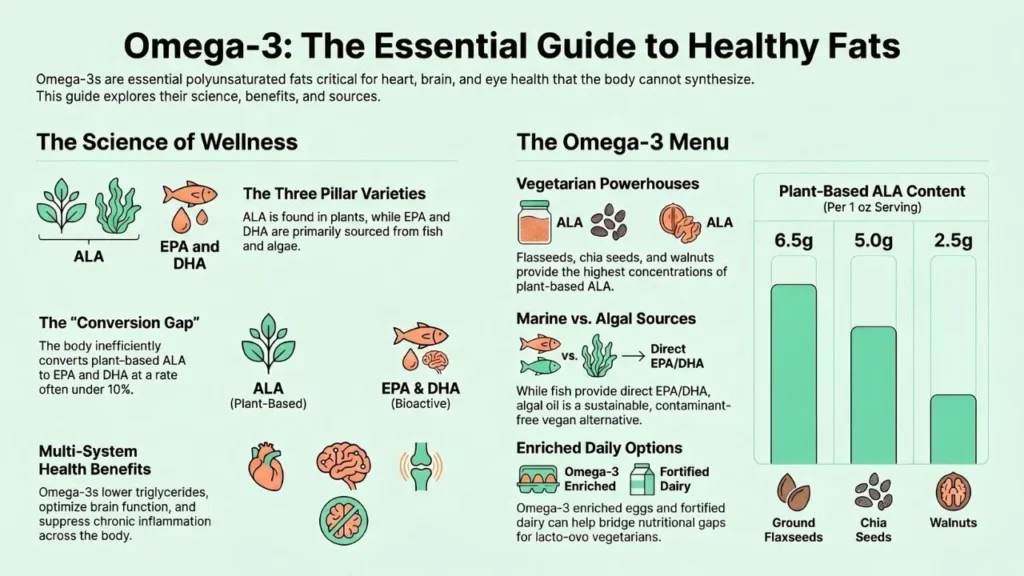
Omega fatty acids foods are essential fats, including Alpha-Linolenic Acid (ALA), Eicosapentaenoic Acid (EPA), and Docosahexaenoic Acid (DHA), that the body cannot produce on its own. Found in vegetarian sources like flaxseeds, chia seeds, and walnuts, and non-vegetarian sources like Indian mackerel and sardines, these fats are crucial for reducing inflammation, supporting heart health, and improving insulin sensitivity in diabetic individuals.
The Silent Nutritional Gap in the Modern Indian Thali
When I look at a typical Indian thali, it appears vibrant and balanced to the naked eye. You see the yellow of the dal, the green of the vegetables, and the white of the rice or the brown of the whole-wheat roti. However, beneath this visual harmony lies a deep nutritional silence regarding essential lipids. Research indicates that a staggering 76% of the global population, including a vast majority of Indians, falls short of the recommended intake for omega-3 fatty acids. Consequently, this is not just a statistic; it is a public health crisis that manifests as rising rates of heart disease and diabetes across our cities and towns.
What this means for your daily routine is that even if you are avoiding deep-fried snacks, your healthy home-cooked meal might be fueling inflammation. The culprit is often the choice of cooking oil. For decades, Indian kitchens have shifted away from traditional fats toward refined vegetable oils like sunflower, soybean, and palm oil. These oils are extremely high in omega-6 fatty acids. While we need some omega-6, having too much of it without enough omega-3 creates an imbalance that drives systemic inflammation, stiffens the arteries, and makes it harder for your cells to respond to insulin.
Dr. Alok Chopra, a cardiologist with four decades of experience, points out that the modern urban Indian diet is effectively starving for omega-3s while being drowned in omega-6. This imbalance is a primary reason why we see individuals who are skinny fat-having a normal body weight but high internal fat and metabolic markers that resemble obesity. By reintroducing omega fatty acids foods into your diet, you are essentially telling your body to stop the inflammatory cycle and start repairing its cellular membranes.

The Hierarchy of Omega-3: Understanding ALA, EPA, and DHA
Before we dive into what to buy at the local market, we need to understand that not all omega fatty acids foods are created equal. The family of omega-3s is divided into three main types, and knowing the difference helps you make smarter choices at the grocery store.
Alpha-Linolenic Acid (ALA)
ALA is the parent omega-3 and is found exclusively in plant-based foods. It is considered essential because your body cannot synthesize it. Think of ALA as the raw material. Once you consume it from sources like flaxseeds or walnuts, your body tries to convert it into the more active forms, EPA and DHA. However, this conversion process is quite inefficient. I know it sounds technical, but what it means for your daily routine is that if you are a strict vegetarian, you need to be very consistent with your intake because only about 5% to 15% of the ALA you eat actually becomes the high-powered EPA your heart needs.
Eicosapentaenoic Acid (EPA)
EPA is often called the heart’s friend. Its primary job is to produce signaling molecules called eicosanoids, which help reduce inflammation throughout the body. For someone struggling with the joint pain often associated with high blood sugar or the early stages of heart disease, EPA is the component that does the heavy lifting. Furthermore, it helps keep your blood vessels relaxed and prevents the stickiness in your blood that leads to clots.
Docosahexaenoic Acid (DHA)
DHA serves as the brain’s primary builder. It makes up a significant portion of your brain and the retina in your eyes. This is why these fats are so critical for pregnant people and growing children. For a busy professional, DHA is what keeps your cognitive function sharp and prevents that mid-afternoon brain fog. Unlike ALA, both EPA and DHA are found directly in marine sources like fish and certain types of algae.
| Omega-3 Type | Common Name | Primary Function | Primary Sources |
| ALA | Alpha-Linolenic Acid | Precursor/Energy | Flaxseeds, Walnuts, Chia Seeds, Mustard Oil |
| EPA | Eicosapentaenoic Acid | Anti-inflammatory | Fatty Fish (Mackerel, Sardines), Algal Oil |
| DHA | Docosahexaenoic Acid | Brain/Eye Structure | Fatty Fish, Indian Salmon, Algal Oil |

Vegetarian Powerhouses for the Indian Kitchen
I hear this all the time from my clients: I don’t eat fish, so am I doomed to be omega-3 deficient? The answer is a loud and clear No. While the conversion of plant-based fats is slower, Indian vegetarians have access to some of the richest ALA sources in the world. The secret is knowing how to prepare them to ensure your body actually absorbs the nutrients.
Flaxseeds (Alsi): The Golden Seed of the North
Flaxseeds are the heavyweights of the vegetarian omega fatty acids foods world. Just one tablespoon of these seeds contains about 2.3 grams of ALA, which is more than the daily requirement for most adults. Moreover, they are highly affordable and found in almost every local grocery store.
However, there is a catch that many people miss. If you sprinkle whole flaxseeds on your salad or curd, they will likely pass through your digestive system completely untouched because their outer shell is very tough. To get the benefits, you must grind them. I suggest grinding a small batch every week and storing it in an airtight container in the refrigerator. Why the fridge? Because these healthy fats are very sensitive to heat and light; they can turn rancid and bitter if left on the kitchen counter. A simple way to use them is to mix two tablespoons of ground flaxseed into your roti dough or stir it into your bowl of dal just before eating.
Walnuts (Akhrot): The Brain Snack
Walnuts are the only nuts that contain a significant amount of omega-3. While almonds are great for Vitamin E and fiber, they don’t help much with your omega balance. A handful of walnuts (about 7-8 halves) gives you 2.6 grams of ALA. For a professional who is always on calls, keeping a small jar of walnuts at your desk is a much better choice than reaching for biscuits or chips. They provide a steady sense of fullness and help keep your blood sugar from spiking.
Chia Seeds: The Modern Addition
While not a traditional Indian crop, chia seeds have become widely available in our cities. They are fantastic because, unlike flaxseeds, you don’t need to grind them, They are naturally protected and can be eaten whole, They also have a unique ability to soak up water and turn into a gel. For a homemaker who wants to keep the family hydrated and nourished, making a chia fresca (chia seeds in water with a squeeze of lemon and a drop of honey) is a perfect afternoon drink.
Traditional Indian Greens and Legumes
In addition to seeds, traditional Indian diets include subtle sources of ALA. Specifically, indigenous greens like Purslane (Kulfa) and Fenugreek (Methi) leaves contain small amounts of omega-3s. Similarly, legumes like Rajma (kidney beans) and soybeans contribute to your daily cumulative total. Half a cup of edamame (green soybeans) provides about 0.28 grams of ALA, which adds up throughout the day.
| Vegetarian Source | Serving Size | ALA Content (g) | Practical Indian Use |
| Flaxseed Oil | 1 tablespoon | 7.26 | Drizzle over warm dal (do not heat) |
| Chia Seeds | 1 ounce (28g) | 5.06 | Add to nimbu paani or curd |
| Walnuts | 1 ounce (28g) | 2.57 | Evening snack or in chutneys |
| Ground Flaxseeds | 1 tablespoon | 2.35 | Mix into roti dough (Atta) |
| Mustard Oil | 1 tablespoon | 0.80 | Traditional cooking oil for saag/curries |
| Soybeans (Boiled) | 1/2 cup | 0.50 | Use in salads or as a snack |

The Marine Advantage: Indian Fish Varieties
If you are a non-vegetarian, you have a direct path to the most potent forms of these fats. The coastal regions of India have a rich tradition of eating oily fish that are packed with EPA and DHA. You don’t need to look for imported salmon; our local markets have everything you need.
Indian Mackerel (Bangda)
Mackerel is perhaps the most famous of the omega fatty acids foods in the Indian con. It is an oily, salt-water fish that is widely available and very affordable. A 100g serving of Bangda provides about 1.5g to 2.6g of omega-3s. Because it is a small fish, it is also generally lower in mercury compared to larger fish like tuna.
Sardines (Mathi/Pedvey)
Sardines are the unsung heroes of the Indian coast. These tiny fish are powerhouses of nutrition. Not only are they rich in EPA and DHA (about 1.7g per 100g), but they also provide calcium and Vitamin D because we often eat them with their soft bones. For an older person struggling with both joint pain and heart health, sardines are an elite dietary choice.
Anchovies (Nethili)
In South India, Anchovies (Nethili) are highly prized for their density. Despite their small size, they contain approximately 2.2g of omega-3 per 100g. Consequently, they are an excellent option for those who want maximum nutrition in a small serving.
Hilsa (Ilish)
A favorite in Bengal and Odisha, Hilsa is a fatty fish that thrives during the monsoon. It contains roughly 1.8g of omega-3 per 100g. While it is a seasonal delicacy, its nutritional profile makes it worth the wait. The traditional preparation of Hilsa in mustard curry is a double-win because mustard seeds also contain small amounts of ALA.
| Indian Fish Name | Omega-3 Content (g/100g) | Regional Availability | Best Cooking Method |
| Anchovies (Nethili) | 2.2 | South India/Coastal | Light pan-fry or dry curry |
| Indian Salmon (Rawas) | 2.0 | West Coast/Urban Markets | Grilled or baked |
| Hilsa (Ilish) | 1.8 | East India/Bengal | Mustard-based curry (steamed) |
| Sardines (Mathi) | 1.7 | South/West Coast | Coconut-based curry |
| Mackerel (Bangda) | 1.5 | Pan-India (Frozen/Fresh) | Grilled or Tandoori style |
| Rohu (Rui) | 1.0 | North/East India | Light curry or steamed |

The Diabetes Connection: Why Omega-3 is Your Secret Weapon
Managing diabetes is often a struggle of counting carbohydrates and worrying about sugar spikes. But what if I told you that the type of fat you eat is just as important as the type of flour in your roti? This is where omega fatty acids foods become a critical part of your nutrition therapy.
Cooling the Silent Fire of Inflammation
Diabetes is essentially a state of chronic inflammation. This inflammation makes it harder for your insulin to do its job. Omega-3s act like a natural anti-inflammatory, helping to cool down the system. When your body is less inflamed, your cells become more sensitive to insulin. What this means for your daily routine is that adding these fats might help stabilize your blood sugar over the long term, even if you don’t see an immediate drop on your glucometer.
The Triglyceride Triumph
One of the most common issues for Indians with diabetes is high triglyceride levels. High triglycerides, combined with low good (HDL) cholesterol, is a recipe for heart disease. Clinical trials have repeatedly shown that high-dose omega-3 (EPA/DHA) can lower triglycerides by 20% to 50%. For a professional who sits at a desk all day and has high lipid markers, increasing fish intake or using a high-quality supplement under medical supervision can be a game-changer.
Protecting the Diabetic Heart
People with diabetes are at a significantly higher risk for heart attacks and strokes. Omega-3s help the heart maintain a steady rhythm and prevent the development of erratic heartbeats (arrhythmias) which can be fatal. Furthermore, these fats help improve the function of the blood vessel lining (the endothelium). Think of your blood vessels like a highway; omega-3s keep the road smooth so the blood can flow without causing traffic jams or accidents.

The 2024 ICMR-NIN Roadmap: New Guidelines for Indians
The Indian Council of Medical Research (ICMR) and the National Institute of Nutrition (NIN) recently released their updated 2024 dietary guidelines, and the focus on fat quality is stronger than ever. The experts have recognized that we are moving toward a period where chronic lifestyle diseases are our biggest challenge.
The new guidelines advocate for a My Plate for the Day model, where half of your plate should be vegetables and fruits. But more importantly, they emphasize getting your fats from visible and invisible sources.
- Visible Fats: The oils you use for cooking. The recommendation is to limit this to 20-50g per day, depending on your activity level.
- Invisible Fats: These are the fats found naturally in nuts, oilseeds, and legumes. The guidelines specifically suggest including a variety of these omega fatty acids foods to meet your daily requirement of 2.2g of n-3 (omega-3) and 6.6g of n-6 (omega-6).
Consequently, we need to move away from the one oil for everything approach. Using a rotation of oils-like mustard oil for some dishes and perhaps a little ghee or cold-pressed sesame oil for others-helps ensure a better balance of fatty acids.
| Category | ICMR-NIN 2024 Recommendation | Significance |
| Visible Fat | 27g per day (for a 2000 kcal diet) | Reduces obesity risk and fatty liver |
| Omega-3 (n-3) | 2.2g per day | Essential for heart and brain protection |
| Vegetable Intake | 400g per day | Provides cofactors for fat metabolism |
| Cooking Method | Steaming, Boiling, Pressure Cooking | Preserves heat-sensitive omega fats |
| Salt Intake | <5g per day | Aligned with WHO for hypertension |

Scientific Hacks: Maximizing Your Omega-3 Absorption
I know it’s frustrating to eat healthy and not see results. Sometimes, it’s not what you’re eating, but how you’re eating it. Here are some research-backed hacks to make your omega fatty acids foods work harder for you.
The Turmeric (Curcumin) Synergy
In India, we are lucky to have turmeric as a staple. Modern research has found something fascinating: Curcumin, the active compound in turmeric, actually increases the synthesis of DHA from ALA in both the liver and brain. This is a massive win for vegetarians! By adding a pinch of turmeric to your flaxseed-enriched curd or using it in your walnut-based chutneys, you are giving your body the tools to build a better brain.
Avoid the Deep Fry Trap
Omega-3 fatty acids are incredibly delicate. They have multiple double bonds that break down when exposed to high heat. Therefore, if you take a piece of mackerel and deep-fry it, you are destroying the very nutrients you bought it for. Instead, favor steaming, poaching, or light pan-searing. A traditional Bengali Shorshe Ilish (steamed Hilsa in mustard) is a nutritional masterpiece because the gentle heat preserves the oils.
The Omega-6 Competition
Think of your body’s enzymes like a busy highway. Both omega-6 and omega-3 use the same pathway to get converted. If your diet is packed with too much omega-6 from refined oils, the highway gets jammed, and the omega-3 never reaches its destination. To get the most from your omega fatty acids foods, you must lower your intake of ultra-processed snacks. This clears the road for the heart-healthy omega-3s to do their work.

Practical Meal Planning for Busy Professionals
I know your mornings are a whirlwind. Whether you’re rushing for a meeting or getting kids ready, health often takes a backseat. However, the beauty of omega fatty acids foods is that they are very meal-prep friendly.
The Prep Once, Eat All Week Strategy
- The Flax-Atta Hack: On Sunday, grind a cup of flaxseeds. Mix it into your 5kg bag of atta. Now, every single roti your family eats is automatically an omega-3 powerhouse.
- The Sprout Jar: Layer sprouted moong, veggies, and lemon dressing in jars for a grab-and-shake breakfast.
- The Morning Jar: In a small jar, mix 2 tablespoons of chia seeds with curd and pomegranate seeds. Leave it in the fridge overnight for a creamy, ready-to-go meal.
Dining Out and Travel
When you’re at a business lunch, look for grilled fish instead of fried options. If you’re at a vegetarian restaurant, a bean-based salad or a dish containing walnuts is your best bet. If all else fails, carrying a small pouch of walnuts in your laptop bag is a lifesaver. It prevents you from reaching for the office biscuits.

The Homemaker’s Guide: Nutrient-Dense Family Meals
If you are managing the kitchen for the whole family, you don’t need to cook separate meals. The principles of incorporating omega fatty acids foods actually benefit everyone-from the kids’ brain development to the grandparents’ heart health.
Regional Swaps for Health
- North India: Swap sunflower oil for mustard oil in your sarson ka saag. Add crushed walnuts to your stuffed parathas for a nutty crunch.
- South India: Use sardines or mackerel in your traditional tamarind curries. Similarly, try adding ground flaxseed to your idli batter to boost its nutritional profile without altering the taste.
- West India: Incorporate flaxseed chutney (Alsi ki chutney) into your daily meals. It’s a traditional Maharashtrian staple that is one of the cheapest ways to get your omega-3s.
- East India: Continue the tradition of using mustard oil and enjoying Hilsa or Rohu, but try to steam the fish rather than deep-frying it.
Managing Kids and Picky Eaters
Kids often won’t eat a bowl of flaxseeds, but they love a smoothie. Simply blend a banana, curd, and a tablespoon of ground flaxseed. Furthermore, homemade chikki made with jaggery, peanuts, and walnuts is a much better alternative to packaged candies.

Common Myths and Misconceptions
There is a lot of noise on the internet about fats. Let’s clear up some of the most common myths I hear in my practice.
Myth 1: Ghee is the best source of omega-3. While traditional ghee has many benefits and is much better than refined oils, it only contains trace amounts of omega-3. Therefore, you cannot rely on ghee alone to meet your requirements.
Myth 2: Vegetarian omega-3 is useless because it doesn’t convert.
This is simply not true. While the conversion is lower, it is still meaningful. Research shows that people who eat plenty of ALA-rich plant foods have a significantly lower risk of heart disease and diabetes.
Myth 3: I take a multivitamin, so I’m covered.
Most standard multivitamins do not contain omega-3 fatty acids because these are oils, not powders. You need to either get them from your food or take a specific algal or fish oil supplement.
The Road Ahead: Building a Sustainable Habit
I know it can feel overwhelming to change your diet. The key is not to do everything at once. Instead, let’s look at your daily routine and find the low-hanging fruit. What is the one thing you can start today?
Perhaps it’s buying a packet of flaxseeds and grinding them this evening. In addition, you might choose mackerel at the fish market this weekend instead of the usual fried pomfret. Or, maybe it’s simply swapping your mid-day biscuit for three whole walnuts.
These small shifts create a ripple effect. When you eat more omega fatty acids foods, you feel more satiated. When you feel satiated, you eat fewer sugary snacks. Consequently, your inflammation goes down. I want you to view your food as nutrition therapy. Every meal is an opportunity to either fuel the fire of inflammation or to cool it down.
Frequently Asked Questions
Q1: How much omega fatty acids foods do I need daily if I have diabetes?
While the ICMR-NIN recommends 2.2g of ALA per day, many experts suggest that people with metabolic issues should aim for a higher intake or supplement with 1-2g of EPA/DHA under a doctor’s guidance to help lower triglycerides.
Q2: Can children eat flaxseeds and chia seeds?
Yes, absolutely. These are great for their brain development. Just ensure flaxseeds are ground so their small systems can absorb the nutrients. Start with small amounts to let their digestion adjust.
Q3: Is algal oil a good option for vegetarians?
Yes! Algal oil is a fantastic modern solution. It provides direct EPA and DHA, bypassing the conversion struggle of ALA.
Q4: Should I worry about the fishy smell of mackerel and sardines?
Fresh fish should smell like the sea, not fishy. To minimize odor, use aromatics like ginger, garlic, and lemon juice. These also add anti-inflammatory benefits to your meal.
Q5: Will eating these fats make me gain weight?
Fat is calorie-dense, but omega-3s are rarely stored as body fat. Instead, they are used to build cell membranes and hormones. Because they help you feel full, they often help with weight management over time.
Conclusion: Your Next Step to Metabolic Health
I’ve shared a lot of science with you today, but at the heart of it all is a very simple message: Your body wants to be healthy, and it just needs the right building blocks. By prioritizing omega fatty acids foods, you are giving your heart, brain, and metabolism the protection they deserve. I know you’re busy, but taking five minutes to prep your flaxseeds or walnuts today is an investment that pays off for years.
If you’re feeling a bit lost about how to fit this into your specific health situation-especially if you’re balancing diabetes with a hectic job-let’s talk. At DietDekho, we specialize in making these clinical insights practical for the Indian lifestyle. We don’t believe in starvation diets; we believe in smart nutrition.
Let’s simplify your journey today
Contact Us
We understand how overwhelming nutrition and weight loss information can feel. With so many opinions and confusing advice online, it’s easy to feel stuck or unsure about what to do next.
At Diet Dekho, you never have to figure it out alone. You can contact us anytime with any questions or concerns. Our expert dietitians are available 24/7 to guide, support, and help you stay on track. Whether your goal is weight loss or building healthier habits, we’re here to make the journey simpler and more sustainable for you.
Disclaimer
This blog is intended to help readers make healthier food choices. Your health should always be the top priority. Before starting any restrictive or special diet, especially if you have a medical condition or health concern, please consult a doctor or a qualified dietitian. Each body responds differently to food and lifestyle changes. Always choose what is safe and suitable for you.

Abhinav is the Founder of Diet Dekho, helping people manage weight and lifestyle health through simple, practical nutrition and personalized diet plans.