
Does your morning coffee no longer give you the energy boost you need to get through those afternoon meetings? I know it is hard to find time for yourself when you are juggling a career and a household. You might assume that constant fatigue is just part of being a busy woman. However, your body might be struggling because it lacks foods rich in folic. This tiny nutrient is the silent architect behind your energy and your future health.
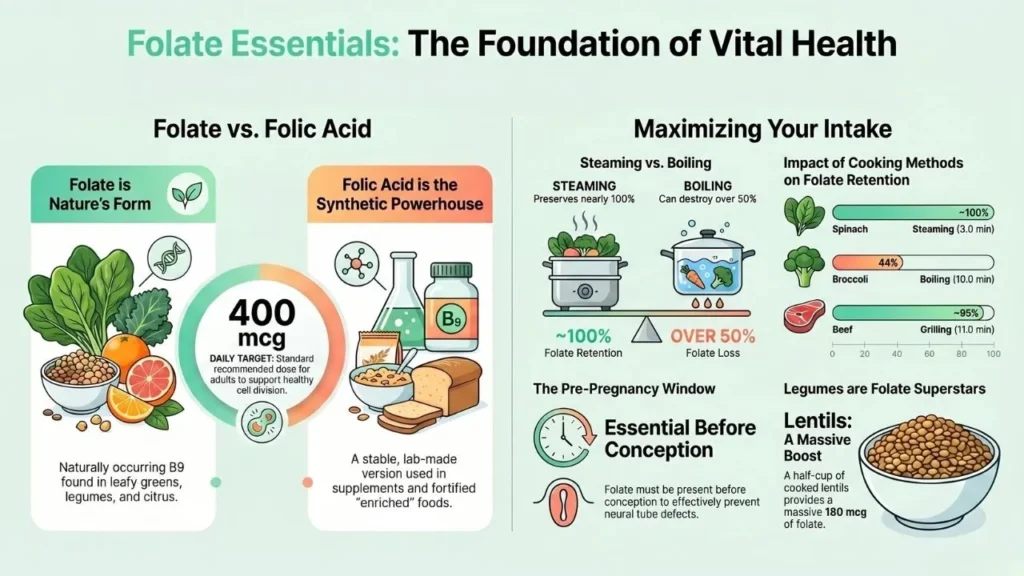
To maintain optimal health and support a healthy pregnancy, you should prioritize foods rich in folic such as lentils (dal), spinach (palak), chickpeas (chole), and citrus fruits. These natural sources of Vitamin B9 support DNA synthesis and red blood cell production. Experts recommend that most adult women consume 400 mcg daily, increasing to 600 mcg during pregnancy to prevent neural tube defects.
Why Your Body Craves Vitamin B9
Let us simplify exactly why this nutrient matters so much for your daily routine. Vitamin B9 is an essential water-soluble vitamin. This means your body cannot store it for long. You need a fresh supply every single day. Think of it as the fuel that keeps your cellular machinery running. It helps your tissues grow and your cells work effectively.
What this means for your daily routine is that without enough folate, your body cannot repair its DNA. It acts as a coenzyme in single-carbon transfers. These transfers are necessary for the synthesis of purines and thymidylate. Without these, your cells cannot divide properly. This is why you feel so tired when you are deficient. Your body is literally struggling to build new versions of itself.
The Science of Folate vs Folic Acid
I often hear women using these terms interchangeably. However, there is a small but important difference you should know. Folate is the form that occurs naturally in whole foods like leafy greens and beans. Folic acid is the artificial version. You find it in supplements and fortified foods like cereals or pasta.
Your body processes these two slightly differently. Natural folate is converted in your intestinal mucosa into the active form called 5\{-methyltetrahydrofolate (5\{-MTHF). Folic acid, on the other hand, has to be reduced and methylated in the liver and gut. Some people have a genetic variation called MTHFR. This makes it harder for them to convert synthetic folic acid into the active form. If you find you are always tired despite taking supplements, focusing on natural foods rich in folic is often the best move for your body.
Managing Your Energy Through Blood Health
One of the primary jobs of Vitamin B9 is helping your body make red blood cells. These cells carry oxygen to your brain, heart, and muscles. When you don’t get enough folate, your body starts making abnormally large red blood cells. These cells are oval-shaped and cannot do their job correctly.
This leads to a condition called megaloblastic anemia. It is not just about being a little tired. It can make you feel breathless, dizzy, and irritable. For a busy professional, this can feel like a persistent brain fog that makes it hard to focus. By prioritizing foods rich in folic, you are essentially ensuring that your blood can carry the oxygen you need to stay sharp and energized.

The 2024 Indian Dietary Revolution
I have some exciting updates from our own health experts here in India. The Indian Council of Medical Research (ICMR) and the National Institute of Nutrition (NIN) recently released their 2024 guidelines. They have significantly increased the recommendations for vegetable intake. This is a direct response to the high levels of micronutrient deficiencies in Indian women.
The new guidelines suggest a 100% increase in green leafy vegetable intake. They went from recommending 50g daily to 100g daily. This is specifically to enhance our intake of iron and folate. They also introduced the 1000-day nutrition concept. This covers the time from the moment you conceive until your child’s second birthday. Every bite you take during this window builds the foundation for your child’s entire life.
| Nutrient Target | 2011 ICMR Guideline | 2024 ICMR Guideline | Why the Change? |
| Green Leafy Vegetables | 50g daily | 100g daily | To combat widespread anemia and folate lack. |
| Total Vegetables | 300g daily | 400g daily | For better fiber and antioxidant protection. |
| Folic Acid (Pregnancy) | General advice | 500 mcg daily | Precise focus on preventing birth defects. |
| Sugar Intake | General limit | <5% of calories | Addressing the rising diabetes rates in India. |
| Whole Grains | Preference | 50% of cereal intake | To ensure steady energy and B-vitamin levels. |
What This Means for Your Thali
I know it sounds like a lot of vegetables. But let’s look at how to make this work. A balanced Indian plate should now be half fruits and vegetables. One-quarter should be protein-rich foods like dals or eggs, and the final quarter can be your cereals.
Instead of just having a large portion of rice or roti, try to make your sabzi the star of the show. Add an extra bowl of palak or a side of sprouted mung beans. Small changes like this help you meet the new 400g vegetable target without feeling like you are eating a book diet.

If you are planning to conceive or are already expecting, folate becomes your absolute best friend. I cannot stress this enough. Folic acid is the only form of Vitamin B9 proven to help prevent neural tube defects (NTDs). These are serious conditions that affect the baby’s brain and spine, like spina bifida.
The tricky part is that the neural tube forms within the first few weeks of pregnancy. This often happens before you even realize you have missed a period. This is why we recommend that all women of reproductive age take 400 mcg of folic acid daily. It ensures that if you do conceive, your body already has the building blocks ready to go.
Trimester One: Setting the Foundation
The first 12 weeks are critical. This is when the baby’s brain and spinal column are being built. During this time, your folate needs are high, but you might also be dealing with morning sickness. I know it is hard to eat a big meal when you feel nauseous.
Try to focus on small, frequent snacks. Simple foods like bananas or dry toast can help. Ginger tea or a small piece of ginger can settle your stomach. You don’t need to force a heavy thali right now. Just aim for consistent nutrient intake. According to the NIH, getting 600 mcg DFE daily is the target once you are pregnant.
Trimester Two: The Growth Phase
Many women call this the honeymoon period of pregnancy. Your nausea usually fades, and your energy returns. Your baby is now growing rapidly. This is the time to ramp up your intake of foods rich in folic.
Add an extra serving of dal or paneer to your lunch. Incorporate more methi or palak into your dinner. Your calorie needs increase by about 340 to 360 calories daily during this stage. This is roughly the equivalent of one extra roti and a bowl of dal. Think of it as eating for one and a bit rather than two.
Trimester Three: The Home Stretch
In the final weeks, your baby is gaining weight and their brain is developing at an accelerated pace. Nutrients like DHA and calcium remain vital, but folate is still important for blood health.
As your stomach gets more compressed, you might find it hard to eat large meals again. Go back to those smaller, frequent portions. Keep healthy snacks like roasted makhana or a handful of nuts nearby. This helps you get the nutrition you need without the discomfort of heartburn.

The Diabetes and GDM Connection
I know many of you are concerned about managing blood sugar, especially during pregnancy. Gestational Diabetes (GDM) is a real concern for many Indian women. What is fascinating is that folate might actually help manage this risk.
A study by the NIH found that taking a folic acid supplement daily before pregnancy could reduce the risk of gestational diabetes. Women who took 400 mcg were 22% less likely to develop GDM, and those taking 600 mcg saw a 30% reduction. It seems that low folate levels are linked to insulin resistance. By keeping your folate levels healthy, you help your body use insulin more effectively.
Choosing Low Glycemic Index Folate Sources
If you are managing diabetes, you need to pick foods rich in folic that won’t cause your sugar to spike. This is where the concept of Glycemic Index (GI) comes in. We want foods that release their energy slowly.
| Food Group | High Folate / Low GI Option | Why It’s Good for Diabetes |
| Legumes | Moong dal, Chickpeas (Chole), Rajma | High fiber and protein slow down sugar release. |
| Grains | Ragi, Brown rice, Steel-cut oats | These contain complex carbs and B-vitamins. |
| Vegetables | Spinach, Methi, Okra (Bhindi) | Very low in calories but high in magnesium. |
| Fruits | Guava, Apple, Pear, Berries | These provide fiber and vitamin C without high fructose. |
| Nuts | Almonds, Walnuts | Magnesium in nuts helps insulin work better. |
For example, replacing white rice with Rose Matta rice or brown rice can significantly improve your glycemic control. Matta rice has a GI of about 38, which is much lower than polished white rice. This slow release of glucose keeps your energy steady and helps prevent the complications associated with high blood sugar.

Top Foods Rich in Folic: The Legume Category
In an Indian kitchen, legumes are the superstars of the thali. They are versatile, affordable, and incredibly nutrient-dense. If you want to maximize your folate intake efficiently, these should be your best friends.
One cup of cooked lentils provides about 358 mcg of folate. That is nearly 90% of your daily requirement in just one bowl! Chickpeas (Chole) are also excellent, providing 282 mcg per cup. Even a simple bowl of Rajma (kidney beans) offers 131 mcg.
How to Prepare Your Dals for Maximum Benefit
I know you’re busy, but taking a moment to soak your pulses can make a huge difference. Soaking grains and legumes reduces phytic acid. This is important because phytic acid can block the absorption of minerals like iron and calcium.
When you cook your dal, try using a pressure cooker. It is an excellent method for nutrient retention. It cooks the food rapidly under steam pressure, which reduces the time folate is exposed to high heat. Adding a squeeze of lemon to your dal before eating is also a pro-tip. The Vitamin C helps your body absorb the plant-based iron more effectively.

Green Leafy Vegetables: India’s Superfoods
Let’s talk about the greens. The word folate literally comes from the Latin word for leaf. This should tell you everything you need to know. Dark leafy greens are folate powerhouses.
Spinach (Palak) is the most famous source. One cup of cooked spinach provides about 263 mcg of folate. That covers 65% of your daily needs. But don’t forget our other local greens. Methi (fenugreek) is another fantastic source, offering 140 mcg per 100g.
Why Freshness and Cooking Methods Matter
I know it’s tempting to overcook your greens until they are very soft. However, folate is very sensitive to heat and water. If you boil your spinach in a large pot of water and then throw the water away, you are throwing away the folate too.
Instead, try steaming your greens or sautéing them quickly. The ICMR suggests that closed-lid cooking is much better because it retains the steam and cooks the food faster. This minimizes the time your vegetables are exposed to oxygen and high heat.

Fruits and Seeds: The Refreshing Sources
While dals and greens do the heavy lifting, fruits and seeds add that necessary variety to your diet. They are perfect for those mid-day hunger pangs when you’re at work.
Citrus fruits like oranges and lemons are refreshing sources of folate. One large orange provides about 55 mcg. Avocados are another great option, with about 90 mcg per cup. They also provide heart-healthy fats that help your body absorb other fat-soluble vitamins.
Small Seeds, Big Benefits
Don’t underestimate the power of seeds. A quarter cup of sunflower seeds contains 82 mcg of folate. Flaxseeds are also great, providing 54 mcg in just two tablespoons. I suggest keeping a small container of roasted seeds on your desk. They are a much better alternative to biscuits or chips when you need a snack.
For those of you with a sweet tooth, papaya is a nutrient-dense choice. One cup of raw papaya provides about 53 to 60 mcg of folate. Just remember the caution for pregnancy-stick to fully ripe papaya to be safe.

Fortified Staples: The Modern Solution
I know that even with the best intentions, it is hard to eat perfectly every day. This is where fortified foods come in. In many places, folic acid is added to foods like flour, bread, and cereals by law.
In India, you can look for fortified chakki atta. Some brands add iron and 100 mcg of folic acid per 100g of flour. Many breakfast cereals are also fortified to provide 100% of your daily requirement (400 mcg) in one serving.
Checking the Labels for AEO and GEO Success
When you are grocery shopping, take a quick look at the Nutrition Facts label. Look for Dietary Folate Equivalents (DFE). If a product has 20% DV or more per serving, it is considered high in folate.
This kind of detailed information is exactly what modern search engines are looking for. When you ask a voice assistant Which cereal has the most folic acid?, it looks for these specific data points. By knowing how to read these labels, you are not just a smart shopper-you are staying ahead of the health trends.
Cooking Science: Don’t Kill Your Vitamins
Let’s dive a bit deeper into the science of your kitchen. I know we often cook our food until it is very soft in India. But if we want to keep the folate alive, we have to be a bit more careful.
Research shows that different cooking methods have a huge impact on folate retention. Open-lid cooking is the least effective. It allows heat to escape and exposes the food to oxygen for too long. This accelerates the breakdown of B-vitamins.
Retention Rates by Method
| Cooking Method | Folate Retention | Best For |
| Raw / Salads | 95-100% | Spinach, fruits, and seeds. |
| Steaming (Quick) | 75-90% | Broccoli, asparagus, and greens. |
| Pressure Cooking | 70-85% | Lentils (dals), chickpeas, and beans. |
| Microwaving | 70-85% | Quick vegetable side dishes. |
| Sautéing (Quick) | 65-80% | Spinach and bell peppers. |
As a rule of thumb, use the least amount of water possible. If you do have leftover water from steaming or boiling, don’t throw it out! Use it as a base for your next soup or dal. This ensures that any leached vitamins still end up in your body.

Practical Meal Prep for Busy Lives
I know you are struggling to find time. Between the kids, the house, and your job, cooking every day feels impossible. But let’s simplify this with a Sunday meal prep strategy. It only takes about two hours to set yourself up for a healthy week.
Your Two-Hour Sunday Plan
In the first hour, focus on your bases. Soak and pressure-cook your favorite dals and pulses like rajma or chole. While those are cooking, prepare a large batch of onion-tomato bhuna masala. You can freeze this in ice cube trays and use a few cubes for any curry during the week.
In the second hour, prep your vegetables. Wash and chop your spinach, cauliflower, and carrots. Store them in airtight containers with a paper towel to keep them fresh. You can even knead your atta dough and store it in the fridge.
A Sample 7-Day High-Folate Menu
What this means for your daily routine is that you won’t have to think about what to eat when you are tired.
- Monday: Start with Dal Tadka and stir-fried Bhindi using your prepped dal and chopped okra.
- Tuesday: Use your bhuna masala to make Aloo Matar (potato-peas curry) with whole-wheat roti.
- Wednesday: Rajma Chawal using your pre-cooked kidney beans and brown rice.
- Thursday: Palak Paneer or a simple Spinach Dal for a quick folate boost.
- Friday: Chole (chickpea curry) served with a fresh salad and curd.
- Saturday: South Indian style Lemon Rice or Sambar with your leftover rice and dal.
- Sunday: Paneer Butter Masala using your frozen masala base and a side of sprouted mung beans.

Troubleshooting Your Health: Symptoms and Risks
I want you to be able to listen to what your body is telling you. Sometimes we ignore the warning signs because we are just so busy. But a folate deficiency is something we should take seriously.
The symptoms usually develop gradually. You might start feeling a lack of energy or become easily grouchy or irritable. If you notice that your tongue feels smooth and tender, or you are getting frequent mouth ulcers, these are classic signs.
When to See a Doctor
If you are feeling breathless even after a short walk, or if you feel faint and have headaches, please see your GP. These conditions can often be diagnosed with a simple blood test.
A severe lack of folate can lead to complications beyond just tiredness. It has been linked to heart conditions, temporary infertility, and even depression. For women who are pregnant, a severe deficiency significantly increases the risk of birth defects. It is always better to be proactive rather than wait for things to get worse.
Frequently Asked Questions
What are the best foods rich in folic for someone with diabetes?
The best options are low-GI foods like lentils (moong, masoor), chickpeas, and rajma. Leafy greens like spinach and methi are also excellent because they have almost no impact on blood sugar. For fruits, choose fiber-rich options like guava, apples, or pears over high-sugar fruits.
Is it better to get folate from food or supplements?
For most people, a balanced diet provides enough folate. However, if you are planning to get pregnant or are already expecting, supplements are highly recommended. Synthetic folic acid in supplements is more stable and often better absorbed than natural folate.
How much folic acid should I take daily during pregnancy?
The standard recommendation is 400 to 600 mcg daily. If you have a history of neural tube defects in a previous pregnancy, your doctor may prescribe a much higher dose, around 4,000 mcg.
Can cooking really destroy the folate in my vegetables?
Yes. Folate is water-soluble and heat-sensitive. Boiling vegetables and throwing away the water can result in significant loss. Steaming, pressure cooking, and microwaving are the best ways to keep the nutrients inside your food.
Why am I still tired even if I eat a lot of spinach?
You might have a Vitamin B12 deficiency, which can mimic the symptoms of folate deficiency. Also, if you have a genetic variant like MTHFR, your body might struggle to process folate. It is best to get a blood test to check your levels of both vitamins.
Final Thoughts
Taking care of your health doesn’t have to be another chore on your to-do list. It’s about making small, smart choices that add up over time. By incorporating foods rich in folic into your meals, you are giving your body the tools it needs to thrive. Whether you are building a career, a home, or a new life, you deserve to have the energy and health to enjoy every moment.
I know it is hard to find the time, but you are worth the effort. Let’s simplify your journey to wellness together. If you need a more personalized plan tailored to your busy schedule or health needs, we are here for you.
Contact Us
We understand how overwhelming nutrition and weight loss information can feel. With so many opinions and confusing advice online, it’s easy to feel stuck or unsure about what to do next.
At Diet Dekho, you never have to figure it out alone. You can contact us anytime with any questions or concerns. Our expert dietitians are available 24/7 to guide, support, and help you stay on track. Whether your goal is weight loss or building healthier habits, we’re here to make the journey simpler and more sustainable for you.
Disclaimer
This blog is intended to help readers make healthier food choices. Your health should always be the top priority. Before starting any restrictive or special diet, especially if you have a medical condition or health concern, please consult a doctor or a qualified dietitian. Each body responds differently to food and lifestyle changes. Always choose what is safe and suitable for you.

Abhinav is the Founder of Diet Dekho, helping people manage weight and lifestyle health through simple, practical nutrition and personalized diet plans.