Imagine you are sitting at your kitchen table after a long day of back-to-back meetings, feeling a sense of exhaustion that sleep just doesn’t seem to touch. You notice your hair feels a bit thinner lately, or perhaps that small scratch on your hand from last week is still lingering. For many of my clients at DietDekho, especially those managing fluctuating blood sugar, finding the right zinc enriched food is often the missing piece of the puzzle that helps them reclaim their energy and health without adding more stress to their busy schedules.
For a quick and reliable fix, the best sources of zinc enriched food for vegetarians include pumpkin seeds, chickpeas, lentils, and dairy products like paneer or curd. To ensure your body actually absorbs this mineral, prioritize soaking or sprouting your legumes and seeds. These simple adjustments support insulin function and immune resilience, making them essential for managing diabetes and daily fatigue.
Why We Need to Talk About Zinc Right Now
When we sit down to discuss your health, we often focus on the big players like protein or carbohydrates, but zinc is that quiet, hardworking friend that keeps the entire system running behind the scenes. Think of it as a supervisor in a massive factory; it doesn’t do all the heavy lifting itself, but without it, the workers don’t know where to go. In scientific terms, zinc is a cofactor for over 300 enzymes that regulate everything from how you digest your dinner to how your nerves send signals to your brain.
What this means for your daily routine is that zinc is deeply involved in how your body handles the food you eat. It plays a structural role in your cell membranes, ensuring they are strong enough to protect your internal machinery from oxidative stress. For my friends who are managing diabetes, this is particularly important because that oxidative stress is often what leads to the long-term complications we want to avoid.
The latest 2024 guidelines from the Indian Council of Medical Research (ICMR) and the National Institute of Nutrition (NIN) have highlighted a shift in how we look at these micronutrients. They have moved toward a more food-based approach, encouraging us to look at our plates as a source of medicine. As we see more people in urban India struggling with the double burden of over-nutrition and under-nutrition, ensuring we get enough of these trace minerals becomes a priority for every household.

Understanding the Zinc Gap in India
I know it is hard to find time to track every single milligram of what you eat, but the data suggests that many of us are falling short. In India, we are seeing a significant zinc gap, particularly among adolescents and adults who rely heavily on plant-based diets. Recent surveys like the Comprehensive National Nutrition Survey (CNNS) show that over 31% of adolescents are struggling with low serum zinc levels.
This isn’t just a number on a report; it translates to kids who aren’t reaching their full height potential and adults who find themselves catching every cold that goes around the office. In my experience, for busy professionals who can’t afford a sick day, this vulnerability is a major hurdle. The reason for this gap is often found in our traditional staples like rice and wheat, which, while delicious, are often polished or processed in ways that remove the mineral-rich outer layers.
| Demographic Group | Estimated Zinc Deficiency Prevalence (%) | Primary Health Concern |
| Adolescents (10–19 years) | 31.1% – 32.0% | Stunted growth and delayed maturation |
| Preschool Children (1–4 years) | 17.0% – 19.0% | Increased risk of diarrhea and infections |
| Tribal Populations (Adults/Adolescents) | 34.4% – 57.5% | Severe dietary inadequacy and poor bioavailability |
| Pregnant population | High (Variable) | Fetal development and low birth weight |
The Special Connection Between Zinc and Diabetes
Let’s simplify one of the most complex parts of how your body works: the relationship between zinc and insulin. I want you to visualize insulin as a key that opens the doors of your cells to let sugar in. In the pancreas, specifically within the \beta-cells, your body doesn’t just store insulin as loose molecules; it packages them into neat, stable structures called hexamers.
Each of these packages requires two zinc ions (Zn^2+) to hold six insulin molecules together. If you don’t have enough zinc, your pancreas struggles to manufacture and release these keys properly. This can lead to what we call insulin resistance, where the doors to your cells stay locked, and sugar begins to build up in your bloodstream.
What this means for your daily routine is that by choosing a zinc enriched food, you are essentially giving your pancreas the raw materials it needs to manage your blood sugar. Clinical studies have actually shown that when people with Type 2 Diabetes (T2DM) ensure they have adequate zinc, their fasting blood glucose levels and HbA1c (the three-month average of blood sugar) tend to improve.
How Zinc Protects Your Pancreas
Beyond just helping with insulin storage, zinc acts as a protective shield for your beta-cells. These cells are extremely sensitive to inflammation and oxidative damage, which is common in people with diabetes. Zinc helps by inducing the production of metallothioneins-proteins that act like sponges, soaking up harmful free radicals before they can cause damage.
| Clinical Marker | Impact of Zinc on Diabetes Management | Mechanism |
| HbA1c | Reduction of 0.4% – 0.8% | Improved long-term glycemic control |
| Fasting Glucose | Reduction of 20 mg/dL | Better baseline blood sugar regulation |
| Lipid Profile | Reduction in LDL and Triglycerides | Cardiovascular protection for diabetics |
| Insulin Sensitivity | Increased Akt/PI3K signaling | Enhanced glucose uptake by muscles |
I often tell my clients that zinc is almost like a natural insulin mimetic. It helps activate the signaling pathways that tell your muscles to take in glucose even when insulin isn’t working perfectly. This is a game-changer for those of us who are trying to manage pre-diabetes or early-stage Type 2 Diabetes through diet and lifestyle alone.
Identifying the Best Vegetarian Zinc Sources
I know it can feel like a challenge to get enough minerals on a vegetarian diet, but we actually have some incredible zinc bombs right in our local Indian markets. You don’t need expensive imports; you just need to know which local foods to prioritize. Let’s break down the heavy hitters that you can start adding to your cart this week.
The Power of Seeds: Tiny but Mighty
Seeds are perhaps the most concentrated source of zinc available to us. For a homemaker or a busy professional, these are the easiest things to sprinkle over a meal or keep in a desk drawer.
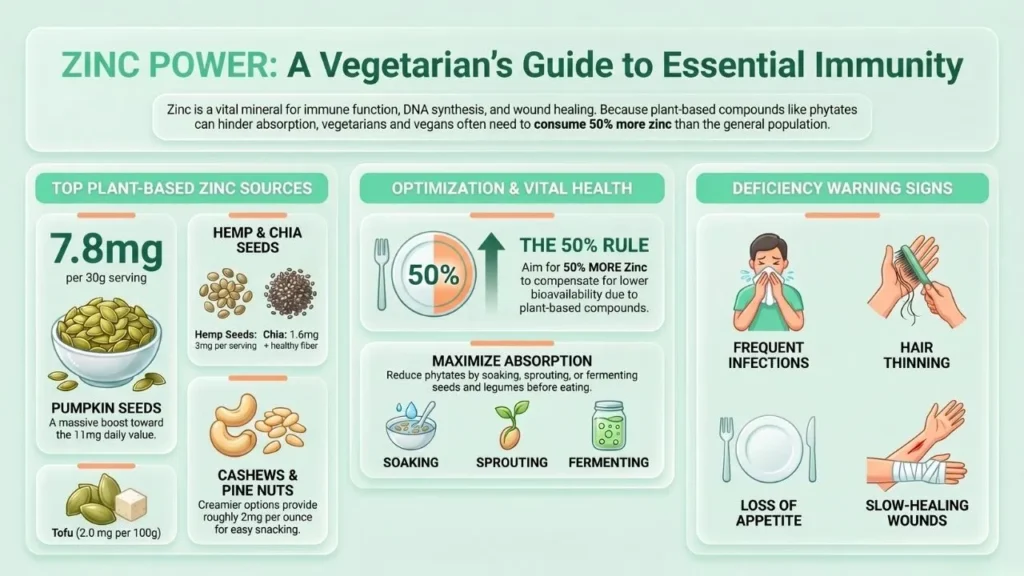
- Pumpkin Seeds (Kaddu ke Beej): These are the gold standard. Just a small handful (about 28 grams) can give you nearly 2.2 mg of zinc, which is about 20% of what an adult needs daily.
- Watermelon Seeds: Don’t throw these away! If you can find the dried versions, they are actually higher in zinc than pumpkin seeds, offering about 10 mg per 100g.
- Sesame Seeds (Til): These are a winter favorite in India for a reason. They provide a significant zinc boost and are perfect when used in chutneys or laddoos.
- Hemp and Chia Seeds: While newer to Indian kitchens, these are excellent for adding to your morning curd or oats. Hemp seeds, in particular, are very rich in minerals.
Legumes: The Heart of the Indian Plate
I love recommending legumes because they are affordable, filling, and incredibly versatile. For my non-gym audience, the fiber in these is a secret weapon for weight management.
- Chickpeas (Chana): Whether you like them in a Chole or a salad, chickpeas are a fantastic way to get your zinc. A cup of cooked chickpeas provides about 2.5 mg of zinc.
- Lentils (Dal): Your daily dal is doing more work than you think. Moong dal, Masoor dal, and Urad dal all contribute a steady stream of zinc to your system.
- Kidney Beans (Rajma): A favorite in many households, Rajma is not just high in protein but also provides about 0.9 mg of zinc per half-cup of cooked beans.
Millets: The Ancient Solution for Modern Health
The 2024 ICMR guidelines have placed a huge emphasis on millets, and for good reason. They are far more nutrient-dense than polished white rice.
| Millet Variety | Zinc Content (mg per 100g) | Additional Benefits |
| Bajra (Pearl Millet) | 2.76 | High fiber, keeps you full longer |
| Jowar (Sorghum) | 2.0 | Great for gluten-free rotis |
| Ragi (Finger Millet) | Moderate | Exceptional calcium for bone health |
| Kodo & Little Millet | 2.0 – 3.0 | Very low glycemic index, ideal for diabetes |
Overcoming the Absorption Challenge: The Phytate Problem
One thing I have to be honest about-and this is where many people get stuck-is that just because a food has zinc doesn’t mean your body is getting all of it. Many plant foods contain phytic acid, or phytates. These are like little magnets that bind to the zinc in your gut and prevent it from being absorbed.
But don’t worry, we can easily outsmart these phytates with a few traditional kitchen tricks that I’m sure your grandmother probably used. Let’s simplify the science of making your zinc enriched food actually work for you.
The Three Golden Rules of Preparation
- Soaking: I know it takes a bit of planning, but soaking your dals, beans, and even seeds for at least 4-8 hours (or overnight) helps leach out the phytic acid.
- Sprouting: This is the most powerful way to boost nutrition. When a seed starts to sprout, it activates enzymes (like phytase) that naturally break down the locks on the minerals, making the zinc much more bioavailable.
- Fermentation: This is why Idlis and Dosas are so healthy! The fermentation process significantly reduces phytate levels, sometimes by up to 90%, allowing your body to absorb the minerals with ease.
Simple Daily Hacks for Better Absorption
What this means for your daily routine is that you should always look for ways to add an activator to your meals. Adding a squeeze of lemon juice (vitamin C) or a side of curd (lactic acid) to your meals can help break down those chemical bonds and help you get the most out of your zinc.
I often tell my busy clients: If you’re eating Rajma, add a little squeeze of lime. If you’re having Bajra roti, have it with a bowl of fresh Dahi. These small pairings make a massive difference in how much nutrition your body actually receives.
A Day in the Life: Zinc-Rich Eating Made Easy
I want to show you how simple it is to hit your zinc targets without spending hours in the kitchen. Here is a sample plan that is perfect for someone who works a 9-to-5 or manages a busy household.
Breakfast: The Energy Booster
Start your day with Moong Dal Chillas stuffed with grated paneer and finely chopped spinach. The Moong dal provides the zinc, the paneer adds bioavailable protein, and the spinach adds a touch of extra minerals.
Mid-Morning Snack: The Office Pick-Me-Up
Skip the biscuits! Instead, keep a small container of roasted pumpkin seeds and almonds in your bag. A handful of these provides a steady release of energy and a significant chunk of your daily zinc requirement.
Lunch: The Traditional Powerhouse
Try two Bajra or Jowar rotis with a bowl of thick mixed dal and a side of cucumber and tomato salad with a lemon dressing. This meal is a triple threat: high fiber for your sugar levels, rich in minerals, and the lemon ensures you absorb every bit of it.
Evening Snack: The Guilt-Free Crunch
If you’re feeling a bit hungry around 4 PM, go for a bowl of roasted Makhana (fox nuts) or roasted Chana. They are light, crunchy, and way better for your heart and blood sugar than fried snacks.
Dinner: The Rejuvenating Finale
Keep it light but nutritious with a bowl of Quinoa Khichdi mixed with plenty of vegetables and served with a bowl of plain curd. Quinoa is a surprising source of zinc and cooks just as fast as white rice but with much better benefits for diabetics.

The 2024 ICMR Guidelines: A Closer Look
It is important to understand that the national health experts have recently updated our targets for a reason. The 2024 Dietary Guidelines for Indians reflect the latest research on our changing lifestyles-specifically the fact that we are moving less but facing more metabolic stress.
For the first time, there is a much stronger emphasis on the 1000-day nutrition concept, but also on the prevention of non-communicable diseases like diabetes and hypertension. The guidelines now specifically recommend that at least 50% of our cereal intake should come from whole grains or millets rather than refined flours.
| Nutrient | Adult Men (Sedentary) | Adult Women (Sedentary) | Significance for Diabetes |
| Zinc (mg/day) | 17.0 | 13.2 | Critical for insulin synthesis |
| Protein (g/kg/day) | 0.83 | 0.83 | Muscle maintenance & satiety |
| Fiber (g/day) | 25 – 30 | 25 – 30 | Regulates glucose absorption |
| Vegetables (g/day) | 400 | 400 | Micronutrient density |
Source: ICMR-NIN 2024 Revised Guidelines.
What this means for your daily routine is that we need to stop thinking about zinc as an extra and start seeing it as a baseline requirement for a healthy Indian life. The increase in the zinc RDA for people of all genders reflects the fact that our plant-based diets need higher intakes to compensate for the absorption barriers we discussed.

Zinc and the Aging Process
As we get older, our bodies naturally become less efficient at absorbing minerals. For my friends who are homemakers or in their senior years, ensuring a steady supply of zinc enriched food is vital for maintaining cognitive health and vision. Zinc is highly concentrated in the eyes, particularly in the retina, and it helps protect against age-related macular degeneration.
Furthermore, zinc is involved in bone growth and maintenance. While we often think of calcium as the bone mineral, zinc is required for the enzymes that build the bone matrix. For women going through menopause, who are at a higher risk of bone density loss and developing insulin resistance, zinc is an essential ally.

The Future of Zinc: Biofortification in India
I’m very excited about a new development in Indian agriculture called biofortification. Our scientists are working hard to breed new varieties of rice, wheat, and millets that naturally contain more zinc right in the grain.
For example, there are now 16 biofortified rice varieties in India that have significantly higher zinc levels-over 24 mg/kg compared to the usual 10-12 mg/kg. This is a sustainable way to help our entire population get more of this mineral without having to change our traditional eating habits. When you’re at the grocery store, keep an eye out for labels that mention biofortified or enriched grains; they are a simple way to upgrade your family’s health.

Recognizing the Red Flags: Symptoms of Deficiency
I know you’re busy, but I want you to listen to what your body is trying to tell you. Sometimes the signs of low zinc are subtle, but when they cluster together, it’s a clear signal to rethink your diet.
- Changes in Taste or Smell: If your favorite meals start tasting off or bland, it might not be the cooking; it could be a zinc deficiency, as zinc is required for the enzymes in your taste buds.
- Frequent Infections: Catching a cold every time the weather changes or finding that a small cut takes forever to heal is a classic sign of a weakened immune system due to low zinc.
- Hair and Skin Issues: Brittle nails, thinning hair, or unexplained skin rashes can all point to the body’s struggle to repair tissues without enough minerals.
- Loss of Appetite: This is often the first sign, especially in children, and can lead to a cycle of poor nutrition.
If you notice these, don’t panic. Let’s focus on those small, home-based solutions we discussed. Start with a handful of seeds and see how you feel in a few weeks.

Practical movement for the Non-Gym Audience
I promised we’d keep this practical for those who don’t spend hours at the gym. While zinc helps with muscle repair, you don’t need to be an athlete to benefit from it. Simple movement like a 20-minute walk after dinner helps your body use the glucose that the zinc and insulin are working so hard to regulate.
Regular household chores, playing with your kids, or even taking the stairs instead of the elevator all count as physical activity that improves your metabolic health. When combined with a zinc enriched food plan, these small activity snacks throughout the day help keep your sugar levels stable and your energy high.
Addressing the High Copper Myth
I occasionally hear from clients who are worried about the balance between zinc and other minerals like copper. It is true that high intakes of one can sometimes interfere with the other, but when you are getting your nutrients from whole foods like lentils and nuts, your body is usually excellent at maintaining balance.
Supplements are where things can get tricky, which is why I always recommend speaking with a professional before starting a high-dose zinc pill. For most of us, the goal should be to fill our plates with the variety and richness that our Indian soil provides.

When you’re out shopping, it’s easy to get overwhelmed by health claims. One tip from the ICMR guidelines is to actually read the back of the pack. Look for the RDA per serving information. If a cereal or a pack of seeds says it provides 25% of your RDA for zinc, that’s a solid win for your daily target.
Avoid products that are high in refined sugars or trans fats, even if they claim to be enriched. A sugary breakfast cereal with added zinc is still a sugary cereal that will spike your blood sugar. Stick to the whole, unprocessed versions as much as possible.
Conclusion: A Supportive Step Forward
I know it’s hard to find time to change everything at once, and you don’t have to. Let’s simplify this: your journey to better health doesn’t need to be a transformative journey or a cutting-edge experiment. It’s about the small, daily choices you make at your kitchen counter.
By choosing to incorporate just one or two zinc enriched food items into your day-maybe some pumpkin seeds on your breakfast or choosing Bajra for your dinner-you are giving your body the support it needs to manage diabetes and keep your immune system strong. You are doing a great job just by taking the time to learn this. Remember, every bite is an opportunity to nourish yourself.
If you feel like you need a more tailored approach to your specific health situation, I’m here to help you figure it out. Let’s work together to create a plan that fits your life, not the other way around.

Frequently Asked Questions (FAQs)
What is the best zinc enriched food for someone with diabetes?
The most effective foods are those that provide zinc without causing blood sugar spikes. I recommend focusing on pumpkin seeds, chickpeas, and millets like Bajra. These provide the zinc needed for insulin production while their high fiber content helps stabilize your glucose levels.
How can I tell if I am deficient in zinc?
Common red flags include a reduced sense of taste or smell, frequent colds that linger longer than usual, and slow-healing minor cuts. If you notice your hair thinning or your appetite dropping, it’s a good time to look at increasing your zinc enriched food intake.
Are there high zinc foods for vegans specifically?
Absolutely! Vegans can get plenty of zinc from pumpkin seeds, hemp seeds, cashews, and various legumes like lentils and chickpeas. The key for vegans is to ensure they soak or sprout these foods to maximize absorption, as plant-based zinc can be harder for the body to use.
Is it safe to take a zinc supplement for my immunity?
While zinc is great for immunity, I always suggest getting it from food first. High-dose supplements can sometimes interfere with other minerals like copper. It’s best to consult your doctor or a dietitian to see if a supplement is necessary, especially if you have an underlying condition like diabetes.
How do I prepare seeds and nuts to get the most zinc?
The best way is to lightly roast them or soak them before eating. Soaking reduces the phytates that block mineral absorption. For seeds like pumpkin or sesame, a light dry-roast on a pan makes them delicious and easier for your body to process.

Contact Us
We understand how overwhelming nutrition and weight loss information can feel. With so many opinions and confusing advice online, it’s easy to feel stuck or unsure about what to do next.
At Diet Dekho, you never have to figure it out alone. You can contact us anytime with any questions or concerns. Our expert dietitians are available 24/7 to guide, support, and help you stay on track. Whether your goal is weight loss or building healthier habits, we’re here to make the journey simpler and more sustainable for you.
Disclaimer
This blog is intended to help readers make healthier food choices. Your health should always be the top priority. Before starting any restrictive or special diet, especially if you have a medical condition or health concern, please consult a doctor or a qualified dietitian. Each body responds differently to food and lifestyle changes. Always choose what is safe and suitable for you.

Abhinav is the Founder of Diet Dekho, helping people manage weight and lifestyle health through simple, practical nutrition and personalized diet plans.