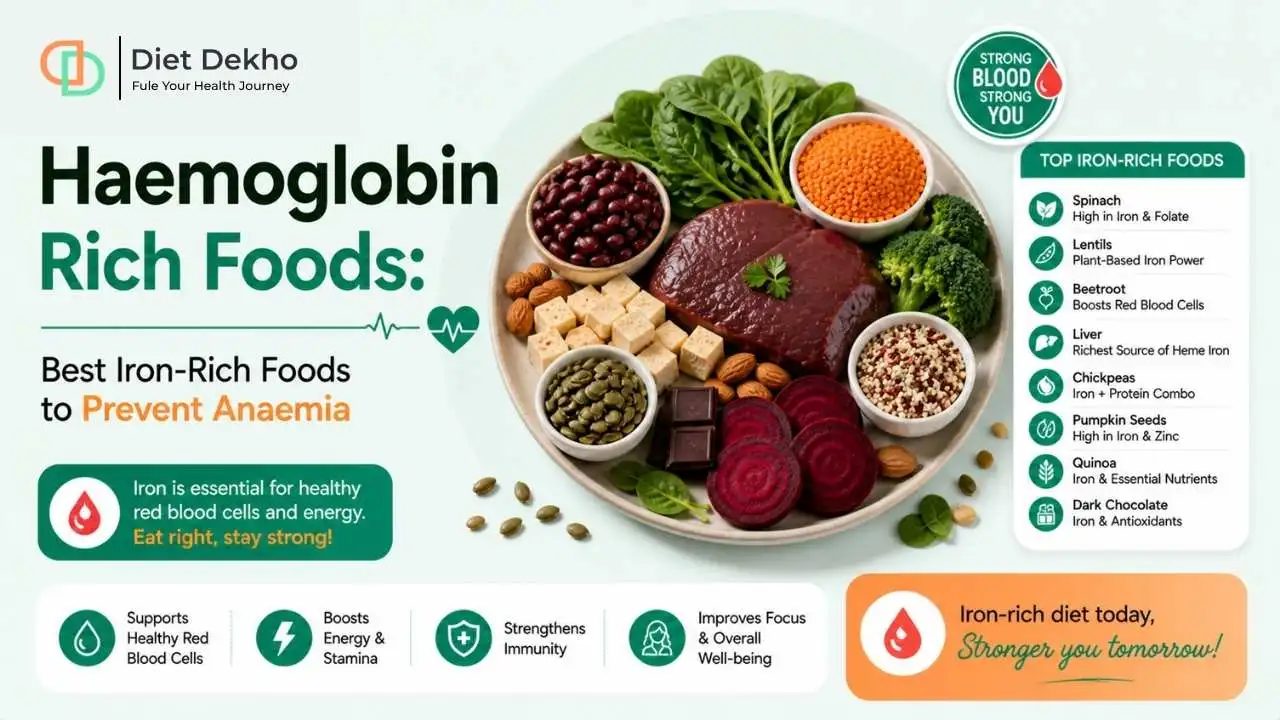
Imagine waking up after eight hours of sleep, yet feeling like you haven’t slept a wink. You try to push through your morning chores or that pile of emails, but your legs feel heavy and your head starts to throb. Many of my clients at DietDekho describe this exact feeling, unaware that their body is desperately craving haemoglobin rich foods to stay afloat.
To effectively raise your levels, focus on haemoglobin rich foods like organ meats, shellfish, and lean red meat for heme iron. For plant-based needs, eat spinach, lentils (Masoor dal), soybeans, pumpkin seeds, and amaranth. Always pair these with Vitamin C sources like lemon or amchur to ensure your body actually absorbs the iron and prevents anaemia.
Understanding the Hidden Struggle of Fatigue
When you feel that mid-afternoon slump, it is easy to reach for another cup of chai or coffee. I know it is hard to find time for a proper meal when you are juggling a house and a career, but that caffeine might be making your fatigue worse. What this means for your daily routine is that your blood isn’t carrying enough oxygen to your brain and muscles. This isn’t just a busy person problem; it is a biological one centered around a protein called haemoglobin.
Haemoglobin is the iron-rich protein in your red blood cells that acts like a delivery truck, carrying oxygen from your lungs to every single cell in your body. When your levels are low, those trucks are empty. You feel breathless because your cells are literally suffocating for air. This condition is known as anaemia, and in India, it is more common than you might think.
I often tell my friends that we are living through a silent crisis. We are surrounded by food, but our blood is starving. If you are struggling with dizziness, pale skin, or a heart that races for no reason, your body is sending you a flare. It is time to look closely at what is on your plate and make space for foods that actually build your blood strength.
The National Picture of Anaemia in India
We cannot talk about haemoglobin rich foods without looking at the reality of health in our country. The National Family Health Survey 5 (NFHS-5) recently released data that should be a wake-up call for all of us. Over half of the women in India, about 57%, are struggling with anaemia. It doesn’t matter if you live in a city or a village; the numbers are high across the board.
This problem is even more severe for our children. Roughly 67% of children under five are anaemic, which can affect how they learn and grow for the rest of their lives. As a dietitian, I see this every day. Parents are busy, and children are often given quick, processed snacks that have zero iron. This creates a volcano of nutritional deficiency that an eminent Indian nutritionist once warned about.
The following table shows the weighted prevalence of anaemia across different groups in India. These statistics highlight why we need to prioritize iron-rich ingredients in every meal we serve at home.
| Population Group in India | Anaemia Prevalence (NFHS-5) |
| Children (6-59 months) | 67.1% |
| Adolescent Girls (15-19 years) | 59.1% |
| Adolescent Boys (15-19 years) | 31.1% |
| All Women (15-49 years) | 57.0% |
| Pregnant People | 52.2% |
| Non-Pregnant People | 57.2% |
| Men (15-49 years) | 25.0% |
Why Your Body Needs Iron Every Day
Let’s simplify the science of your blood. Every time you breathe, your lungs take in oxygen. That oxygen needs a ride to your heart, your brain, and your working muscles. Haemoglobin is that ride. It is made of four protein chains, and at the center of each one is an atom of iron. If you don’t eat enough haemoglobin rich foods, your body cannot build these proteins, and your red blood cell count drops.
This protein makes up about 95% of the dry weight of your red blood cells. When you lack iron, your body produces cells that are smaller and paler than they should be. This is why doctors often look at the color of your tongue or the inside of your eyelids to check for anaemia. Without enough iron, your muscles cannot store oxygen either, which is why even small tasks like climbing stairs can leave you feeling completely exhausted.
What this means for your daily routine is that iron is not just a supplement; it is a fuel. You need a steady supply because your body is constantly breaking down old red blood cells and making new ones. For women, this need is even higher due to menstruation and childbirth. Let’s look at the normal ranges so you can understand what your blood test results are trying to tell you.
| Group | Normal Haemoglobin Range (g/dL) |
| Adult Male | 13.5 to 17.5 |
| Adult Female | 12.0 to 15.5 |
| Children | 11.0 to 13.0 |
| Newborn | 17.0 to 22.0 |

Heme vs Non-Heme Iron: Making the Right Choice
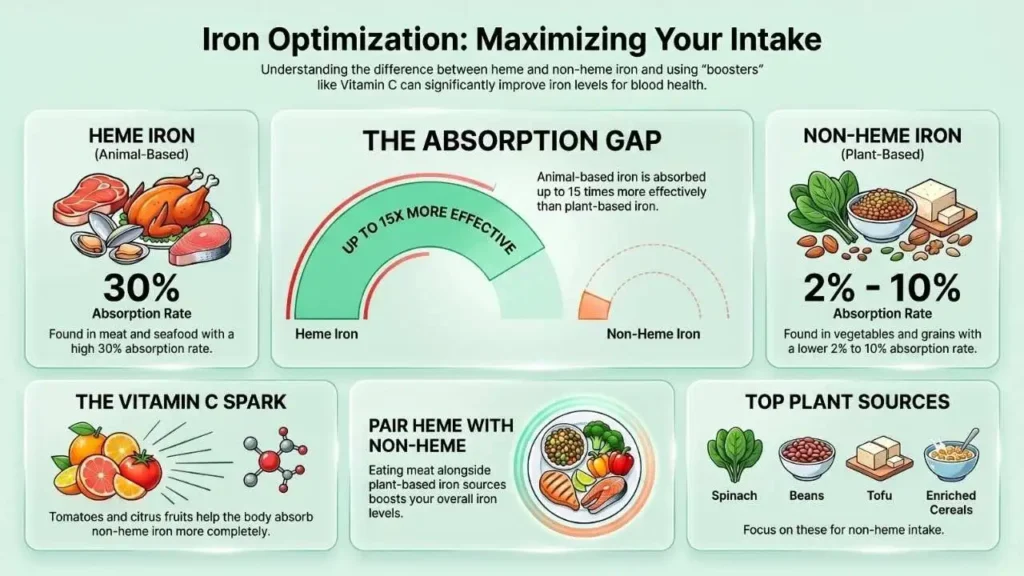
I often hear from my vegetarian friends who say they eat spinach every day but still feel tired. The reason is that not all iron is created equal. There are two types: heme and non-heme. Heme iron is found only in animal products like meat, poultry, and fish. It is very easy for your body to absorb, with an uptake rate of about 15% to 35%.
Non-heme iron comes from plants-like your dals, leafy greens, and nuts. The tricky part is that non-heme iron is unstable and much harder for your body to use. Only about 2% to 20% of it gets absorbed under the best conditions. This is why vegetarians need to eat nearly twice as much iron as meat-eaters to maintain the same levels.
If you are a busy professional who eats meat, adding small portions of lean beef or seafood can boost your levels quickly. But if you are a homemaker relying on a vegetarian kitchen, don’t worry. You just need to be a bit more strategic with how you cook your haemoglobin rich foods. I’ll show you how to use Vitamin C and traditional techniques to unlock the iron in your plant-based meals.

Top Animal-Based Iron Sources for Quick Results
For those who consume non-vegetarian food, animal sources are the most efficient way to raise haemoglobin. Organ meats, especially liver, are nutritional gold mines. Beef liver contains about 5 mg of iron per serving, which is roughly 28% of what a woman needs in a day. It is also packed with Vitamin B12 and folate, which are the supporting actors your body needs to make blood.
Seafood is another incredible category. Oysters, clams, and mussels are among the highest sources of iron you can find. Three ounces of oysters can provide a staggering 8 mg of iron. If you aren’t a fan of shellfish, simple canned sardines or tuna are great, shelf-stable options for a quick lunch at the office.
| Heme Iron Source | Iron Content (mg) | Serving Size |
| Oysters (cooked) | 8.0 | 3 oz |
| Beef Liver | 5.0 | 3 oz |
| Lean Beef | 2.7 | 3 oz |
| Sardines (canned) | 2.0 | 3 oz |
| Turkey (ground) | 1.4 | 3 oz |
| Chicken (roasted) | 1.0 | 3 oz |
I know it’s hard to find time to cook elaborate meat dishes during the week. A simple trick is to keep canned tuna or sardines in your pantry. You can toss them into a salad or a quick wrap. Even a small portion of chicken or fish helps your body absorb the iron from the vegetables you eat alongside them.

The Power of Indian Dals and Legumes
In most Indian households, dal is the heart of every meal. For our vegetarian and vegan friends, legumes are the primary haemoglobin rich foods. But did you know that some dals are much better for your blood than others? Masoor dal (red lentils) is one of the best choices, providing nearly 6.6 mg of iron per cooked cup.
Soy products are also exceptionally high in iron. Soybeans contain about 8.8 mg of iron per cup, making them a powerhouse for anyone avoiding meat. Tofu, which is made from soy, is another versatile option. Half a cup of firm tofu gives you about 3 mg of iron along with plenty of protein and calcium.
| Legume / Dal | Iron Content (mg) | Serving Size (Cooked) |
| Soybeans | 8.8 | 1 cup |
| White Beans | 8.0 | 1 cup |
| Masoor Dal (Red Lentils) | 6.6 | 1 cup |
| Chole (Chickpeas) | 4.7 | 1 cup |
| Rajma (Kidney Beans) | 5.2 | 1 cup |
| Moong Dal | 4.3 | 1 cup |
Let’s simplify your shopping list. If you are struggling with low energy, swap your usual yellow moong dal for masoor dal or rajma a few times a week. These small changes add up. I always suggest my clients sprout their beans before cooking. Sprouting reduces the phytates that normally block iron absorption, making the nutrients more available to your body.

Leafy Greens: More Than Just Spinach
We’ve all seen the cartoons where spinach gives instant strength. While spinach is a good source of iron, containing about 3 mg per half-cup, it isn’t the only green you should reach for. In fact, many traditional Indian greens are even more powerful. Amaranth leaves, known as Chaulai or Math, are incredible haemoglobin rich foods, offering about 6.37 mg of iron per 100 grams.
Fenugreek (Methi) and drumstick leaves (Moringa) are also blood-building superstars. Moringa leaves are so nutrient-dense that they are often used in herbal teas and supplements to fight anaemia. These greens are easy to stir-fry with a bit of garlic and oil, making them a perfect side dish for busy homemakers who want to boost their family’s health.
| Green Leafy Vegetable | Iron Content (mg) | Serving Size |
| Amaranth (Chaulai) | 6.37 | 100g |
| Methi (Fenugreek) | 5.69 | 100g |
| Beet Greens | 5.80 | 100g |
| Spinach (Palak) | 2.7 – 3.2 | 100g |
| Moringa Leaves | 4.56 | 100g |
One thing I tell my friends is that cooking your greens actually helps. Raw spinach contains oxalates that can interfere with iron absorption, but cooking them slightly reduces these and makes the iron easier to get. Add a squeeze of lemon at the very end to help your body soak up every milligram of that iron.

Managing Anaemia and Diabetes Together
I know many of you are managing your blood sugar levels alongside your iron levels. This can feel like a balancing act, but the good news is that many haemoglobin rich foods are also great for a diabetic diet. Legumes like lentils and chickpeas have a low Glycemic Index (GI), meaning they don’t cause sharp spikes in your blood sugar.
Iron deficiency is actually very common in people with diabetes. High blood sugar can cause chronic inflammation, which makes it harder for your body to use its iron stores. Over time, diabetes can also affect the kidneys. Since the kidneys produce the hormone erythropoietin (EPO)-which tells your bone marrow to make red blood cells-any kidney damage can lead to anaemia.
What this means for your daily routine is that you must prioritize fiber-rich iron sources. Whole grains like oats, millets (Bajra and Ragi), and quinoa are perfect. They keep you full longer and provide a steady release of energy. Avoid the iron tonics that are full of sugar and instead focus on real, whole foods that support both your blood and your glucose levels.
| Low-GI Iron Food | Iron Content | Benefit for Diabetes |
| Lentils | 6.6 mg / cup | High fiber, stabilizes blood sugar |
| Cashews | 2.0 mg / 18 nuts | Healthy fats, low GI |
| Ragi (Finger Millet) | 3.9 mg / 100g | Complex carb, slow digestion |
| Spinach | 3.2 mg / 0.5 cup | Very low calorie, nutrient dense |
| Tofu | 3.0 mg / 0.5 cup | High protein, zero sugar |
The Role of Seeds and Traditional Superfoods
If you are a busy professional, you need snacks that work as hard as you do. Pumpkin seeds are a fantastic desk snack. Just a small handful provides over 4 mg of iron, which is more than you get from a serving of beef. Sesame seeds (Til) are another Indian staple that we often overlook. They are incredibly rich in iron, containing about 9.5 mg per half-cup.
Garden cress seeds, also known as Aliv or Haleem, are a true Indian superfood for anaemia. These tiny seeds are so potent that just one tablespoon contains 1.8 mg of iron. Traditionally, they are made into ladoos with jaggery and coconut for new mothers. For a modern twist, you can soak them overnight and add them to your morning smoothie or yogurt bowl.
Jaggery (Gur) is the unrefined soul of Indian sweets. Unlike white sugar, it actually contains iron. Many people find that drinking jaggery water first thing in the morning or having a small piece after dinner helps boost their energy. But I know you have to be careful with sugar if you are diabetic, so enjoy jaggery in moderation and pair it with fiber-rich seeds to prevent blood sugar spikes.

Why Vitamin C is Your Best Friend
You could be eating all the haemoglobin rich foods in the world, but if your body isn’t absorbing the iron, it won’t help your fatigue. This is where Vitamin C comes in. Ascorbic acid-the fancy name for Vitamin C-significantly increases the absorption of non-heme iron from plants.
Think of Vitamin C as the key that unlocks the iron in your vegetables. Adding a source of Vitamin C to your meal can increase iron uptake by up to three times. It is one of the easiest health hacks you can start today. Squeeze some lime on your dal, add fresh bell peppers to your poha, or have a bowl of strawberries for dessert.
| Vitamin C Source | How to Use with Iron Foods |
| Lemon / Lime | Squeeze over dals, poha, and stir-fries |
| Tomatoes | Cook alongside spinach or lentils |
| Amchur Powder | Sprinkle on black chickpeas (kala chana) |
| Amla (Gooseberry) | Eat as a pickle or juice alongside meals |
| Oranges / Guava | Enjoy as a snack immediately after a meal |
I know it sounds simple, but this one habit can change your life. If you’re a busy professional grabbing lunch at your desk, just carrying a small lemon in your bag can make your meal much more nutritious. What this means for your daily routine is that you don’t need expensive supplements; you just need a little bit of vitamin-rich zing on your plate.
The Tea and Coffee Trap You Need to Avoid
I know we all love our morning chai and office coffee, but this is a difficult truth: caffeine and tannins are major iron blockers. Clinical studies have shown that drinking a cup of coffee with a meal can reduce iron absorption by about 39%. Tea is even worse, potentially blocking up to 64% of the iron in your food.
These drinks contain substances that bind to iron while it is still in your stomach, forming a clump that your body simply cannot use. For someone who is already struggling with low haemoglobin, this is a heavy price to pay for a midday pick-me-up. It is especially risky for premenopausal women who already have higher iron needs.
Let’s simplify your caffeine habit. You don’t have to give up your favorite drink forever. Just wait one hour after your meal before having your tea or coffee. This gives your stomach enough time to process the iron from your haemoglobin rich foods without interference. I know it’s hard to wait, but your energy levels will thank you.
Traditional Cooking: The Magic of the Iron Kadai
Our grandmothers knew something that we have forgotten in the age of non-stick pans. Cooking in a cast-iron skillet or kadai can actually increase the iron content of your food. This is particularly effective when you are cooking moist or acidic foods, like a tomato-based curry or a spinach stir-fry. Small amounts of the iron from the pan leach naturally into the food.
This is a perfect home-based solution for the non-gym audience. It requires zero extra effort once you have the pan. For busy homemakers, it’s a way to fortify the whole family’s meals without anyone even noticing a difference in taste. What this means for your daily routine is that your kitchen tools can be just as important as your ingredients.
I often recommend my clients start by making their daily tadka or dry sabzis in an iron kadai. It’s a one-time purchase that lasts a lifetime and serves as a continuous source of supplemental iron. Just remember to dry the pan thoroughly after washing to prevent rust, and you’ll have a blood-building tool right on your stovetop.
Meal Planning for the Busy Professional
I know you are juggling meetings and deadlines, and cooking is often the last thing on your mind. But skipping meals or eating refined flour (maida) only deepens your exhaustion. Let’s look at some quick, 20-minute meal ideas that are packed with haemoglobin rich foods.
Soya Poha is a personal favorite. By adding soaked soya granules to your usual rice flakes, you add about 10 mg of iron to your breakfast. Another fast option is a Spinach and Tahini Wrap. You can use whole wheat rotis, add a layer of iron-rich sesame paste (tahini), and fill it with sautéed spinach and onions. It’s portable, delicious, and takes less than 15 minutes to assemble.
For dinner, a one-pot Ragi and Moong Dal Khichdi is a lifesaver. Ragi is a traditional millet that is naturally rich in iron and calcium, and when paired with moong dal, it becomes a complete protein. These meals are designed to fit into your busy life while ensuring your haemoglobin levels stay within the healthy range.
| Meal Time | Quick Iron-Rich Idea | Why it Works |
| Breakfast | Soya Poha with Lemon | High iron from soya + Vitamin C from lemon |
| Lunch | Chickpea & Spinach Salad | Plant-based iron combo with fiber |
| Snack | Pumpkin Seeds & Raisins | Easy, portable energy with zero prep |
| Dinner | Masoor Dal with Palak Roti | Double iron hit from lentils and greens |
Expert Advice for Long-Term Success
Raising your haemoglobin isn’t something that happens overnight. It takes consistency. As a dietitian, I want you to focus on the Big Three: eating haemoglobin rich foods, adding Vitamin C, and timing your tea/coffee correctly. If you follow these three rules, you will likely start to feel a difference in your energy levels within a few weeks.
Always remember that certain groups need more care. If you are pregnant, nursing, or have a heavy menstrual cycle, your iron requirements are much higher. For my friends with diabetes, keep an eye on your kidney health, as this is often where anaemia starts in the body.
Expert nutritionists like Dr. C. Gopalan have long emphasized that satisfying hunger isn’t the same as nourishing the body. We need to be intentional. What this means for your daily routine is that every bite is an opportunity to strengthen your blood. Don’t wait until you are too exhausted to function; start adding these iron-rich staples to your grocery list today.
Frequently Asked Questions
How can I increase my haemoglobin levels in a week?
While you can’t completely reverse anaemia in seven days, you can start the process by eating heme iron sources like liver or oysters for maximum absorption. Vegetarians should combine high-iron foods like masoor dal and spinach with large amounts of Vitamin C (lemon juice) and strictly avoid tea or coffee with meals to see a quick improvement in energy.
What are the best haemoglobin rich foods for vegetarians?
The best plant-based sources include soybeans, lentils (especially masoor dal), amaranth leaves, pumpkin seeds, and millets like ragi and bajra. To make these effective, always soak or sprout your beans and grains to reduce phytates, and pair them with Vitamin C to help your body absorb the iron.
Is it safe for people with diabetes to eat iron-rich fruits?
Yes, but you should choose low-GI fruits. Pomegranates, berries, and apples are generally safe in moderation. Dried fruits like dates and apricots are excellent haemoglobin rich foods but are higher in sugar, so they should be eaten in small, controlled portions and checked against your blood glucose goals.
Can cooking in iron pots really help with anaemia?
Yes, clinical evidence and traditional practices show that cooking in cast-iron cookware increases the iron content of your food, especially in acidic dishes like tomato-based curries or sautéed greens. It is a simple, effective way to get extra iron into your diet every single day.
Why do I feel tired even if I eat iron-rich food?
You might be consuming iron blockers like tea, coffee, or high-calcium supplements at the same time as your meals. These prevent your body from using the iron you’ve eaten. Alternatively, your fatigue could be due to a Vitamin B12 or folate deficiency, which also affects red blood cell production.
Taking the Next Step Toward Vitality
I know it is hard to find time to focus on your health when the world is moving so fast. But you cannot pour from an empty cup. If your delivery trucks are empty, everything in your life feels harder than it needs to be. By choosing these haemoglobin rich foods, you are giving yourself the gift of energy, focus, and a stronger heart.
Let’s simplify this. Start small. Tomorrow, swap your white bread for a ragi roti. Squeeze a lemon over your dinner. Wait an hour before you have your afternoon tea. These are home-based solutions that any busy professional or homemaker can follow starting today.
If you are feeling overwhelmed and need a clear, simple plan tailored to your health and diabetes needs, we are here for you. At DietDekho, we specialize in making healthy eating relatable and practical for your real life. Let’s work together to build a diet that makes you feel vibrant again.
Contact Us
We understand how overwhelming nutrition and weight loss information can feel. With so many opinions and confusing advice online, it’s easy to feel stuck or unsure about what to do next.
At Diet Dekho, you never have to figure it out alone. You can contact us anytime with any questions or concerns. Our expert dietitians are available 24/7 to guide, support, and help you stay on track. Whether your goal is weight loss or building healthier habits, we’re here to make the journey simpler and more sustainable for you.
Disclaimer
This blog is intended to help readers make healthier food choices. Your health should always be the top priority. Before starting any restrictive or special diet, especially if you have a medical condition or health concern, please consult a doctor or a qualified dietitian. Each body responds differently to food and lifestyle changes. Always choose what is safe and suitable for you.

Abhinav is the Founder of Diet Dekho, helping people manage weight and lifestyle health through simple, practical nutrition and personalized diet plans.