🩺 Medically Reviewed & Nutrition Verified by Dt. Mahi Patel (B.Sc. Clinical Nutrition & Dietetics) | Editorial Lead: Diet Dekho Clinical Nutrition Desk | Cross-referenced with ICMR & NIN Dietary Standards.
Imagine a young mother in a bustling Delhi neighborhood, wondering why her toddler has a round, protruding belly despite being a fussy eater who mostly fills up on rice and sugary biscuits. She might think her child is just healthy or chubby, but deep down, the child’s persistent fatigue and thinning hair tell a different story about disease kwashiorkor. This is the diagnostic paradox we often see in nutrition clinics: a child who looks full but is actually starving for the most vital building block of life-protein.
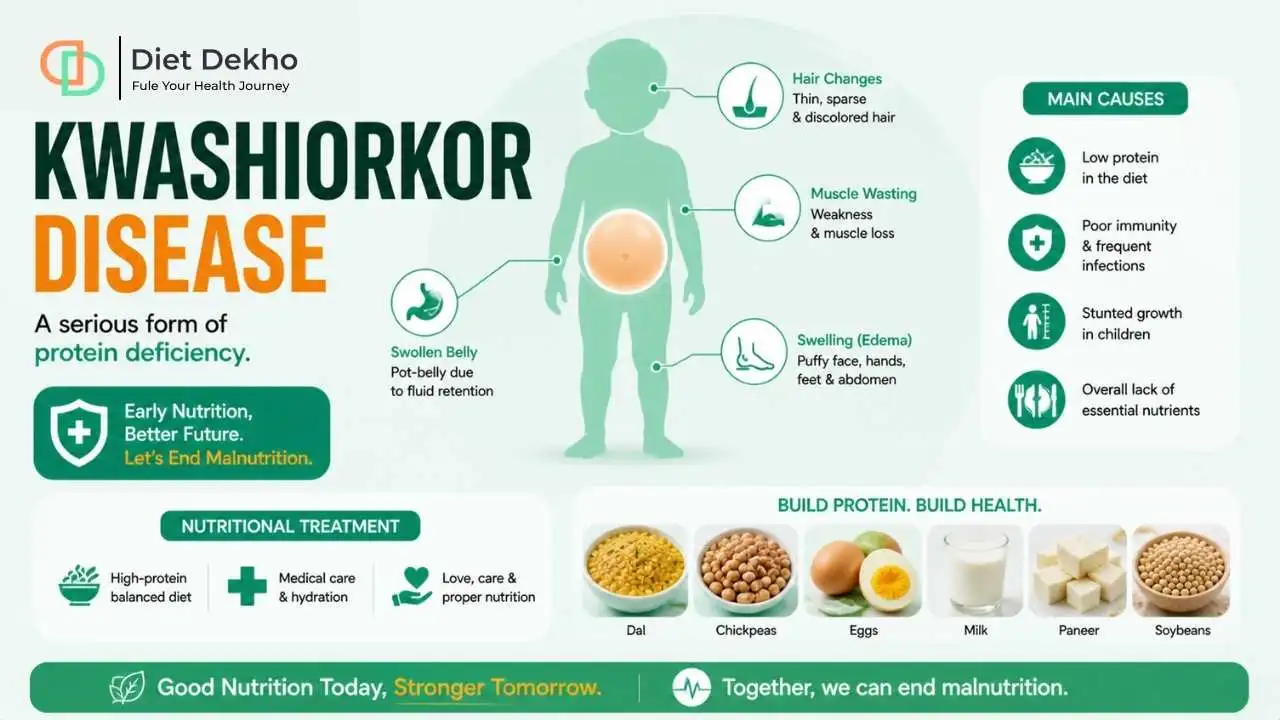
Disease kwashiorkor is a severe form of protein-energy malnutrition (PEM) characterized by swelling (edema), an enlarged liver, and a distended abdomen. It occurs when a diet contains enough calories but lacks sufficient high-quality protein. This condition primarily affects children during weaning, leading to stunted growth, skin lesions, and compromised immunity.
Understanding the Roots: What is Disease Kwashiorkor?
I know it is hard to find time to research medical terms when you are juggling a job and a household, but let’s simplify this concept together. The word itself comes from a language in Ghana and translates to the deposed child. This refers to an older child who is taken off breast milk because a new sibling has arrived. When breast milk-which is a perfect protein source-is replaced by starchy, protein-poor staples like white rice, maize, or cassava, the body begins to struggle.
What this means for your daily routine is that filling foods are not always nutritious foods. In many Indian households, we rely heavily on rice, chapatis, and potatoes. While these give us energy, they do not provide the amino acids required for cellular repair. Without these building blocks, the body’s internal plumbing starts to leak, leading to the characteristic swelling known as edema.
The Biological Mechanism: Why the Body Swells
To understand why the disease kwashiorkor causes a bloated appearance, we have to look at a protein called albumin. Your liver produces albumin to keep fluid inside your blood vessels. Think of albumin as a magnet that holds water in the right place. When protein intake drops too low, the liver cannot make enough albumin.
Without that magnet in the blood, water leaks out into the surrounding tissues, especially in the feet, legs, and belly. This fluid retention is why a child might look plump even though their muscles are wasting away. Internally, the liver also begins to store fat because it lacks the proteins needed to move fat out to the rest of the body. This leads to an enlarged fatty liver, another reason for the protruding stomach.
| Metabolic Factor | Normal Function | In Kwashiorkor | Result |
| Serum Albumin | Maintains oncotic pressure | Severely low (< 2.4 g/dL) | Edema/Swelling |
| Apolipoproteins | Transport fat from liver | Deficient | Fatty Liver |
| Muscle Mass | Tissue repair/Growth | Used as energy source | Wasting/Weakness |
| Immune Cells | Fight infections | Reduced T-cell count | Frequent Illness |

The Indian Perspective: Statistics and the Protein Gap
I see so many parents who are worried about their child’s height or their own stubborn belly fat. In India, we are facing a double burden of malnutrition. On one hand, we see rising obesity; on the other, acute protein deficiency remains a silent crisis. According to the National Family Health Survey-5 (NFHS-5), nearly 35.5% of Indian children under five are stunted, which means they are too short for their age due to chronic poor nutrition.
The data suggests that wasting-a sign of acute malnutrition-affects about 19.3% of our children. While these numbers are slowly improving, the protein gap in urban adults is equally concerning. A survey found that 6 out of 10 urban Indians do not eat enough protein-rich foods daily. Most of us consume only about 0.6 grams of protein per kilogram of body weight, whereas the ICMR-NIN 2020 guidelines recommend 0.83 grams.
State-Wise Nutritional Status in India (Children Under 5)
Data from NFHS-5 reveals significant regional variations in how malnutrition manifests across the country.
| State/UT | Stunted (%) | Wasted (%) | Underweight (%) |
| Bihar | 42.9 | 22.9 | 41.0 |
| Gujarat | 39.0 | 25.1 | 39.7 |
| Maharashtra | 35.2 | 25.6 | 36.1 |
| Kerala | 23.4 | 15.8 | 19.7 |
| Karnataka | 35.4 | 19.5 | 32.9 |
| Uttar Pradesh | 39.7 | 17.3 | 32.1 |
This table highlights that in states like Bihar and Gujarat, nearly 40% of children are underweight, placing them at high risk for conditions like disease kwashiorkor if their protein intake is not prioritized.

Identifying the Signs: Symptoms You Should Know
It is easy to miss the early signs when you are busy. You might think a child is just being cranky or lazy. However, if you notice a child who was previously active becoming lethargic and irritable, it is time to look closer. One of the most distinct markers is the flag sign in the hair. This is where bands of light-colored hair alternate with darker hair, reflecting periods of poor nutrition.
The skin also tells a story. In severe cases, it develops a flaky paint appearance-red, scaly patches that may peel off. If you press your thumb into the child’s foot and the indentation stays for a few seconds, that is pitting edema. This swelling is not a sign of health; it is a sign that the body’s internal balance is failing.
Kwashiorkor vs. Marasmus: Clearing the Confusion
I often get asked about the difference between these two. Let’s simplify this: Marasmus is skin and bones. It is caused by a total lack of food-no calories, no protein, nothing. The body uses up all its fat and muscle to survive, leading to a shriveled, old man facial appearance.
In contrast, a child with kwashiorkor might look well-fed at a glance because they have some subcutaneous fat and lots of fluid swelling. They are getting enough calories from sugar or starch, but their muscles are literally being digested by the body to find protein. Both are dangerous, but they require different nutritional approaches for recovery.
| Feature | Kwashiorkor | Marasmus |
| Root Cause | Protein deficiency | Total calorie deficiency |
| Physical Look | Swollen/Puffy | Wasted/Shriveled |
| Appetite | Very poor | Usually hungry |
| Liver | Large and fatty | Normal size |
| Subcutaneous Fat | Present | Absent |

The Impact on Growth and Brain Development
What this means for a child’s future is profound. Nutritionists often talk about the 1000-day window-from conception to the second birthday. If a child suffers from protein deficiency during this time, the damage can be permanent. They may never reach their full height, and their brain development can be significantly delayed.
Protein is not just for muscles; it is for neurotransmitters and brain structure. Long-term studies show that children who recover from severe malnutrition still struggle with cognitive tasks and school performance. This is why immediate, high-quality dietary intervention is so important.
Treatment: The Road to Recovery
If you suspect a child has disease kwashiorkor, the first step is medical consultation. I must warn you: do not try to overfeed them with heavy protein meals immediately. A body that has been starved of protein is very fragile. Suddenly giving too much can cause refeeding syndrome, where internal electrolytes shift so rapidly that it can cause heart failure.
The Phased Approach
Doctors and dietitians follow a careful plan:
- Stabilization Phase: We first treat infections with antibiotics and provide small, frequent meals of simple carbohydrates and fats to give the body energy.
- Rehabilitation Phase: Once the swelling starts to go down and the child’s appetite returns, we slowly introduce milk-based or peanut-based therapeutic foods (RUTF) that are rich in protein and micronutrients.
- Home-Based Care: This is where we transition back to a balanced Indian diet, focusing on high-quality protein sources like lentils, dairy, and eggs.

Practical Nutritional Solutions for Busy Families
I know how hard it is to cook elaborate meals when you are working. But keeping your family healthy does not have to be a full-time job. Let’s look at some simple, high-protein Indian foods you can start using today.
According to the National Academy of Medicine, an average adult needs about 0.8 grams of protein per kilogram of body weight. For an Indian man weighing 65kg, that is about 54 grams of protein daily. For a child, the needs are higher relative to their size to support growth.
Top Indian Protein Sources
| Food Category | High-Protein Examples | Protein Content (approx.) |
| Dairy | Paneer, Curd, Milk | 18g per 100g Paneer |
| Legumes | Moong Dal, Rajma, Chana | 24g per 100g Moong Dal |
| Animal Source | Eggs, Chicken, Fish | 6g per Egg, 24g per 100g Salmon |
| Millets/Seeds | Ragi, Soya Chunks, Makhana | 52g per 100g Soya Chunks |
The Power of the Protein Package
As experts at Harvard emphasize, it is not just about the protein; it is about the package it comes in. When you choose lentils (dal), you get fiber and minerals with no saturated fat. When you choose eggs or fatty fish like salmon, you get essential vitamins and Omega-3s. Avoid processed meats like sausages, as they are linked to long-term health risks.
Quick High-Protein Recipes for Professionals and Homemakers
I want to give you some tools you can use in your kitchen right now. These recipes are designed for speed and nutrition.
1. The 15-Minute Moong Dal Chilla
This is a savior for busy mornings. Soak moong dal overnight (or use split yellow moong). Grind it with a bit of ginger and green chili.
- Protein Boost: Add 50g of crumbled paneer inside as a stuffing.
- Nutritional Value: Approx 20-25g protein per serving.
- Why it works: It’s a complete meal that keeps you full until lunch, preventing the 11 AM samosa craving.
2. Paneer Bhurji on Whole Wheat Toast
Crumble paneer and sauté it with onions, tomatoes, and a pinch of turmeric.
- Protein Boost: Serve it with two slices of multigrain bread or a bowl of curd.
- Nutritional Value: Approx 18-22g protein.
- Why it works: Paneer is a high-quality animal protein that is easy to stock in your fridge.
3. Sprouted Moong Salad (The No-Cook Snack)
Keep a box of sprouted moong in your fridge. Toss a cup with chopped cucumber, tomatoes, peanuts, and lemon juice.
- Nutritional Value: Approx 15g protein per cup.
- Why it works: Sprouting increases the bioavailability of proteins and enzymes, making it easier for children to digest.

Addressing the Urban Pot Belly Syndrome
What this means for your daily routine as an adult is realizing that protein deficiency does not just happen in famine zones. Many Indian adults have a pot belly despite having thin arms and legs. This is often due to a diet too high in simple carbs (rice/sugar) and too low in protein, leading to poor metabolism and fat storage around the liver.
Adding just one extra source of protein to every meal can help shift this balance. One study showed that people who included protein with every meal felt more energetic and lost weight more effectively because protein maintains stable blood glucose levels.
Conclusion: Small Steps to a Healthier Future
Managing disease kwashiorkor and general protein deficiency is about making consistent, small choices. Whether it is adding an egg to your child’s breakfast or swapping a bowl of rice for a bowl of dal, these steps matter. I know it’s hard to change lifelong eating habits, but your body-and your children’s futures-will thank you.
If you are struggling with your diet or want a personalized plan tailored to your busy schedule, we are here to help. Our team at DietDekho specializes in practical, Indian-centric nutritional solutions that fit your life.
Ready to transform your health?

Frequently Asked Questions
What are the primary causes of disease kwashiorkor?
The main cause is a severe lack of protein in the diet, even if the person is eating enough calories from carbohydrates like rice or maize. It often occurs in children after weaning from breast milk.
How can I tell if a child has symptoms of kwashiorkor?
Look for swelling in the feet and legs, a bloated stomach, thinning hair that changes color (yellow or orange), and skin that looks like flaky paint. The child may also be very irritable or unusually tired.
What is the difference between kwashiorkor vs marasmus?
Kwashiorkor is a protein deficiency characterized by swelling and a fatty liver. Marasmus is a total calorie and energy deficiency that leads to severe weight loss and a skin and bones appearance without swelling.
What is the best treatment for kwashiorkor?
Treatment must be gradual to avoid complications. It starts with treating infections and providing carbohydrates and fats, followed by a slow introduction of high-quality protein through therapeutic foods or milk.
Can vegetarians get enough protein to prevent this disease?
Yes, but they must combine foods carefully. Combining cereals (like rice or wheat) with legumes (dal/beans) or eating dairy products like paneer, milk, and curd provides the full range of amino acids the body needs.
Contact Us
We understand how overwhelming nutrition and weight loss information can feel. With so many opinions and confusing advice online, it’s easy to feel stuck or unsure about what to do next.
At Diet Dekho, you never have to figure it out alone. You can contact us anytime with any questions or concerns. Our expert dietitians are available 24/7 to guide, support, and help you stay on track. Whether your goal is weight loss or building healthier habits, we’re here to make the journey simpler and more sustainable for you.
Disclaimer
This blog is intended to help readers make healthier food choices. Your health should always be the top priority. Before starting any restrictive or special diet, especially if you have a medical condition or health concern, please consult a doctor or a qualified dietitian. Each body responds differently to food and lifestyle changes. Always choose what is safe and suitable for you.
Medical & Nutritional Disclaimer: The nutritional charts and recommendations presented in this article are intended solely for educational and preventive wellness guidance. They are not a replacement for clinical consultation, personal diagnosis, or medical prescription. Always consult a qualified medical professional or certified clinical dietitian before making drastic modifications to your clinical diet routine.

Abhinav is the Founder of Diet Dekho, helping people manage weight and lifestyle health through simple, practical nutrition and personalized diet plans.