Picture this: It is 8:30 AM on a Tuesday in a bustling Mumbai or Delhi household. You are rushing to finish your tea, the kids need their tiffin packed, and your laptop is already pinging with notifications. You look at your plate of poha or white rice and wonder if these carbs foods are the reason you feel so sluggish by noon. Managing your health while juggling a career and a home is incredibly taxing, and when you are told to watch your sugar levels, it can feel like every meal is a minefield. I know it is hard to find time to research every single bite, but let’s simplify this together so you can take control without giving up the flavors you love.
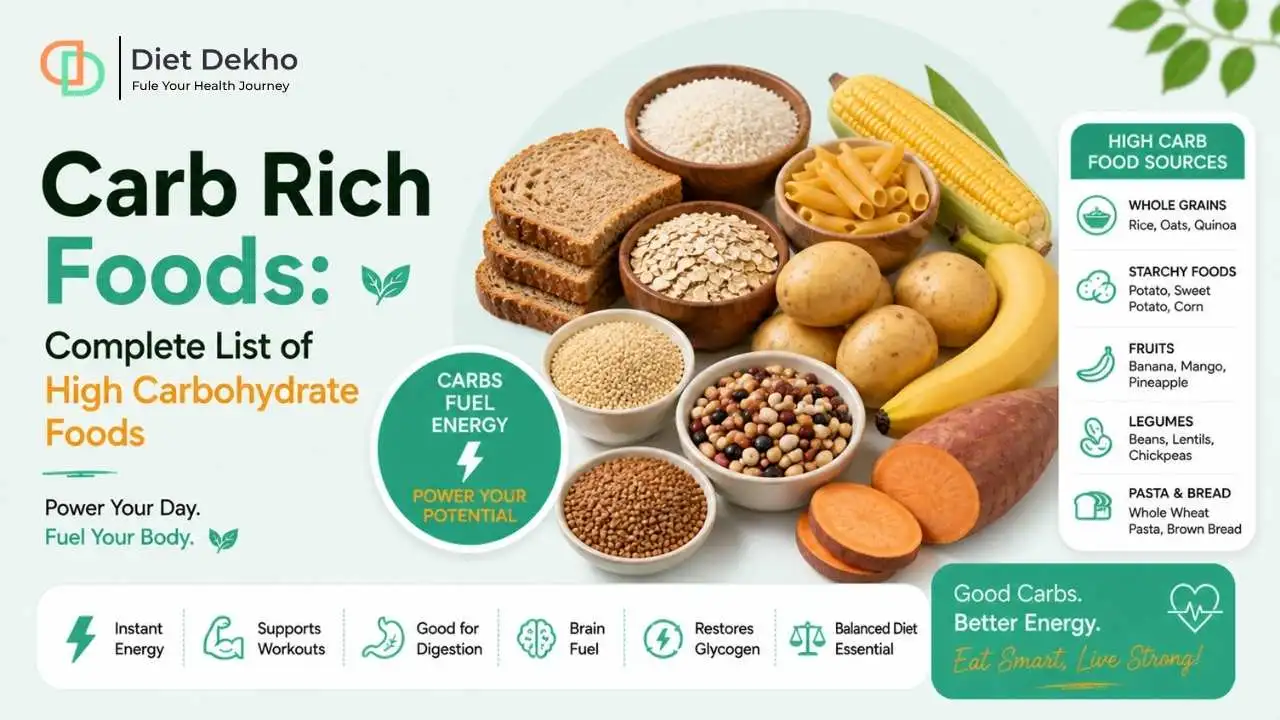
Immediately after the hook, it is important to address the central question clearly. Carbs foods are the body’s primary energy source, found in grains like rice and wheat, pulses, fruits, and starchy vegetables. For optimal health, especially for those managing diabetes, it is essential to choose complex carbohydrates like whole grains, legumes, and non-starchy vegetables. These provide sustained energy and prevent the sharp blood sugar spikes associated with refined simple carbs like white bread or sugary snacks.
The Reality of the Indian Plate and the Carbohydrate Overload
What this means for your daily routine is that we need to look at the hidden impact of our traditional meals. In many Indian homes, the comfort of a warm chapati or a steaming bowl of rice is non-negotiable. However, recent data from the Indian Council of Medical Research (ICMR) reveals an alarming trend that we need to talk about. The average Indian diet is now categorized as one of the most carb-heavy in the world, with roughly 62.3% of daily calories coming from carbohydrate sources.
This carbohydrate overload is a major factor behind the rising rates of diabetes and obesity across the country. I know it sounds overwhelming, but the problem is not just the quantity of the food; it is the quality. Most of these calories come from low-quality, refined sources like white rice and finely milled flour (maida). When we eat these, our bodies break them down into sugar very quickly, leading to those energy crashes that leave you reaching for a biscuit or another cup of sweet chai.
Understanding the ICMR-NIN 2024 Guidelines
To help us get back on track, the National Institute of Nutrition (NIN) recently released updated guidelines. They suggest that for a balanced life, we should try to keep our cereal and millet intake to no more than 45% of our total daily calories. The goal here is not to starve yourself but to make room for other essential groups like proteins and healthy fats.
| Nutrient Category | 2024 ICMR Recommendation | Current Average Indian Intake |
| Carbohydrates | 50% – 55% of total calories | 62.3% |
| Proteins | 10% – 15% of total calories | 12.0% |
| Fats | 20% – 30% of total calories | ~12.0% to 25.0% |
| Added Sugar | < 5% of total calories | ~10% in some states |
Table data sourced from.
By looking at this table, you can see that we are slightly overdoing the carbs foods while falling short on the protein and fiber that keep our metabolism running smoothly. I often tell my clients that if you can shift just 5% of your calories from refined carbs to plant-based proteins like dal or dairy like curd, you can significantly lower your risk of diabetes.

Simple vs. Complex: Choosing Your Fuel Wisely
Let’s think of your body like a car. To keep it running, you need fuel. Simple carbohydrates are like high-octane racing fuel that burns off in a flash. They give you a quick burst but leave the tank empty very soon. These are found in sugary drinks, white bread, and most packaged snacks. On the other hand, complex carbohydrates are like high-quality, steady fuel. They are made of longer chains of sugar molecules that take much more time for your body to break down.
What this means for your daily routine is that when you choose complex carbs-like whole wheat, oats, or lentils-you are giving your brain and muscles a steady supply of energy that lasts for hours. This is particularly important for busy professionals who need to stay sharp through back-to-back meetings. If you start your morning with simple carbs, you are setting yourself up for a blood sugar rollercoaster.
The Magic of Fiber
One of the best friends you can have on your health journey is dietary fiber. Fiber is a type of complex carbohydrate that your body cannot actually digest. Because it stays intact as it moves through your system, it acts like a brake for sugar absorption. It keeps you feeling full longer, supports your gut health, and even helps lower your cholesterol. Harvard Health researchers emphasize that the type of carbohydrate you choose-specifically those high in fiber-is far more important for your long-term health than just the total number of grams you eat.

I know the terms Glycemic Index and Glycemic Load sound like medical jargon, but they are actually very simple tools once you get the hang of them. Think of the Glycemic Index (GI) as a speedometer. It tells you how fast a specific food raises your blood sugar on a scale of 0 to 100.
- Low GI (55 or less): These are your slow and steady foods. They digest slowly and keep your energy levels stable.
- Moderate GI (56-69): These are okay in moderation but need to be watched.
- High GI (70 or more): These are the speedsters that cause rapid sugar spikes. You want to limit these or pair them carefully.
However, the GI does not tell the whole story. This is where Glycemic Load (GL) comes in. If GI is the speed, GL is the distance you travel. It takes into account the portion size of the food you are actually eating. For example, watermelon has a high GI (72), which makes it look bad for sugar. But it is mostly water! Because it has so few carbs per slice, its GL is actually very low (around 4), meaning a normal serving won’t hurt your sugar levels.
A Practical GI Chart for Indian Staples
I’ve put together this list so you can see how some of our favorite carbs foods compare. You might be surprised to see where some of your daily staples fall.
| Food Item | Glycemic Index (GI) | Glycemic Load (GL) | Classification |
| White Rice | 73 – 82 | 25 – 34 | High GI / High GL |
| Brown Rice | 55 – 60 | 18 – 20 | Moderate GI / Medium GL |
| Whole Wheat Roti | 54 – 60 | 12 – 15 | Moderate GI / Medium GL |
| Maida (White Flour) | 71 | 25 | High GI / High GL |
| Boiled Potato | 78 | 18 | High GI / Medium GL |
| Moong Dal | 38 | 6 | Low GI / Low GL |
| Chickpeas (Chole) | 28 | 7 | Low GI / Low GL |
| Apple | 39 | 6 | Low GI / Low GL |
| Poha (Flattened Rice) | 55 – 60 | 18 | Moderate GI / Medium GL |

The Millet Paradox: Are They Always Better?
We often hear that millets like Ragi (Finger Millet) and Jowar (Sorghum) are the ultimate solution for diabetes. While they are packed with minerals and fiber, recent studies show that how you prepare them makes a huge difference. For instance, a traditional Ragi ball (mudde) has a very high GI of 98.2 because the flour is so finely ground and boiled.
What this means for your daily routine is that you should look for ways to keep the grain more intact. A fermented Ragi dosa or an Idli made with sorghum grits actually has a much lower glycemic impact than a plain porridge or a soft ball. The fermentation process and the addition of pulses (like urad dal) help slow down the digestion of the carbs.
Breaking Down the Millet Research
| Millet Type | Preparation Method | Glycemic Index (GI) | Category |
| Finger Millet (Ragi) | Stiff Porridge (Ball) | 98.2 | High |
| Sorghum (Jowar) | Unleavened Roti | 84.1 | High |
| Sorghum (Jowar) | Fermented Idli | 61.3 | Moderate |
| Pearl Millet (Bajra) | Unleavened Roti | 70.1 | High |
| Broken Wheat (Daliya) | Upma | 50.0 | Low |
I know it’s frustrating to learn that your healthy Ragi roti might still spike your sugar, but don’t worry. The trick is to pair these carbs foods with plenty of fiber-rich vegetables and a good source of protein like curd or dal.

Hidden Sugars: The Secret Saboteurs in Your Kitchen
Sometimes you are doing everything right-you skipped the paratha, you didn’t have the rice-but your numbers still don’t line up. If that sounds familiar, we need to look at the hidden carbs in your condiments and sauces. Many commercial sauces are essentially liquid desserts disguised as savory toppings.
Did you know that a single tablespoon of commercial tomato ketchup can have as much sugar as a chocolate chip cookie? Or that those healthy packaged salad dressings are often loaded with high-fructose corn syrup to hide the taste of cheap oils? When you are out at a restaurant, chefs often add a spoonful of sugar to spicy gravies like Butter Chicken or Paneer Lababdar to balance the acidity of the tomatoes.
Swaps for a Cleaner Kitchen
| Instead of… | Try This… | Why it Works |
| Tomato Ketchup | Fresh Mint/Coriander Chutney | Zero sugar, high in antioxidants |
| Packaged Fruit Juice | Whole Fruit (like an Orange) | Retains fiber, halves the sugar |
| Sugary Energy Drinks | Savoury Buttermilk (Chaas) | Probiotics and hydration, low carb |
| Sweetened Curd/Yogurt | Plain Curd with Seeds | Added protein and healthy fats |
I know it is hard to find time to make everything from scratch, but even swapping one bottled sauce for a homemade chutney can make a world of difference for your waistline and your energy levels.
Practical Solutions for Busy Professionals
For those of you balancing a 9-to-5 job, I understand that meal prep often sounds like just another chore. But let’s simplify this. You don’t need a 5-course gourmet meal to be healthy. The key is in the pairing.
The Protein Buffer Technique
Whenever you eat carbs foods, always try to buffer them with protein and fat. If you are having a small portion of rice, add a double portion of dal. If you are having a roti, make sure there is a bowl of curd and a big serving of green vegetables on the side. This simple rule slows down how quickly the sugar enters your blood.
According to Harvard T.H. Chan School of Public Health, people who eat a moderate amount of carbohydrates (50-55% of their diet) have lower mortality rates than those on extremely high-carb or extremely low-carb diets. This tells us that balance is more sustainable than restriction.
Quick Breakfast Ideas that Won’t Spike Your Sugar
- Moong Dal Chilla: This is a lifesaver. You can make the batter on Sunday and keep it in the fridge. It’s high in protein and very filling.
- Vegetable Daliya: Broken wheat is a low-GI gem. Cook it with lots of carrots, beans, and peas for a hearty, slow-digesting meal.
- Egg Bhurji with Multigrain Toast: Eggs are one of the most complete protein sources. Pairing them with a single slice of high-fiber toast is a perfect way to stay full until lunch.
- Sprouts Poha: Traditional poha is moderate GI, but if you add a handful of moong sprouts and peanuts, you lower the overall glycemic load and add a crunch that satisfies.

For the Homemakers: Cooking with Heart and Health
As the person who often manages the family’s kitchen, you have a massive influence on the health of your loved ones. I know you want to provide food that is both comforting and nutritious. What this means for your daily routine is making small, smart adjustments to the recipes you already know and love.
The Atta Upgrade
You don’t have to stop making rotis. Instead, try mixing your whole wheat flour with protein-rich alternatives. Adding a portion of besan (chickpea flour), sattu (roasted chana flour), or even soy flour can significantly boost the protein content of your bread. It helps your family stay fuller for longer and reduces the overall carb load of the meal.
Managing the Starchy Trio: Potato, Corn, and Peas
We often treat potatoes, corn, and peas as vegetables, but in the world of carbs foods, they act much more like grains. If you are serving a potato sabzi, try to reduce the number of rotis on the plate. Think of it as a carb swap. If you want the potato, skip the rice. If you want the rice, stick to green leafy vegetables like palak or methi for the sabzi.
The Role of Healthy Fats
Don’t be afraid of a little ghee or oil. Healthy fats, when used in moderation, actually help slow down the digestion of carbohydrates. The ICMR suggests using a variety of oils, like mustard oil, groundnut oil, or a blend of rice bran and safflower oil, to get a good balance of fatty acids. Just remember, a little goes a long way!
Weight Loss and the Pot Belly Struggle
Many of my clients at DietDekho struggle with what they call the Indian pot belly. Even people who are quite active can find it hard to lose that midsection fat. Often, the culprit is a diet that is too high in refined carbs foods and too low in protein.
When you eat more carbs than your body needs for immediate energy, your pancreas produces extra insulin. High insulin levels signal your body to store that excess glucose as fat, particularly around your internal organs in the abdominal area. This visceral fat is not just a cosmetic concern; it is metabolically active and increases your risk of heart disease.
To combat this, prioritize fiber-rich complex carbs. They keep you full, reducing the urge to snack on simple sugars, and they help your body maintain a better metabolic rate.

Smart Habits for Sustainable Change
I know it’s hard to change everything at once. Let’s focus on these three simple habits that you can start today:
- Hydrate Before You Eat: Sometimes your brain confuses thirst with hunger. Drinking a glass of water before a meal can help you manage your portions better.
- The 20-Minute Rule: It takes your brain about 20 minutes to receive the signal from your stomach that you are full. Eat slowly, savor your food, and wait a bit before going for a second serving.
- Walk After Your Main Meal: A simple 10-15 minute stroll after lunch or dinner can help your muscles soak up the glucose from your meal, reducing the burden on your pancreas.

Frequently Asked Questions (FAQs) about Carbs Foods
Q1: Is rice completely bad for people with diabetes?
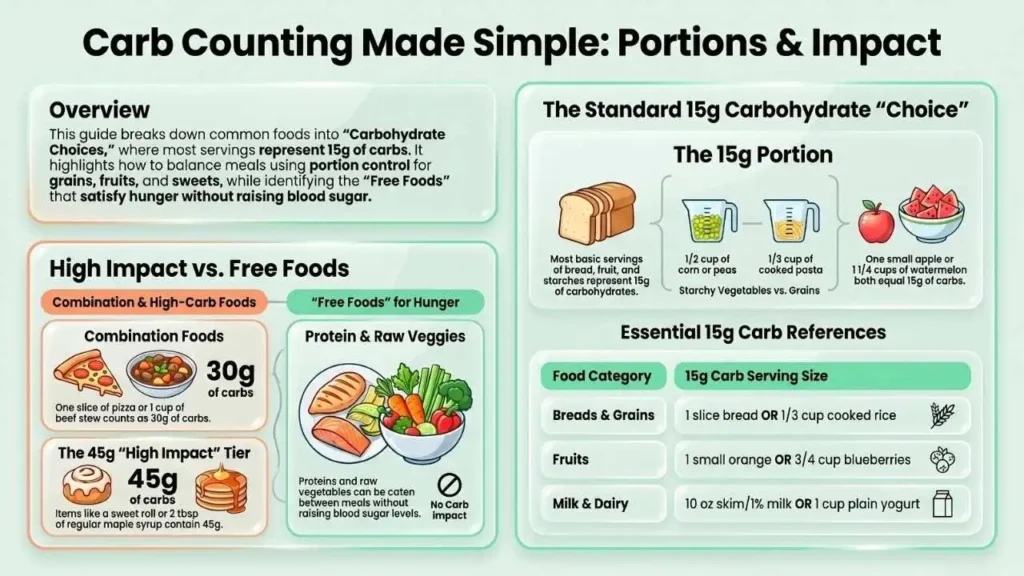
Not at all. You can still enjoy rice, but the trick is in the quantity and the type. Try substituting white rice with brown or red rice, which has more fiber. Always keep your serving size to about 1/3 of a cup and fill the rest of your plate with dal and vegetables to keep your blood sugar stable.
Q2: Which are the best good carbs for energy?
The best carbs foods for sustained energy are complex carbohydrates like whole grains (oats, daliya), legumes (chana, rajma), and fiber-rich fruits. These break down slowly, giving you a steady fuel supply without the crash associated with sugary snacks.
Q3: What is the difference between simple and complex carbs?
Simple carbs have a basic structure and digest very quickly, causing sharp sugar spikes (e.g., sugar, white bread). Complex carbs have long chains of molecules, contain fiber, and digest slowly, providing better energy and health benefits (e.g., whole wheat, beans, vegetables).
Q4: How can I manage my carbohydrate intake if I eat out often?
When dining out, look for grilled or tandoori options instead of deep-fried starters. Choose tomato-based curries over creamy ones, and try to opt for a whole wheat roti instead of naan. You can also ask for a side of raita or salad to add fiber and probiotics to your meal.
Q5: Are potatoes considered a healthy carb?
Potatoes contain valuable nutrients like potassium and vitamin C, but they are high in starch and have a high Glycemic Index. If you enjoy potatoes, treat them as your main carb for that meal and skip the bread or rice to keep your total carbs foods intake in balance.
Conclusion: Your Journey to a Balanced Life
Managing your health in a world full of tempting, high-carb treats is a challenge, but you don’t have to do it alone. By choosing complex carbs foods, watching your portions, and making smart swaps in your kitchen, you can enjoy your favorite Indian flavors while keeping your blood sugar and energy levels right where they need to be. Remember, it’s about progress, not perfection. Every small change you make today is a step toward a more vibrant, energetic you.
If you are feeling stuck or need a personalized plan that fits your busy life, let’s talk. We can help you find a rhythm that works for you and your family.
Ready to transform your health?
Contact Us
We understand how overwhelming nutrition and weight loss information can feel. With so many opinions and confusing advice online, it’s easy to feel stuck or unsure about what to do next.
At Diet Dekho, you never have to figure it out alone. You can contact us anytime with any questions or concerns. Our expert dietitians are available 24/7 to guide, support, and help you stay on track. Whether your goal is weight loss or building healthier habits, we’re here to make the journey simpler and more sustainable for you.
Disclaimer
This blog is intended to help readers make healthier food choices. Your health should always be the top priority. Before starting any restrictive or special diet, especially if you have a medical condition or health concern, please consult a doctor or a qualified dietitian. Each body responds differently to food and lifestyle changes. Always choose what is safe and suitable for you.

Abhinav is the Founder of Diet Dekho, helping people manage weight and lifestyle health through simple, practical nutrition and personalized diet plans.